Devanahalli's Meteoric Rise: From Sericulture Village to Bengaluru's Economic Powerhouse
From a tranquil sericulture village on Bengaluru's outskirts in the 1990s, Devanahalli has undergone a remarkable transformation, emerging as one of the city's most powerful growth engines. This region has rapidly evolved into a vibrant hub for employment, industry, and investment, fundamentally reshaping north Bengaluru's economic landscape.
The Airport Catalyst and Economic Shift
Ever since the commencement of operations at Kempegowda International Airport (KIA) — one of India's busiest airports — Devanahalli has witnessed a dramatic economic shift over the past two decades. The airport's presence has served as a primary catalyst, attracting substantial development and investment to the area.
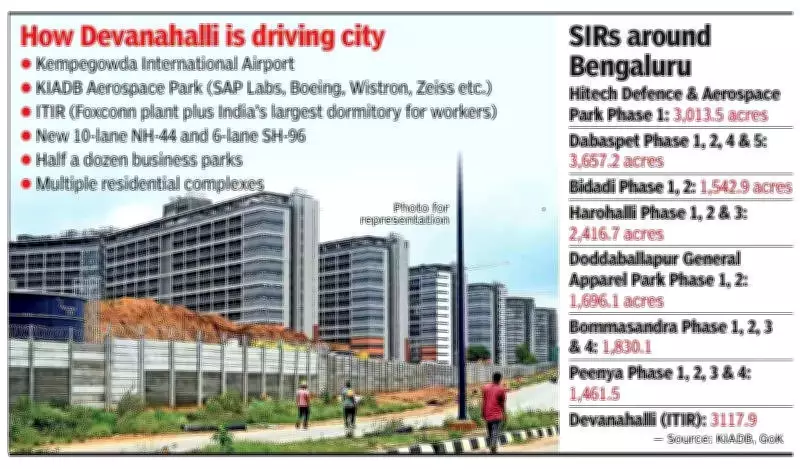
With the proposed Airport City, Information Technology Investment Region (ITIR), Aerospace Park, and a wave of high-value residential developments, Devanahalli has firmly established itself as the epicentre of north Bengaluru's expansion. The steady influx of global manufacturers, technology firms, and allied industries has not only altered the skyline but also generated thousands of jobs, reinforcing its position as a high-growth corridor.

The Special Investment Region Initiative
Further strengthening the region's growth trajectory, the Karnataka government recently notified the 'Devanahalli Special Investment Region' (SIR), spanning an impressive 3,117.9 acres across 13 village panchayats. This strategic initiative by the Karnataka Industrial Areas Development Board (KIADB) aims to consolidate and upgrade key industrial clusters into globally competitive economic hubs.
The affected areas include Devanahalli General Phase 1, Devanahalli General Industrial Area Phase 2, and Adhinarayana Hosahalli Phase 2. These regions will now benefit from world-class infrastructure and enhanced civic amenities under the new framework.
Addressing Infrastructure and Administrative Challenges
According to KIADB officials, the SIR notification directly addresses long-standing infrastructure concerns raised by industrialists and entrepreneurs. The industrial townships will be withdrawn from the administrative control of local bodies and brought under direct state government oversight.
"Often, the local bodies neglected development in these areas despite industries paying taxes. This hindered production and manufacturing activities," explained a KIADB official. "By notifying them as SIRs, the areas will be placed under the direct monitoring of the state government."
Officials highlighted that jurisdictional overlaps had created significant operational hurdles, citing the recent example of property tax notices issued by two village panchayats to Taiwan-based Foxconn. "Such issues arise because of overlapping authority, which the SIR framework seeks to address," the official noted.
The SIR Framework and Governance Structure
Under the SIR framework, the state can notify an industrial area exceeding 2,500 acres — or 1,250 acres in the case of industrial zones — as a Special Investment Region. Commerce and Industries Minister MB Patil emphasized, "The main objective of granting SIR status is to transform these regions into centres of economic activity supported by premium infrastructure, modern civic amenities, centres of excellence, and a proactive policy framework."
Once notified, the state government assumes full authority to regulate and develop the region. "Administratively, each SIR will be governed by an apex body approved by KIADB and will report to a regional development authority (RDA), project development agencies under the government, or special purpose vehicles, as assigned," a KIADB official explained, adding that the model mirrors the successful Electronics City Industrial Township Authority.
The Regional Development Authority will function as the local planning authority, overseeing infrastructure, taxation, and regulation within the SIR. While the apex authority will serve as a single-window system for investors, the RDA will assess and collect taxes, with 30% remitted to the parent local body.

A Model for Future Development
Devanahalli's transformation represents a significant case study in urban and industrial development. What began as a modest agricultural community has become a blueprint for how strategic infrastructure investment and thoughtful policy frameworks can catalyze regional economic growth.
The combination of transportation infrastructure (through KIA), planned industrial zones, and now the Special Investment Region status creates a powerful ecosystem for continued expansion. This development not only benefits large corporations but also creates substantial employment opportunities and stimulates ancillary businesses throughout the region.
As Devanahalli continues its remarkable journey from sericulture village to economic powerhouse, it stands as a testament to Bengaluru's ongoing evolution as India's premier technology and innovation hub, with growth corridors extending well beyond the traditional city center.