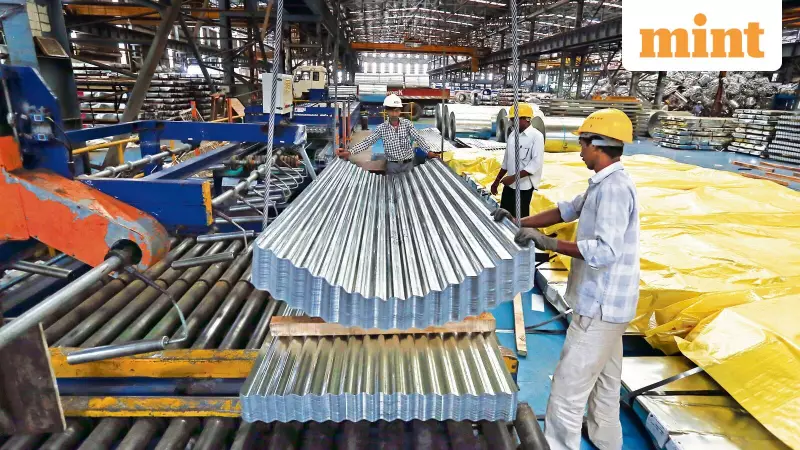
In a swift market reaction, domestic steel producers have raised prices across key products in the first week of January 2026. This move comes within days of the Indian government's decision to impose a three-year safeguard duty on most imported flat steel products.
Price Hikes and Market Dynamics
According to data from commodities intelligence firm Big Mint, prices for hot-rolled coil (HRC) and cold-rolled coil (CRC) were increased by 2-4% on 3 January. This followed a previous hike of 1.5-3% implemented in late December 2025. Similarly, rebar prices saw a significant rise of nearly 3-6% in early January, building on an approximate 4% increase from the preceding month.
These adjustments mark a pivotal shift for an industry that had been grappling with depressed margins. Benchmark HRC prices had plummeted to a 10-month low of ₹47,100 per tonne in November, while rebar touched a five-year low of ₹47,000 per tonne, pressured by low demand and oversupply.

The Safeguard Duty: A Protective Shield
The catalyst for this pricing power is the safeguard duty announced by the finance ministry on 30 December 2025. The duty structure is set for three years, starting at 12% for the first year, then 11.5% for the second, and 11% for the third year. This measure follows an interim order from April 2025 that lapsed in November, aimed at curbing a surge in cheap imports.
Analysts point out that this duty, combined with a weaker Indian rupee, has significantly raised the landed cost of steel imports from countries like China and Japan. Niladri N Bhattacharjee of Grant Thornton Bharat stated that this has given domestic producers the confidence to implement price hikes. He noted that while prices are still below the peaks of FY22, the move signals improved bargaining power for steelmakers.
Boosting Profitability and Future Caution
The price increases are expected to provide a much-needed boost to the profitability of domestic steel companies, many of which are in the midst of major capacity expansion plans. Dhruv Goel, CEO of Big Mint, explained that production cuts by smaller players and the safeguard duty have helped balance demand and supply, allowing mills to raise prices that were previously at a discount to imported costs.
However, analysts urge caution regarding the sustainability of further sharp increases. Bhattacharjee believes the current hike appears sustainable with some room for more growth, but he warns that rising domestic capacity and utilization rates might restrict gains, preventing a return to FY22 highs.
Goel echoed this sentiment, highlighting that while prices should remain firm in the near term, oversupply risks could emerge in the second half of 2026 as new capacities become operational. Major projects include Jindal Steel's 3 million tonnes per annum (mtpa) plant commissioned in September 2025, and the full ramp-up of 5 mtpa facilities each by JSW Steel and Tata Steel by the end of FY26.
Supporting the current price strength are strong export bookings aided by the weak rupee, better order acceptance, and seasonal demand in the January-March quarter. Rising input costs, particularly for imported coking coal, have also contributed to the upward pressure on steel prices.
Data from the steel ministry for the first eight months of FY26 shows India was a net importer, with finished steel imports at 4.19 million tonnes (down 36.3%) and exports at 4.18 million tonnes (up 32.6%). Domestic consumption grew healthily by 7.3% to 105.04 million tonnes.