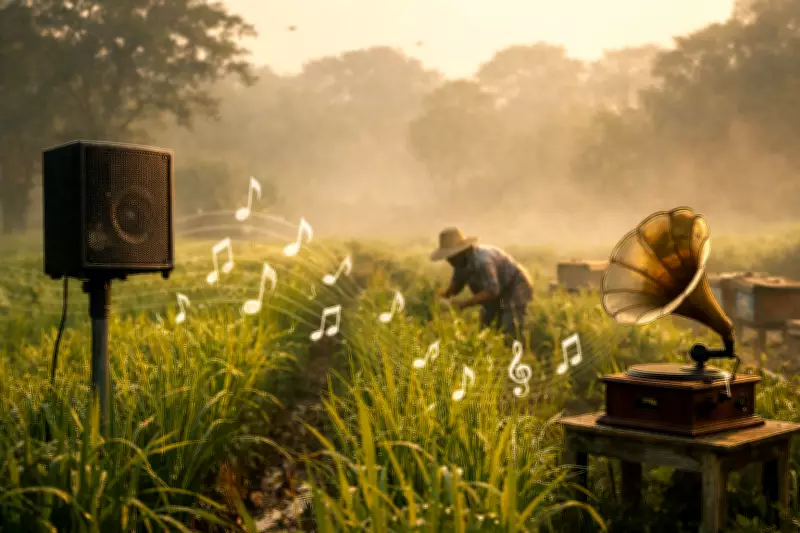
Farmers Worldwide Experiment with Sound to Boost Crop Growth and Health
Across agricultural landscapes in diverse regions of the globe, sound is increasingly becoming an integral component of modern farming practices. Loudspeakers are now being strategically installed between crop rows, broadcasting a variety of audio ranging from classical compositions to low, steady frequencies designed to mimic natural sounds like insect activity or gentle winds.
Agricultural producers report they are actively testing whether these acoustic interventions can enhance plant resilience, improve coloration, or increase overall productivity. Numerous farmers have observed modest yet discernible improvements following several weeks of consistent sound exposure, sparking broader interest in this unconventional approach.
Scientific Investigation into Plant Acoustics
What was once dismissed as mere folklore is now attracting serious scientific scrutiny. Academic institutions and research organizations worldwide are conducting meticulously controlled experiments to determine whether sound vibrations influence fundamental plant processes including growth patterns, water transport mechanisms, and stress adaptation capabilities.

While research outcomes remain inconsistent, the fundamental question has gained significant traction within the scientific community: Can agricultural crops demonstrate measurable responses to specific sound frequencies?
Global Implementation in Agricultural Fields
In agricultural regions spanning India, Japan, and various European nations, progressive farmers now schedule sound sessions with the same regularity as irrigation cycles. Audio equipment mounted on field poles delivers programmed tracks during optimal periods such as dawn or dusk.
The acoustic repertoire varies considerably, encompassing Hindustani classical music, violin performances, temple bell recordings, and ambient tones engineered to resemble insect vibrations. Growers implementing these techniques frequently report observing:
- Accelerated seed germination rates
- Increased stem thickness and structural integrity
- Enhanced flowering and reproductive development
- Reduced pest infestation and damage
The Historical and Biological Foundation
Scientific curiosity about plant responsiveness to vibration predates contemporary agricultural applications by decades. During the early twentieth century, pioneering scientist Jagadish Chandra Bose demonstrated that plants generate minute electrical signals when subjected to physical contact, mechanical agitation, or environmental stress, revealing their environmental sensitivity exceeds previous assumptions.
Contemporary laboratory research has further investigated how sound waves—essentially pressure vibrations propagating through atmospheric media—might influence cellular functions in plants. Scientific observations indicate specific frequency ranges can potentially:
- Stimulate accelerated root system development
- Modify genetic expression related to stress response mechanisms
- Alter seedling elongation rates during early growth stages
- Affect stomatal aperture regulation governing gas exchange
Remarkably, some experimental evidence suggests plants may differentiate between vibrations caused by herbivore feeding versus wind exposure, potentially activating chemical defense systems preemptively.
Controlled Greenhouse Experiments
Scientific investigations differ substantially from field applications. Rather than employing diverse musical selections, researchers typically expose plant specimens to precisely defined sound frequencies at controlled volumes for predetermined daily durations.
Experimental designs commonly involve cultivating identical plant groups under equivalent environmental conditions—varying only in acoustic exposure. Research outcomes demonstrate considerable variability. Certain trials indicate seedlings subjected to gentle low-frequency vibrations exhibit enhanced vertical growth or more robust root architecture.
Other studies document minimal observable effects, while some research even suggests excessive or irregular acoustic exposure may inhibit growth, implying plants might respond optimally only within specific acoustic parameters.

Given these inconsistent findings, scientific discourse remains measured. Researchers avoid characterizing sound as miraculous treatment, instead describing acoustic influence as one among multiple environmental factors warranting investigation—comparable to airflow patterns or light spectrum considerations—that might affect development under specific circumstances.
Agricultural Persistence and Practical Considerations
Farming has historically integrated traditional knowledge with empirical experimentation. Agricultural producers routinely test new seed varieties, adjust watering schedules, and evaluate treatment methods recommended by peers. Implementing field acoustics represents another low-risk trial requiring minimal investment beyond electrical power and intellectual curiosity.
Human psychological factors may contribute to perceived benefits. Working in acoustically enriched environments might enhance farmer wellbeing during extended work periods, potentially increasing observational attention to crop conditions. This heightened awareness could indirectly improve cultivation decisions regarding irrigation, pruning, or pest management.
Sustainability concerns provide additional motivation for exploration. With fertilizer costs escalating and chemical applications facing increased scrutiny, growers demonstrate keen interest in gentle, non-invasive methodologies that might incrementally improve yields without imposing additional environmental burdens.
Definitive Conclusions on Acoustic Agriculture
The most accurate response remains cautiously qualified: Under specific conditions, sound exposure appears to generate measurable effects in certain contexts.
Laboratory investigations suggest vibrational energy can influence physiological processes, while limited field trials report positive outcomes. However, results exhibit substantial variation across crop species and experimental configurations, with no specific audio type demonstrating consistently reproducible harvest improvements at commercial scales.
Plants do not perceive music through human cognitive frameworks—they lack capacity for melodic or rhythmic recognition. Their potential responsiveness relates instead to physical vibration transmission through atmospheric and plant tissue media, subtly affecting cellular structures, membrane dynamics, and internal fluid movements.
Essentially, the phenomenon involves physics rather than aesthetic appreciation. Nevertheless, the evocative imagery of cultivated fields resonating with acoustic vibrations continues capturing global imagination. This represents a fascinating intersection where agricultural intuition converges with contemporary sensor technology and laboratory methodology.
Currently, field acoustics remains an intriguing experimental approach rather than established agricultural innovation. However, as plant acoustic research advances, future farming might incorporate sound exposure management with precision comparable to irrigation scheduling—utilizing vibrations not for entertainment but as subtle environmental modifiers influencing growth trajectories.