

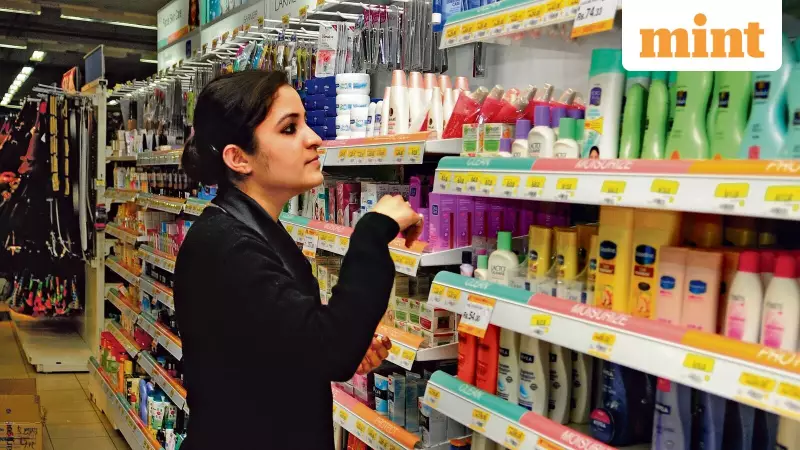
India's fast-moving consumer goods (FMCG) and consumer durables industry is stepping into the new year with a renewed focus on driving sales through higher volumes, rather than relying on price increases. Senior executives across the sector report a gradual improvement in demand following a prolonged phase of slow growth, fueled by moderating inflation, adjustments to the Goods and Services Tax (GST), and a stable macroeconomic backdrop.
Recalibration and Recovery: The 2025 Backdrop
The year 2025 served as a period of significant transition for India's consumer economy. Retail inflation dropped sharply to 0.25% in October and 0.71% in November 2025, primarily due to falling food prices. This easing of price pressures has materially boosted household sentiment. Concurrently, the sector witnessed major leadership changes at legacy firms like Nestlé, Britannia Industries, and Hindustan Unilever.
The implementation of revised GST rates provided a tailwind, despite causing a temporary sales dip during the transition. "2025 has been a year of recalibration," said Naveen Malpani, Partner and Consumer & Retail Industry Leader at Grant Thornton Bharat. He noted the industry's focus on operational discipline, premiumisation, and channel profitability during this phase.

Volume Growth Takes Centre Stage
With commodity prices softening and GST changes now in effect, companies are betting on volume expansion to fuel growth in 2026. "A large part of growth is likely to be volume-led," stated Manish Tiwary, Chairman and Managing Director of Nestlé India. He highlighted that the food industry, in particular, should see much healthier volume growth in 2026 compared to the first half of 2025.
This optimism is backed by consumption data. According to NIQ, overall FMCG volumes grew 5.4% in the September quarter of 2025. Notably, rural FMCG volumes rose 7.7%, significantly outpacing the 3.7% growth in urban markets. For the first nine months of 2025, average volume growth stood at 5.6%, up from 4.6% a year earlier.
K. Ramakrishnan, Managing Director of Worldpanel by Numerator, explained, "The GST 2.0 effect is going to come into picture in 2026, helping growth. Low inflation is also helping manufacturers to pass on some price benefits to the shoppers."
Rural Resilience vs. Urban Caution
A clear divergence is visible between rural and urban demand trajectories. While rural markets continue to lead the recovery, the drivers behind the prolonged urban slowdown remain less clear, even with cooling inflation. Consumer sentiment, however, is on an upward trend. The Centre for Monitoring Indian Economy's Index of Consumer Sentiments (ICS) rose 2.4% in October and a further 2.2% in November 2025.
Saugata Gupta, CEO and Managing Director of Marico Ltd., acknowledged the government's policies in keeping the rural economy steady. "Some GST benefits, particularly in food, will also support urban demand, so I expect overall demand conditions to remain stable," he added.
Commodity Stability and Margin Questions
A sober commodity cost outlook is a key pillar supporting the volume-growth thesis. Nestlé's Tiwary described commodity costs as "sober," expressing hope for more volume growth rather than price growth in 2026. Vineet Agrawal, CEO of Wipro Consumer Care & Lighting, noted that palm oil prices have cooled due to strong production in Malaysia and Indonesia and weaker exports.
However, challenges persist. Sanjay Chitkara, Co-chief Sales and Marketing Officer at LG Electronics India Ltd., pointed out that the consumer durables sector faced a prolonged cool summer and elevated global raw material costs in 2025. He also expects price increases in air conditioners in early 2026 due to Bureau of Energy Efficiency (BEE) rating changes, though these will be offset by the earlier GST cut.
The overarching question for 2026 revolves around margin protection. Companies must navigate currency volatility, rising competition from startups and digital brands, and the need to invest in marketing and distribution while prioritizing volumes over pricing.

Channel Evolution and Consumer Confidence
Business models and shopping channels are rapidly evolving. Malpani of Grant Thornton highlighted that quick commerce has transitioned from an occasional top-up channel to a regular part of household shopping routines. He predicts that premiumisation and value-seeking will coexist in 2026, with premium offerings seeing uptake across both urban and rural markets.
Indian consumers are entering the new year with notable confidence. A BCG Global Consumer Radar Report found that 60% of Indian consumers expect their total spending to rise over the next six months, up from 50% in September 2024. Remarkably, only 17% believe recent global conflicts will slow India's growth, reflecting strong domestic optimism.
As companies like Bikaji Foods International roll out mass-media campaigns and focus on range selling and distribution, the stage is set for a year where availability, visibility, and volume will be the critical metrics for success in India's complex FMCG battleground.





