

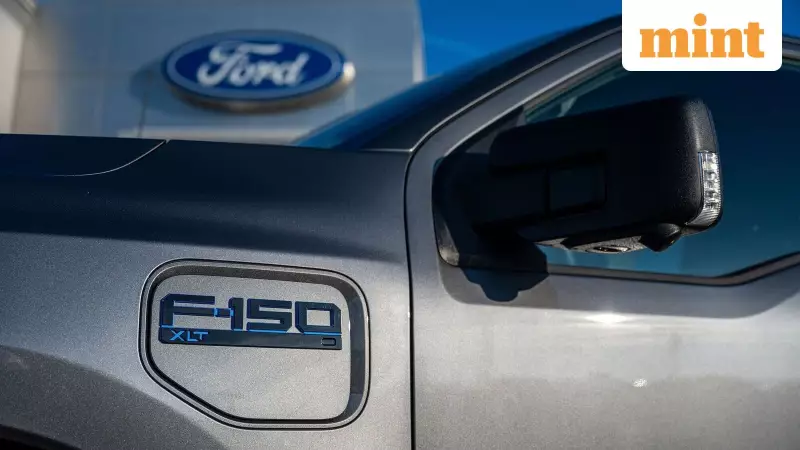
In a major blow to America's electric vehicle ambitions, Ford Motor Company has decided to end the current generation of its F-150 Lightning electric pickup truck. The announcement, made in December 2025, comes with a staggering $19.5 billion financial hit and a strategic refocus for the automaker's EV plans. This move marks another high-profile stumble for a traditional carmaker trying to capture the magic that made Tesla's Model Y the world's bestselling car.
The Dream of an Electric Pickup Revolution
The journey began with immense promise in May 2021. Ford CEO Jim Farley, in a Tesla-style presentation from Dearborn, Michigan, unveiled the electric F-150 with superhero-like bravado. He proclaimed it hauled and towed like a "beast," metaphorically equipped with a "Superman cape and a Captain America shield." The goal was clear: create an electric vehicle worthy of the F-Series badge, America's bestselling truck for nearly half a century.
The public and investor response was initially electric. $100 reservations poured in so rapidly that Ford had to stop accepting them by December 2021. Farley raced to triple the planned production capacity to 150,000 trucks annually. He staked his reputation on the project, telling CNBC that scaling the electric business to a million units and making it more profitable than gas vehicles was the only way to compete with Tesla's market valuation. The truck won accolades, including MotorTrend's Truck of the Year and the North American Truck of the Year award.

Where the Rubber Met the Road: The Expectations Game
Despite the hype and critical praise, a fundamental disconnect emerged in the showroom. The Ford F-150 Lightning faced what industry observers call the "expectations game." While it delivered sports-car acceleration and impressive towing specs, it stumbled on a core truck requirement: consistent range under load.
Surveys by researcher Strategic Vision revealed that almost 35% of Lightning buyers were previous owners of traditional, gas-powered pickups. These buyers had specific, demanding expectations for capability. They reported dissatisfaction when the truck's range "decreased dramatically" while towing heavy loads like boats or RVs—a direct trade-off between vehicle weight and expensive battery power.
"Traditional Ford F-150 truck buyers are among the most truckiest of all truck people," explained Alexander Edwards, President of Strategic Vision. "While the Ford F-150 Lightning... was a fantastic vehicle, it was not a fantastic vehicle for people who needed it to behave like a Ford F-150 truck all by itself." He suggested it was better suited for a Tesla owner who occasionally needed truck functionality.
A Niche Product in a Mass-Market Ambition
Ford argued the Lightning successfully attracted a new audience, with almost 75% of buyers coming from non-Ford brands. However, the vehicle was ultimately judged against the rugged standards of its gas-powered sibling. This was exacerbated by its high price, averaging 18% more than the non-electric F-150 last year, according to Edmunds.
The conclusion was stark: the Lightning was not the best truck that happened to be electric. It was, at best, the best truck that was electric—a much smaller market niche. Sales never approached the 150,000 annual target, with just 23,000 units sold in the US through the first nine months of 2025, a mere 1% increase.
In a telling contrast, customer satisfaction scores for Rivian's electric truck were much higher. Rivian attracted buyers with different expectations who were delighted their EV could tow a boat, not frustrated by the need to recharge afterwards.
Ford's strategic retreat is cheered by critics of government EV incentives, seeing it as proof that without regulatory pushes, consumers reject green technology. Yet, the core issue appears simpler. Like other would-be "Tesla killers," Ford failed to bottle the essential formula: creating a vehicle that exceeds expectations for its category, not just as an electric version of an existing one. Unless US automakers master this expectations game, their electric dreams risk going nowhere.






