

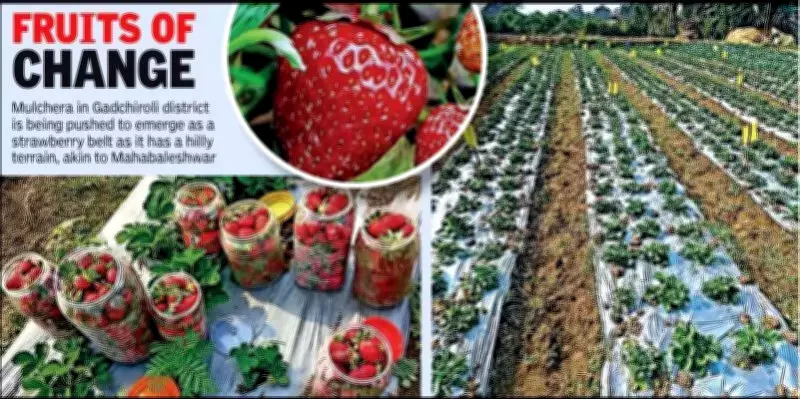
Gadchiroli Farmers Achieve Agricultural Breakthrough with Strawberry Cultivation
In a remarkable transformation story, Gadchiroli district in Maharashtra is rapidly evolving from its notorious reputation as a Maoist hotbed to becoming an emerging hub for agricultural innovation. The latest evidence of this change comes from a group of resilient farmers who have successfully cultivated strawberries in the tropical climate of this region—a fruit traditionally associated with the hilly slopes of Mahabaleshwar or the cooler Northeast regions of India.
From Unfamiliar Fruit to Thriving Crop
Many farmers in Gadchiroli had never even seen a strawberry before they began growing them. Pavirarao Samatdar, one of the pioneering farmers, shared his experience: "I had to search the internet to understand what a strawberry looked like when agricultural officials first mentioned it to me. Most of us were completely unfamiliar with this fruit before we started cultivation." Samatdar has dedicated half an acre of his five-acre holding to strawberry farming and is currently harvesting his crop as March comes to a close.
The strawberries grown in Gadchiroli are fetching an impressive Rs 400 per kilogram in local markets and are being consumed entirely within the district. Interestingly, the large police force deployed in the region to maintain security has become a significant customer for this new agricultural product, according to sources in the agriculture department.

Systematic Agricultural Transformation
Preeti Hiralkar, the district superintendent agriculture officer, explained the evolution of this agricultural initiative: "While Gadchiroli remains predominantly a paddy-growing area, our department has been actively promoting alternative crops to diversify agricultural practices. The strawberry experiment began modestly with just two or three farmers in 2019 but gradually gained momentum."
The program has now expanded to include approximately 50 farmers cultivating strawberries across 12 acres. This expansion received formal approval from the district planning committee, providing institutional support for the agricultural innovation.
Climate Adaptation and Strategic Planning
Hiralkar detailed the climatic considerations: "The Mulchera area within Gadchiroli features hilly terrain that provides conditions somewhat similar to Mahabaleshwar. Farmers sow the seeds between October and December when temperatures in Gadchiroli become cooler. Under optimal conditions, an acre can yield around 10 tonnes of strawberries."
However, most farmers have begun cautiously, starting with quarter-acre or half-acre plots. Agricultural officials now aim to encourage expansion of cultivation areas and recruit more farmers into the program.
Vikas Patil, the taluka agriculture officer, noted the economic viability: "The market rates for Gadchiroli strawberries are comparable to what Mahabaleshwar strawberries command during peak season, demonstrating the commercial potential of this initiative."
Overcoming Initial Challenges
The journey wasn't without obstacles. Initially, farmers sourced saplings from Mahabaleshwar, but these proved unsuitable for Gadchiroli's local climate. The breakthrough came when they obtained the Winter Dawn variety from Rajnandgaon in neighboring Chhattisgarh, which adapted successfully to the regional conditions.
While individual farmers in Nagpur and Wardha districts have also experimented with strawberry cultivation, agricultural officials are specifically promoting Mulchera in Gadchiroli to emerge as a dedicated strawberry belt, potentially creating a new agricultural identity for this transforming region.
This agricultural success story represents more than just crop diversification—it symbolizes Gadchiroli's broader transformation from conflict zone to development hub, with farmers leading the way through innovation and adaptation to new economic opportunities.






