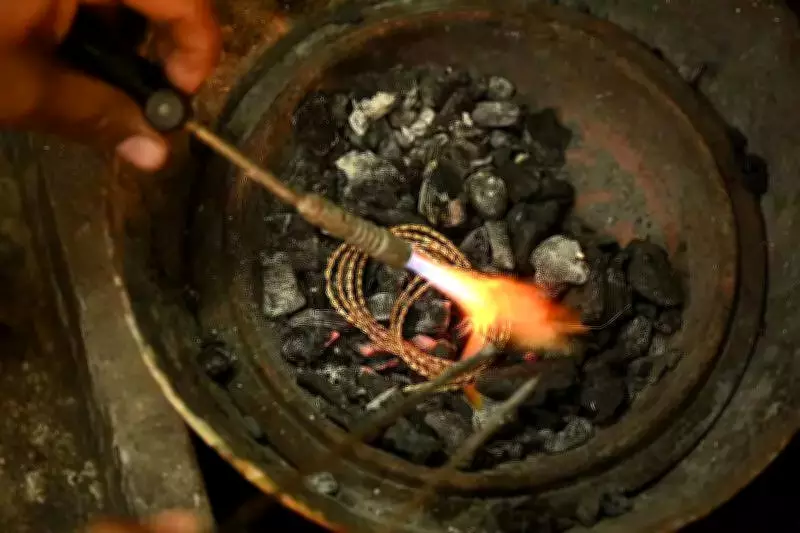
Gold Price Turmoil Forces Coimbatore Goldsmiths to Abandon Craft
In Coimbatore, a city once celebrated as a hub for handmade gold jewellery, artisans are now facing a stark reality. The volatile gold market, marked by steep price hikes and uncertainty, is compelling skilled goldsmiths to abandon their centuries-old craft in search of more stable livelihoods.
Personal Stories of Distress and Transition
S Kalidas, 34, a former goldsmith from Kempatty Colony, describes his experience in the industry as a "life or death situation." He quit due to severe mental distress, a sentiment echoed by many others in the district. "Though I loved making ornaments, I had to give it up 10 months ago because the earnings weren't enough to support my family," Kalidas reveals. He now drives a rental auto, earning around Rs 800 to Rs 1,000 daily, a shift that highlights the growing desperation among artisans.
R Bhuvaneshwari, 48, from Dharmaraj Street, shares a similar plight. Once working seven days a week, she now finds employment for just two days, earning a meager Rs 600 weekly. Her three children, who also worked in gold ornament units, have quit. One son runs a food cart, making Rs 1,300 to Rs 1,500 daily, while her younger daughter has moved to Mysuru for farming.

Industry-Wide Exodus and Unit Closures
The exodus from gold manufacturing has accelerated in 2025, following a sharp increase in gold prices. Goldsmiths are transitioning to roles such as security guards, auto drivers, painters in construction, hawkers, and street vendors. This trend, ongoing for three to four years, has intensified, eroding Coimbatore's identity as a premier jewellery destination that once attracted customers nationwide and internationally.
M Nataraj, owner of a gold ornament making unit in Kempatty Colony, illustrates the downturn. He once employed 10 goldsmiths but now retains only four. To cut costs, he moved to a smaller facility, citing unaffordable rent and labor salaries. "In 2024, we handled nearly 500 grams of gold weekly, but now it's barely 50 grams," he laments. The demand has shifted towards gold bars and coins, with fewer investing in jewellery due to high prices.
Financial Strains and Market Shifts
Price fluctuations are crippling the industry. Nataraj explains a common scenario: "When gold dropped to Rs 13,900 per gram for 22 karat, work orders were placed. But by delivery, prices rose to Rs 14,700 per gram, forcing us to accept the lower rate." This unpredictability results in significant losses for manufacturers.
M Ganesan, 52, who runs a micro unit on Dharmaraj Street, notes that while gold prices soar, labor charges for goldsmiths have plummeted. "From 5% of making charges, it fell to 3%, and now it's under 2%," he says. Additionally, consumer preference is shifting to machine-made jewellery for its quicker production and ready-to-wear designs, further marginalizing traditional artisans.
The crisis in Coimbatore's gold industry underscores broader economic challenges, as skilled workers are forced into lower-paying jobs, and a cultural heritage fades amid market instability.