GST Revisions Tilt the Scales in Favour of Conventional Vehicles
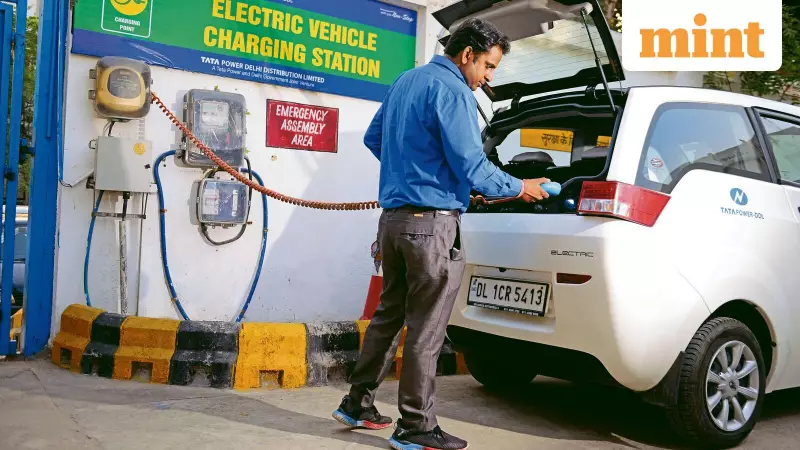
In a significant market shift, October witnessed a dramatic surge in the sales of internal combustion engine (ICE) vehicles, leaving electric vehicles (EVs) trailing behind. This trend reversal, fueled by recent tax cuts and the festive shopping spirit, has raised questions about the immediate future of India's electric mobility transition.
Data released by the Federation of Automobile Dealers Associations (Fada) on Friday painted a clear picture: the overall share of electric vehicles across scooters, bikes, and cars fell to its lowest point in the current financial year. The decline was sharp and consistent across segments.
The share of electric two-wheelers plummeted to 4.56% in October from 8.09% in September. Similarly, the share of electric four-wheelers dropped to 3.24% from 5.12% the previous month. These figures represent the lowest penetration levels seen in months, harkening back to levels last observed in April 2024 for two-wheelers and February 2025 for four-wheelers.

Conventional Vehicles Reap the Benefits of Policy Shift
The primary driver behind this market movement was a pivotal decision by the GST Council in September. The council slashed the Goods and Services Tax on many categories of ICE two-wheelers and four-wheelers from 28% to 18%. Electric vehicles, which were already benefiting from a low 5% GST rate, saw no change in their tax structure.
This policy move had an immediate and profound effect. The price gap between conventional and electric vehicles narrowed significantly, making petrol and diesel options suddenly more attractive from a upfront cost perspective. Automobile companies compounded this advantage by passing on the full benefit of the tax cuts and layering on additional festive season discounts between Navratri and Diwali, creating an irresistible proposition for thousands of buyers.
As a result, the market share of ICE vehicles expanded sharply. For two-wheelers, the ICE share jumped from 91.71% in September to 95.31% in October. In the four-wheeler segment, the share of conventional fuel vehicles rose from 65.61% to 68.1% over the same period.
Analysts Point to a Confluence of Challenges for EVs
Market analysts suggest that the GST cuts for ICE vehicles added to the existing headwinds for EV manufacturers, who were already grappling with supply chain disruptions. In a note dated 6 November, analysts from the global equity research firm Bernstein stated, "Consumer interest in EVs has softened following the latest GST revision, which narrowed the price gap between ICE vehicles and EVs, sparking increased sales of traditional ICE products during the festive season."
They further highlighted that production at several original equipment manufacturers (OEMs) was impacted by rare earth supply constraints. In response, many manufacturers have begun transitioning to motors that use ferrite-based designs instead of rare earth magnets to improve supply resilience.
However, industry leaders advocate for a measured perspective. Fada president C.S. Vigneshwar advised caution, suggesting that it is prudent to "wait for the trend to stabilise in the coming months before drawing any conclusion on the numbers for EVs."
Ashim Sharma, a senior partner at Nomura Research Institute, provided a crucial nuance. He explained that the GST cuts broadened the consumer base by attracting buyers in the small car and entry-level motorcycle segments. "EVs still grew, but their share went down as the base deepened with a much faster growth in the entry level segments in both cars and bike segments," Sharma said, pointing out that there are hardly any EV options available for these price-sensitive buyers.
Record Overall Sales Amid Shifting Dynamics
Despite the dip in market share, it is important to note that the Indian automobile industry celebrated record sales overall in October. According to Fada's data, two-wheeler sales surged an impressive 52% year-on-year to reach 3.15 million units. Passenger vehicle sales saw a more modest, yet healthy, growth of 11% to reach 557,373 units.

Even within the electric segment, sales in absolute numbers continued to grow, albeit at a slower pace. Electric two-wheeler sales grew by 6% year-on-year in October to 147,728 units, while electric four-wheeler sales rose 58% to 18,059 units, though this was on a relatively low base. For electric two-wheelers, this 6% growth is the slowest since July, and for four-wheelers, it is the weakest since May.
In contrast, ICE two-wheelers saw a massive 55% surge to 3.02 million units, while ICE four-wheelers experienced a 10% growth to 539,314 units during the same month.
Industry Stays the Course, Bets on Long-Term EV Value
Despite the current headwinds, the EV industry remains largely unruffled, banking on the fundamental strengths and long-term value proposition of electric mobility. Tarun Mehta, co-founder and CEO of Ather Energy, expressed confidence in the category's inherent advantages.
In a previous interview, Mehta emphasized that EVs have "enough true consumer value" due to better riding experience, superior performance, lower maintenance, and a significantly better total cost of ownership (TCO). He believed that even a 10% reduction in the cost of petrol vehicles would not diminish the long-term appeal of EVs.
This sentiment was echoed by Ola Electric's Bhavish Aggarwal, who referred to the current phase as a "healthy transition phase before the next wave of mainstream adoption." He attributes this future growth to value-conscious consumers who will eventually recognize the superior performance and lower cost of EV ownership.
The market is poised for more action in the coming months, with several new electric vehicle launches on the horizon. Mahindra & Mahindra is set to launch a seven-seater EV this month, followed by Maruti Suzuki's first EV for India, the e-Vitara, in December. These launches are expected to reinvigorate consumer interest and provide more options, potentially helping electric vehicles regain their lost market share as the initial shock of the GST revision settles.