

Gujarat Achieves Milestone with Over 50 Lakh Car Registrations
Gujarat has officially crossed the significant threshold of 50 lakh car registrations, highlighting the state's accelerated motorization and a car and jeep ownership rate that substantially outpaces the national average. This development underscores Gujarat's economic vitality and shifting mobility patterns.
Detailed Figures and Comparative Analysis
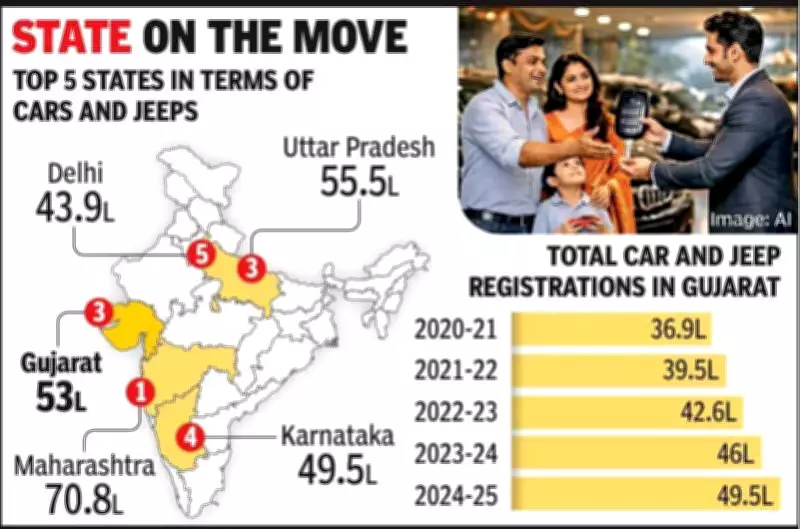
According to the Gujarat government's Socio-Economic Review, the state recorded 49.5 lakh cars and jeeps as of March 31, 2025. Subsequent data from the Vahan dashboard reveals that approximately 3.5 lakh additional cars have been registered since that date, elevating the total to around 53 lakh vehicles. This positions Gujarat not only as a leader in absolute car numbers but also in per capita ownership metrics.
The review indicates that Gujarat boasts 6,735 cars and jeeps per lakh population, a figure that significantly exceeds the national average of 4,229 per lakh population. With a projected population of 7.3 crore, compared to India's estimated 141.3 crore, the state's vehicle density is notably higher. Nationally, the total count of cars and jeeps stands at 5.9 crore.

State Rankings and Growth Trends
In terms of absolute car numbers, Gujarat ranks among the top five states in India. Vahan dashboard data shows Maharashtra leading with 70.8 lakh cars, followed by Uttar Pradesh with 55.5 lakh, Gujarat with 53 lakh, Karnataka with 49.5 lakh, and Delhi with 43.9 lakh. This latest data places Gujarat ahead of Karnataka and Delhi in total car registrations.
The growth in car ownership in Gujarat has been pronounced over the past five years. The number of cars and jeeps increased from 36.9 lakh in 2020-21 to 49.5 lakh in 2024-25, representing a rise of approximately 34.4%. Over a longer period, the increase in overall vehicle ownership is even more striking. The number of vehicles per lakh population in Gujarat rose from 31,249 in 2015-16 to 47,177 in 2024-25, marking a 51% increase over a decade.
Factors Driving the Surge in Car Ownership
Officials from the transport department attribute this rise to a combination of economic and social factors. Amit Khatri, a traffic expert, commented, "In major cities such as Ahmedabad, Vadodara, Surat, and Rajkot, expanding urban boundaries and limited public transport have pushed more families towards private vehicles." Khatri added, "Gujarat has witnessed horizontal urban growth. These stretching boundaries have increased dependence on cars for daily travel."
A senior officer noted that industrial growth and rising incomes in GIDC-linked areas have also fueled the increase in car ownership, with many individuals commuting between cities and nearby towns like Nadiad, Vadodara, and Padra. In rural regions, appreciation in land value has enhanced household finances, enabling more families to purchase cars.
An official highlighted that many residents prefer using cars for road trips of 150-200 km due to inadequate public transport options. Easy financing has further accelerated purchases. According to RTO officials, nearly 80% of car buyers opt for loans because credit is available at affordable rates, while the remaining 20%, often senior citizens or those nearing retirement, tend to make cash purchases. The advent of automatic transmission has made driving more accessible, encouraging more women and younger buyers to transition from two-wheelers to cars.
Broader Implications and Future Outlook
This surge in car registrations reflects broader trends in Gujarat's socio-economic landscape, including urbanization, economic development, and changing lifestyle preferences. The state's high per capita ownership rate signals a robust consumer market and potential challenges for infrastructure and environmental sustainability. As Gujarat continues to grow, monitoring these trends will be crucial for policymakers and stakeholders in the automotive and transportation sectors.






