

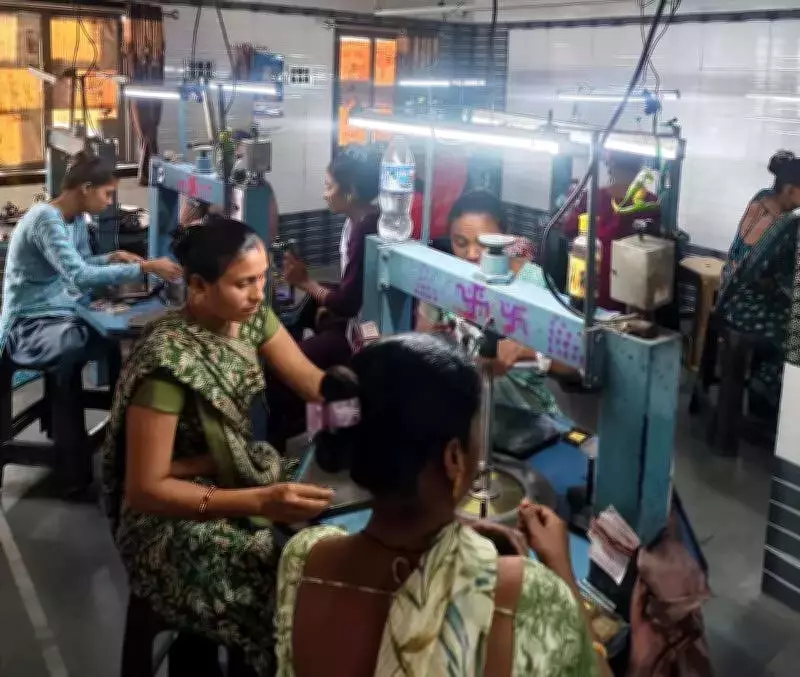
Gujarat's Rural Women Transform Diamond Industry with All-Female Polishing Units
Seventy-three years after Marilyn Monroe famously declared diamonds as a girl's best friend, women in Gujarat's villages have taken that relationship to an entirely new level. They are not just wearing diamonds—they are cutting, polishing, and building sustainable businesses around them.
Redefining a Male-Dominated Trade
Across the countryside, all-women diamond polishing units have begun to emerge, fundamentally reshaping one of India's most storied and traditionally male-dominated trades. These micro-enterprises, run largely by women with five to seven years of shop-floor experience, are redefining who holds power in diamond manufacturing.
Traditionally, many of these women were confined to household responsibilities or seasonal agricultural labor, often assisting males on farms. However, this work paid just around Rs 200 per day—a figure that barely covered basic needs.

Financial Transformation and Empowerment
Diamond polishing, by contrast, offers up to Rs 500 a day, a comfortable 9am-to-6pm schedule, and, most importantly, employment close to home with substantial earnings. After accounting for wages, electricity expenses, and loan repayments, unit operators report net monthly earnings ranging between Rs 20,000 and Rs 30,000.
Beyond income, the shift has fostered remarkable financial independence, skill development, and entrepreneurial confidence among rural women. "Women get work near home and it is safe," said Alpa Makwana, who runs a 10-scaife unit with 40 employees in Virpur, Bhavnagar. "Since we are handling a high-value product, we want trusted hands, and we find them among women from our own families and neighborhoods."
Her elder sister-in-law, Kailash, runs a separate unit nearby and emphasized the stability this work provides: "Diamond polishing gives you job security and a real income."
Building Trust Through Community Networks
The workforce comes largely from family, relatives, and neighbors—a close-knit circle that both employers and employees say creates a safe, trustworthy environment. This community-based approach also reassures male relatives who might otherwise object to women working outside traditional roles.
Employers have noticed a distinct productivity advantage with female workers. "The output of women employees is higher than men," said Atul Rathod, who operates a polishing unit in Virpur with more than 400 women on his floor. "Once they start in the morning, they work with complete focus, without any break, right through to lunch."
Diverse Business Models and Backgrounds
Some units handle the entire production cycle, including cutting, shaping, and finishing for jewelry settings. Others specialize in basic polishing before passing stones on to larger centers. The women running these enterprises come from varied backgrounds, not all following conventional paths.
Sonal Chauhan, who employs 12 women at her unit in Sonpari village of Bhavnagar, left school after primary level and learned polishing in Palitana, her hometown. She worked as an artisan for several years before marriage and eventually started her own unit with three scaife machines. "All my staff are women. Earnings depend on the type of work, but each employee earns at least Rs 10,000 a month," she explained.
Rough stones come from her former employer, and the polished diamonds are returned through the same channel—demonstrating how established industry networks support these new enterprises.
Personal Stories of Economic Necessity and Opportunity
For many women, diamond polishing represents both economic necessity and newfound opportunity. "My family is large and my father's earnings are limited. So, I left school and started working in a diamond unit," said Prasanna Chauhan, an artisan who earns Rs 10,000 a month.
Rama Parmar, from Malpur village, runs a five-scaife unit with 10 employees that handles both natural diamonds and lab-grown stones. "Working in a diamond unit gives women a genuine option for quality employment," she emphasized.

In Ranparda, Priya Navadiya runs a three-scaife unit from home, where only family women handle polishing while males source roughs and deliver the finished goods. "We learned the craft by working alongside experienced women," she noted, highlighting the knowledge transfer occurring within these communities.
A Growing Movement with Industry Recognition
The trend is gaining momentum across the region. "Gradually the role of women in the diamond industry is growing with many running the units while some have all-women staff," said Madhu Kakadiya, president of the Palitana Diamond Association.
What began as individual efforts has evolved into a movement that challenges traditional gender roles while creating sustainable economic opportunities. These women are not just polishing diamonds—they are polishing their futures, transforming both their personal circumstances and the industry landscape through determination, skill, and entrepreneurial spirit.





