

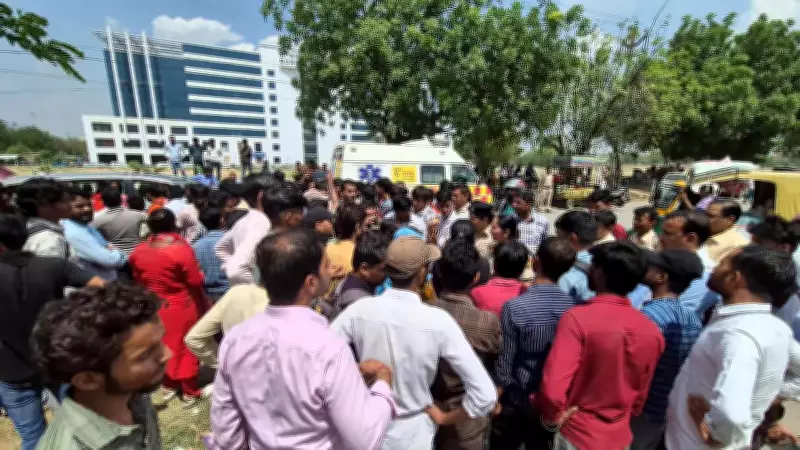
Contract Workers in Gurgaon Stage Protests Amid Cost-of-Living Crisis
Contractual workers, who constitute the essential backbone of manufacturing and garment units in Gurgaon, have taken to the streets as the cost-of-living crisis deepens. These workers, hired for periods of 7 to 11 months through labour contractors or third-party agencies, receive only the government-mandated minimum wage and make up the majority of the shop-floor workforce.
Companies Avoid Direct Responsibility Through Contract Labour
Companies heavily rely on contractual workers to sidestep direct responsibility, often shifting blame to contractors whenever disputes arise. Under existing labour laws, a worker who completes one year of continuous service becomes entitled to benefits enjoyed by permanent employees. These benefits include gratuity, paid leave, insurance coverage, notice-period protection, and annual increments.
However, contractual workers rarely reach that critical one-year threshold. They face persistent job insecurity, fixed minimum wages without any increments, and payment only for days actually worked. Many workers have also alleged underpayment and abrupt termination for raising grievances.

Legal Framework and Workforce Composition
The Contract Labour (Regulation & Abolition) Act, 1970, defines a contractual worker as one employed through a contractor and not on the company's direct payroll. In Haryana's industrial belt, such workers make up an astonishing 80-90% of the total workforce. In stark contrast, permanent employees represent a small group typically occupying mid- and senior-level roles, usually possessing engineering, MBA, or technical qualifications.
Contractual workers are largely unskilled or have ITI training. Most are paid minimum wages that are significantly lower than the salaries of permanent employees. By hiring through contractors, companies avoid dearness allowance-linked increments, performance incentives, various allowances, and higher bonuses. This practice creates a stark dual wage system within the very same factory.
Systemic Exploitation and Avoidance of Liabilities
Permanent workers receive long-term benefits such as gratuity, retrenchment compensation, leave encashment, and pension. Labour researcher Rekha Sehgal explained, "By rotating contractual workers every 7 to 11 months, companies systematically avoid building these financial liabilities. Tenure is kept deliberately short so workers never qualify for permanent status benefits."
Outsourcing labour also eliminates recruitment and training costs for companies. Hiring processes, paperwork, recordkeeping, and workforce replacement are entirely handled by contractors. This arrangement gives companies complete flexibility to scale their workforce up or down based on fluctuating production cycles.
Legal Loopholes and Core Production Violations
Avoiding legal obligations serves as another primary motivation for employing contract labour. Since contractual workers are technically not company employees, firms bypass compliance with standing orders, paid leave provisions, canteen subsidies, and maintenance of proper wage records. Contractors bear the legal responsibility, effectively insulating companies from direct accountability.
Despite legal restrictions on deploying contract labour for core production activities, many industrial units routinely place them on assembly lines, in paint shops, handling packaging, conducting quality checks, and in the garment sector, across almost the entire production chain.
Workers' Demands and Government Response
Workers' groups stated that the protests stem from basic legal and economic demands. These include higher minimum wages, implementation of an 8-hour workday, double-rate overtime payment, and ultimately the abolition of the contract labour system. Santosh Kumar of Mazdoor Adhikar Sangarsh Samiti added, "Workers are also fighting various forms of exploitation such as black-marketing of LPG, non-payment of overtime, and non-implementation of mandated minimum wages."
The Haryana government recently announced a 35% increase in minimum wages. However, Satvir Singh of CITU noted, "Even this adjustment brings wages only to around Rs 15,200, which remains at starvation-level given today's rampant inflation," highlighting expenses on rent, education, medical care, and food.

Overtime Violations and Calls for Permanent Status
Somnath of Jan Sangarsh Manch pointed out that overtime violations remain rampant across industries. "The law clearly requires double wages for extra hours worked, but companies often pay nothing or pay at normal rates. This constitutes open plunder of workers' labour," he asserted.
Labour groups are also demanding permanent status for workers performing permanent jobs. Rekha Sehgal emphasized, "People who have worked for years are deliberately kept on contract, systematically denied Provident Fund, ESI, gratuity, leave, and job security. This creates a permanent underclass of vulnerable workers."





