

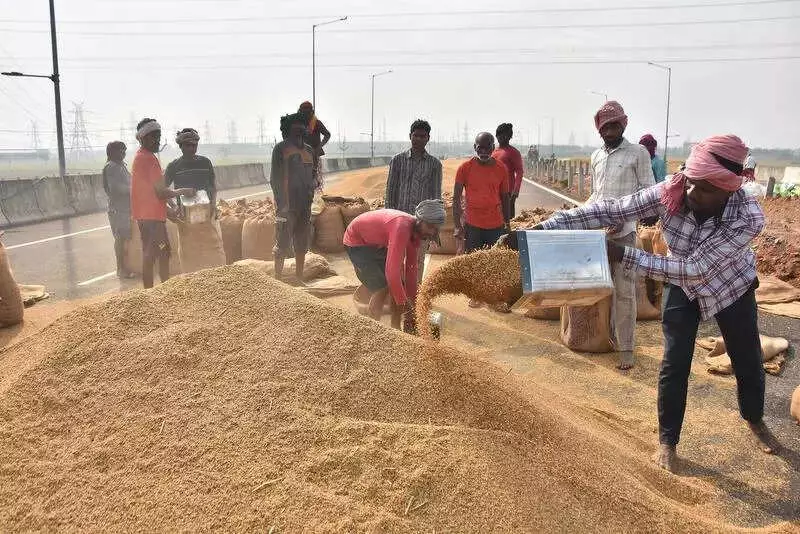
Paddy farmers across Andhra Pradesh, who managed to escape severe damage from recent cyclones, are now confronting a critical post-harvest challenge. Their newly harvested crop is grappling with alarmingly high moisture content, disrupting the ongoing Kharif procurement process and threatening significant financial losses.
Roads Turned into Drying Yards as Moisture Levels Soar
Across the state, moisture readings in the harvested paddy have surged to between 20% and 26%. This is substantially above the officially permitted limit of 17% for procurement. Fearing severe price cuts at government centres, growers are hesitating to sell their produce.
In the absence of adequate drying facilities, farmers have resorted to desperate measures. In and around Vijayawada, particularly near the West Bypass, Inner Ring Road, and adjoining villages, long stretches of roadside have been converted into makeshift drying grounds. Farmers are spreading their paddy on tarpaulins, guarding it day and night, in the hope of strong sunlight to reduce the moisture.

Twin Cyclones and Financial Strain Compound Crisis
The root of the problem lies in a series of weather disruptions. The lingering effects of Cyclone Ditwah, which followed closely after Cyclone Montha, resulted in persistently cloudy skies and high humidity. This weather pattern prevented the proper drying of machine-harvested grain across Andhra Pradesh.
The financial burden on farmers is intensifying daily. With an initial investment of nearly ₹25,000 per acre and an extra ₹3,000 to ₹4,000 for machine harvesting, they are now incurring additional labour costs solely for drying the grain. Despite these efforts, progress is slow, and moisture levels remain stubbornly high.
Distress Sales and Middlemen Exploit the Situation
Many farmers report that middlemen are capitalizing on their predicament, offering prices that are ₹300 less per quintal, citing the high moisture content. Although officials advise against offline sales, some growers feel they have no alternative.
This has already led to distress sales, particularly for moisture-heavy BPT varieties, which have been sold for as low as ₹1,400 per quintal. Furthermore, concerns are mounting about potential pest infestation in the exposed paddy heaps, with some portions of the crop already reported damaged in certain areas.
The combination of unseasonal rains, twin cyclones, and now the moisture complication has left paddy cultivators in Andhra Pradesh bracing for heavy losses. Their hopes are pinned on a sustained spell of clear, sunny weather to salvage what remains of their hard-earned harvest.






