India Surpasses China to Become World's Top Rice Producer
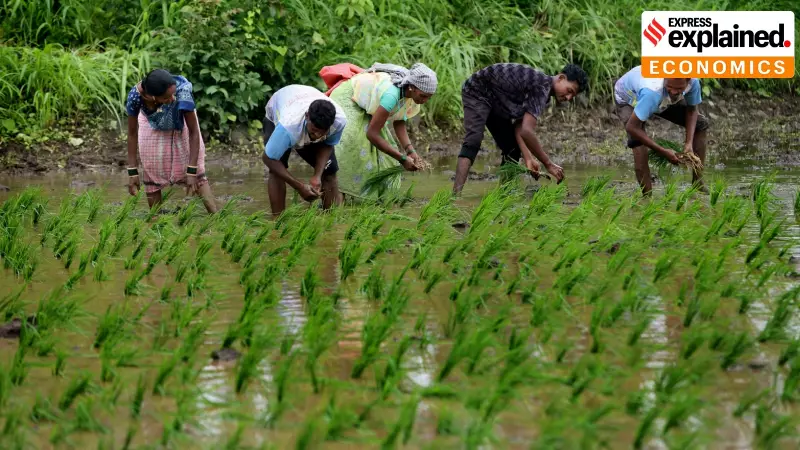
India has achieved a significant agricultural milestone by overtaking China as the world's largest rice producer. Union Agriculture Minister Shivraj Singh Chouhan announced this achievement last week, calling it an "extraordinary accomplishment." The country produced approximately 150 million metric tonnes of rice during the 2024-25 period, while China produced 145.28 million metric tonnes.
This represents a remarkable turnaround from a decade ago. In 2014-15, India's rice production stood at 104.4 million metric tonnes, while China produced 148.5 million metric tonnes. India's steady growth combined with China's production stagnation has now placed India at the top position, accounting for about 28% of global rice production.
The Steady Rise of Indian Rice Production
India's journey to becoming the world's top rice producer has been marked by consistent growth over decades. Between 1969-70 and 2024-25, the area under paddy cultivation expanded by more than 36%. During this same period, yield tripled and production nearly quadrupled.

The most dramatic increase occurred in just the last five years. In 2019-20, paddy covered 43.66 million hectares with production of 118.87 million metric tonnes. By 2024-25, these figures jumped to 51.42 million hectares and 150 million metric tonnes respectively. Consequently, India's share of global rice output increased from 21.95% in 2011 to 28% in 2024.
Other major rice-producing countries lag far behind India and China. Bangladesh holds third place with 36.6 million metric tonnes, followed by Indonesia with 34.1 million metric tonnes.
Why Farmers Prefer Paddy Cultivation
Paddy has become India's most widely grown crop for several compelling reasons. It currently grows in 614 of India's approximately 800 districts, covering 51.42 million hectares. For comparison, wheat - the second most widely grown crop - covers only 32.8 million hectares.
Farmers find paddy attractive because it provides higher returns than alternative crops. At 2021-22 minimum support price rates, paddy cultivation yielded a net return of Rs 56,226 per hectare. This significantly exceeded returns from maize (Rs 17,856 per hectare) and moong (Rs 45,665 per hectare).
Another key factor is the assured procurement system based on minimum support prices. This guarantee reduces market risks for farmers. Additionally, yields of other crops like cotton have stagnated or declined, making paddy even more appealing.
India's position as the world's leading rice exporter further reinforces paddy's dominance. During 2024-25, the country exported 6 million tonnes of basmati rice and 14.13 million tonnes of non-basmati rice, earning $5.9 billion and $6.5 billion respectively.
The Hidden Costs of Rice Dominance
Despite the production success, India's paddy dominance creates serious challenges. The crop requires enormous amounts of water - between 1,000 and 3,000 liters to produce just one kilogram of rice. This water intensity has led to groundwater depletion in many regions.
Punjab provides a stark example of this problem. Excessive groundwater withdrawal for paddy cultivation has created significant health and environmental challenges. The issue extends to other states experiencing declining groundwater levels as well.
Rice yields vary dramatically across states due to different agro-climatic conditions. In 2024-25, Punjab achieved 4,428 kg per hectare while Bihar managed only 2,561 kg per hectare. The national average stood at 2,929 kg per hectare.
Government Focus on Crop Diversification
Recognizing these challenges, the Union government has intensified efforts to promote crop diversification. The Agriculture Ministry recently proposed incentives for farmers who shift from paddy to alternative crops.
Officials calculate that the government spends approximately Rs 1.36 lakh per hectare on rice production when considering procurement, milling, transport, and storage costs. This figure excludes subsidies for power, fertilizers, and seeds. If farmers grow non-procured crops or leave land fallow, the government could save these resources.

The ministry suggests focusing diversification efforts on districts with paddy yields below the national average of 2,929 kg per hectare. Promoting oilseeds and pulses could reduce India's dependence on imports while addressing nutritional security concerns.
Excessive Rice Stocks and Storage Challenges
India's rice production success has created another problem - excessive stockpiles. As of January 1, 2026, the central pool held 63.06 million metric tonnes of rice. This far exceeds the 7.61 million metric tonnes required by stocking norms and the additional 37.2 million tonnes needed for welfare programs.
The government has attempted to manage these stocks through open market sales and allocating rice for ethanol production. However, stocks remain persistently high. During the 2023-24 kharif marketing season, the Food Corporation of India procured 525.48 lakh metric tonnes of rice, representing 38.13% of total production.
Procurement concentrates heavily in certain states. Punjab, Haryana, Chhattisgarh, and Odisha together contribute nearly 56.10% of total rice procurement.
India's achievement as the world's top rice producer represents both an agricultural success story and a complex policy challenge. While the production numbers impress, they mask underlying issues of water scarcity, crop diversity, and nutritional security that require urgent attention.