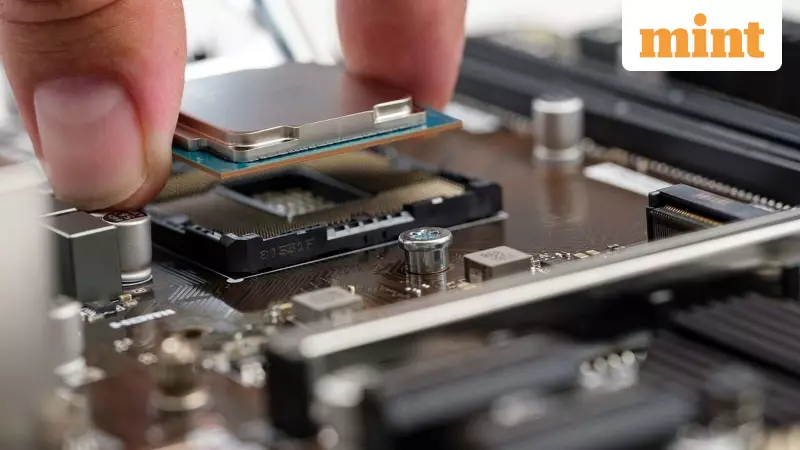
New Delhi: India has taken a significant step to support its domestic electronics industry. The government has withdrawn a key quality control order on flux-cored solder wire. This material is essential for making everyday electronic items like televisions, mobile phones, chargers, and earphones.
Supporting Manufacturing and Exports
The Department for Promotion of Industry and Internal Trade (DPIIT) issued the withdrawal order. Officials stated the move serves public interest. It followed discussions with the Bureau of Indian Standards (BIS). The decision aims to boost domestic manufacturing and increase exports.
With this rollback, the total number of active quality control orders (QCOs) in India now stands at 711. This is down from 761 previously.

Addressing Industry Concerns
A senior government official explained the rationale. The withdrawal is part of a broader review of QCOs. The goal is to ensure quality norms do not disrupt manufacturing. They must not undermine India's ambitions for electronics sector growth.
"The withdrawal will not apply retrospectively," the official said. "Any actions taken while the order was in force will remain valid." The official requested anonymity while sharing these details.
Industry executives raised specific concerns. They flagged limited domestic testing capacity. They also pointed to uncertain certification timelines. These factors created risks of supply bottlenecks.
Electronics manufacturers operate under tight production schedules. Many have export commitments. The previous rules posed challenges for them.
Impact on Imports and Chinese Suppliers
The withdrawal is expected to directly benefit Chinese suppliers. China dominates India's imports of flux-cored solder wire. This wire joins electronic components and wires by melting. It forms reliable electrical connections.
Commerce ministry data reveals a clear trend. Imports of cored solder wire stood at $24.40 million in FY21. They rose to $32.45 million in FY22 before easing to $24.66 million in FY23.
The QCO came into force in March 2024. Following its enforcement, imports fell sharply to $16.33 million in FY24. They recovered only marginally to $21.90 million in FY25.
This decline occurred despite much higher overall solder wire imports. Total imports were $101.39 million in FY24 and $109.28 million in FY25. The impact was clearly concentrated in the flux-cored segment.
Broader Policy Context
The withdrawal aligns with recommendations from a NITI Aayog committee. This committee was set up under former cabinet secretary Rajiv Gauba. It suggested easing and rationalizing quality control orders.
QCOs are meant to ensure products meet Indian quality standards. This applies to both domestic and imported goods before they enter the market.
Quality controls are important, but timing matters. Without adequate testing infrastructure, such orders can create challenges. This observation comes from Abhash Kumar, a trade economist and associate professor at Delhi University.
Beneficiaries and Supply Chain
Large electronics manufacturers stand to gain from this decision. Major players include Dixon Technologies, Foxconn India, and Samsung Electronics India. Others like Wistron and Tata Electronics will also benefit.
These companies are electronics manufacturing service providers. They will enjoy smoother access to flux-cored solder wire. This material is a critical consumable on high-volume assembly lines.
Domestic production capacity for this wire remains limited. China is the single largest source of imports into India. Other suppliers include Japan, South Korea, Taiwan, and Malaysia.
Wider Rollback of QCOs
This withdrawal is not an isolated move. India recently informed the World Trade Organization (WTO) about withdrawing 49 quality control orders in total.
The rollbacks span multiple ministries. The Department of Chemicals and Petrochemicals accounts for the bulk. It withdrew 38 QCOs covering 39 products.
The mining ministry withdrew seven QCOs. The textiles ministry withdrew two. These details were reported earlier.
In addition, the steel ministry has suspended an amendment to one QCO. This covers 55 steel products. The heavy industries ministry has deferred one QCO on electrical equipment covering eight products.

Industry Application and Use
Flux-cored solder wire sees widespread use across industries. It is essential in printed circuit boards and consumer electronics. The automotive electronics sector relies on it. Industrial equipment manufacturers also use it extensively.
The QCO was originally notified in September 2023. This gave the industry six months to prepare before it came into force in March 2024. Such advance notification is standard practice for quality control orders.
The government's move reflects a pragmatic approach. It balances the need for quality standards with the realities of manufacturing and global supply chains. The electronics sector, a priority for India's economic growth, receives focused support through this policy adjustment.