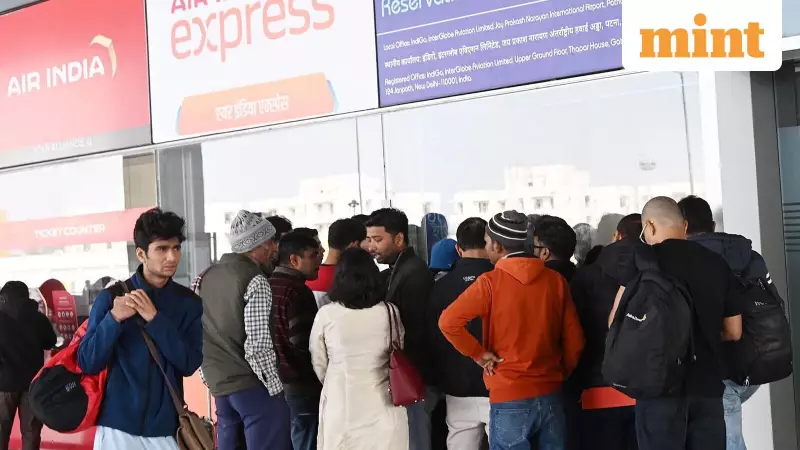
In a surprising turn of events for India's aviation sector, domestic airfares have plummeted to their lowest level in four years during the October-December quarter of 2025. This decline occurred despite the quarter being traditionally a period of strong seasonal demand for air travel.
Key Drivers Behind the Fare Slump
Analysts point to a combination of factors for this unusual price drop. A significant slowdown in passenger traffic growth throughout the year and notably weaker demand on non-metro routes are primary contributors. Furthermore, the wave of flight cancellations by market leader IndiGo in December is seen as a likely additional cause that exacerbated the situation.
Data from Elara Capital reveals that average airfares dipped by approximately 1% in the October-December period, falling from ₹5,485 in the same quarter last year to ₹5,436 in 2025. This price softening happened alongside a sharp deceleration in domestic air travel growth, which slowed to just 3% in Q3 of the 2026 fiscal year compared to a 9% growth in the corresponding period the previous year.

Gagan Dixit, an aviation analyst at Elara Capital, noted that fares on about 300 routes, which account for roughly one-fifth of India's total air traffic, declined by 6% during the quarter. "This hints at demand-side concerns in the current high airfare environment," Dixit stated in a report. He emphasized that the decline was more pronounced in non-metro cities, while fares in major metros remained largely flat.
The Impact of IndiGo's Operational Disruption
The aviation sector's challenges were compounded by IndiGo's operational crisis in early December. A combination of pilot shortages and planning gaps related to new Flight Duty Time Limitations (FDTL) norms, aimed at enhancing pilot safety, led to over 4,500 flight cancellations. This was the airline's worst operational stretch since its listing in 2015.
Analysts believe these cancellations had a paradoxical effect on fares. While a supply crunch typically pushes prices up, the impact was nuanced. Jinesh Joshi, an aviation analyst at PL Capital, explained that the supply shock mainly supported fares on metro and busy routes where travel is often essential. "On non-metro routes, which are largely driven by leisure travel, passengers tend to cancel or postpone trips more easily during disruptions, leading to weaker demand and softer fares," Joshi said.
Shobit Singhal of Anand Rathi Institutional Equities added that the uncertainty may have prompted some passengers on non-metro routes to shift to alternative modes of transport, further dampening demand and putting downward pressure on prices.
Broader Market Context and Future Outlook
The fare drop is particularly notable because it occurred even as the combined fleet of India's four major airlines—IndiGo, the Tata Group's Air India, Akasa Air, and SpiceJet—grew. They operated a total of 550 aircraft during the quarter, which is 6% higher than the 518 aircraft operated a year ago. Despite this increased capacity, the industry's passenger load factor remained flat year-on-year at 87%, indicating a clear slowdown in demand growth.
Broader passenger traffic data from the Directorate General of Civil Aviation (DGCA) shows a successive quarterly decline through 2025, falling from 43.2 million in January-March to 38.2 million in July-September. Data for the October-December quarter is awaited.
Credit rating agency ICRA has revised its outlook for domestic passenger traffic growth in the current fiscal year down to 0–3%, from an earlier forecast of 4–6%. This revision factors in the impact of an aircraft accident in June 2025, cross-border geopolitical tensions, and IndiGo's December cancellations.
Despite the current softness, analysts caution against viewing a single-quarter decline as a sign of a structural demand slowdown. Joshi from PL Capital pointed to a record 15 million domestic passengers in November 2025 as a sign of underlying resilience, driven by a strong return of business travel. The industry's massive order book of over 1,000 aircraft for delivery by 2032 also signals long-term confidence.

In response to its pilot shortage, IndiGo has outlined a plan to add 158 pilots by February 10, 2026, and a further 742 by December 2026, who will be rostered under the new FDTL norms. The coming months will be crucial in determining whether fare stability returns as operations normalize and demand patterns evolve.