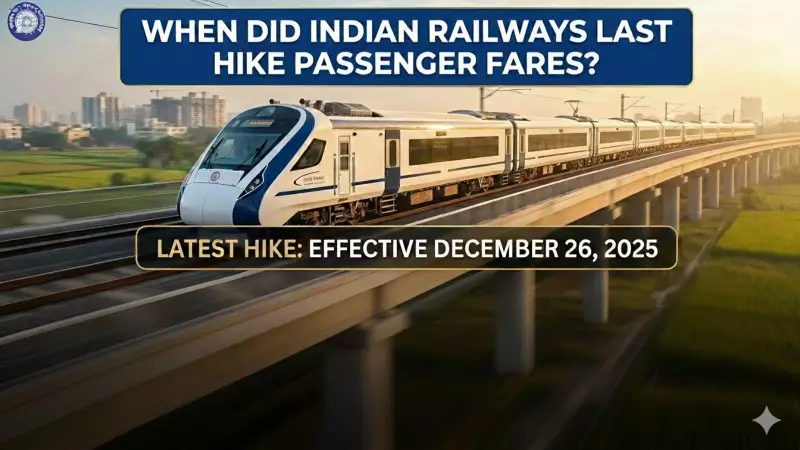
Indian Railways, long celebrated as one of the most affordable transport networks in the country, has implemented a rationalisation of its passenger fares. The national transporter expects this strategic move to bolster its revenue by approximately Rs 600 crore in the current fiscal year. This development naturally leads passengers to ask a critical question: when was the last time train ticket prices were revised?
The Latest Fare Revision: July 2025
The most recent adjustment to passenger fares came into effect on July 1, 2025. According to an official statement from the Ministry of Railways, this revision was designed to streamline fare structures and enhance the financial sustainability of passenger services. Notably, this hike did not affect suburban single-journey tickets or Season Tickets for both suburban and non-suburban routes, offering some relief to daily commuters.
The fare increase was structured in a graded manner based on travel distance and class. For Second Class travel, fares were raised by half a paisa per kilometre. However, a significant condition was applied: there was no increase for any journey up to 500 km. For longer distances, the hike was implemented as a lump sum: an extra Rs 5 for 501-1,500 km, Rs 10 for 1,501-2,500 km, and Rs 15 for journeys between 2,501 and 3,000 km.

Class-Wise Breakdown of the 2025 Hike
The fare rationalisation applied different rates across various travel classes. For Sleeper Class and First Class, the increase was set at 0.5 paisa per kilometre. A slightly higher increment was seen for non-AC classes on Mail/Express trains, where Second Class, Sleeper Class, and First Class fares were raised by 1 paisa per kilometre.
The most substantial adjustment was reserved for air-conditioned travel. Fares for AC classes on Mail/Express trains, which include AC Chair Car and AC 3-Tier/3-Economy, were increased by 2 paisa per kilometre in the July 2025 revision.
Historical Context: The Previous Hike in 2020
Prior to the 2025 adjustment, the national transporter had revised passenger fares earlier on January 1, 2020. At that time, the railway administration cited the significant financial burden arising from the implementation of the Seventh Pay Commission recommendations as the primary reason necessitating the fare rationalisation. This highlights how operational costs and policy decisions directly influence ticket pricing on the world's largest railway networks.
Financial Implications and Passenger Impact
The targeted additional revenue of Rs 600 crore from the latest fare rationalisation underscores the railways' continuous effort to balance its service affordability with economic viability. While the per-kilometre increases appear minimal, they collectively represent a crucial revenue stream for maintaining and upgrading the massive infrastructure.
Despite these hikes, Indian Railways continues to position itself as a cheaper alternative to road and air travel for most distances, especially for the non-AC and sleeper classes. The careful structuring of the hike—protecting short-distance travel and season ticket holders—demonstrates an attempt to minimise the impact on regular commuters while seeking funds for overall service improvement.