

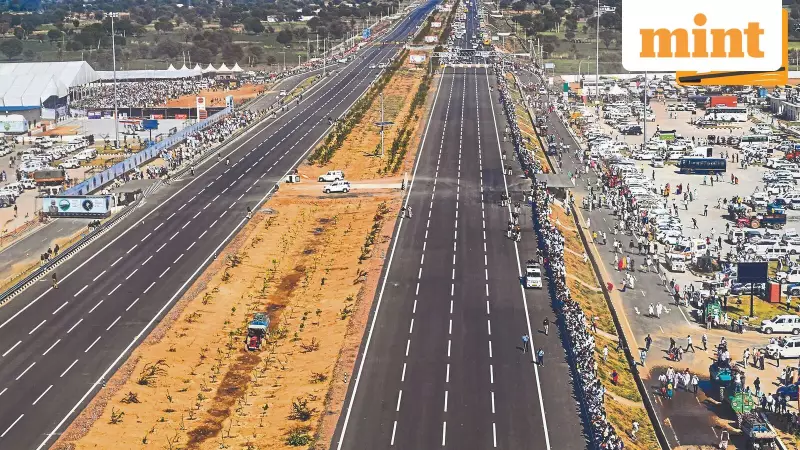
As 2025 draws to a close, India stands on the brink of a fundamental transformation in its infrastructure development narrative. The focus is decisively shifting from a pure public spending-led model to a sophisticated, systems-driven strategy. The year 2026 is poised to be a defining chapter, where execution reforms, private capital, and asset efficiency take center stage to propel sustainable growth.
The Strategic Pivot: From Capex to Efficiency
Over the past four years, central capital expenditure has surged more than three-fold, reaching an estimated ₹11.1 trillion in FY25. Infrastructure has been the primary beneficiary, acting as a long-term productivity investment. However, with fiscal consolidation now a priority, the upcoming Budget 2026 is expected to emphasize capital efficiency, programme outcomes, and heightened private participation over sheer budgetary outlays.
Infrastructure expert Vaibhav Dange observes that 2026 will be the year India's infrastructure story becomes more output-driven than policy-driven. The system is maturing, with a focus shifting from creating capacity to ensuring it delivers tangible economic productivity, which is crucial for sustaining momentum.

Highways: Expressways and Reviving Private Investment
The roads sector, historically the largest recipient of infra capex, is undergoing a strategic pivot. The government is now focusing on developing access-controlled expressways instead of traditional highways. Plans are advancing for a new expressway quadrilateral covering North-South and East-West corridors, designed to replicate the economic success of the Golden Quadrilateral with higher safety and speed.
Given the high cost of expressways (₹30–40 crore per kilometre), attracting private capital is essential. A critical step is the expected finalization of a revised Model Concession Agreement (MCA) for Build-Operate-Transfer (BOT) projects. The previous framework had deterred private players for nearly a decade by placing excessive traffic risk on them.
In a major push, the National Highways Authority of India (NHAI) has identified 53 BOT projects spanning over 5,200 km, valued at ₹2.1 trillion, for awards starting soon. Another 100 stretches worth over ₹3 trillion are under evaluation. These will likely operate under the new MCA, featuring enhanced investor protections.
Budget 2026 will also emphasize asset monetization. NHAI has already raised over ₹60,000 crore through InvITs and TOT bundles. Improved Fastag data has boosted valuation confidence, potentially attracting more global pension and sovereign funds. The fiscal focus will be as much on recycling operational assets as building new ones.
Railways: Freight Corridors and Monetizing Stations
Indian Railways, now the largest single recipient of government capex with allocations exceeding ₹2.5 trillion annually, is shifting focus towards freight efficiency and asset monetization. The structural milestone of commissioning the Eastern and Western Dedicated Freight Corridors (over 3,300 km) is complete, with early data showing freight train speeds more than double on these routes.
The Railways is scaling up the Gati Shakti Cargo Terminal (GCT) programme, allowing private players to develop freight terminals on railway land. With over 100 GCTs operational or under development, policy support in Budget 2026 could help increase rail's freight share from 27% to 40%.
Furthermore, the Amrit Bharat Station Scheme aims to redevelop over 1,300 stations at an estimated cost of ₹25,000 crore, integrating them with commercial real estate. Budget 2026 may formalize monetization frameworks for this model.
Former Railway Planning ED V. Shanker advocates for a mix of gross budgetary support and market borrowings to fund capex. This, he argues, would mobilize larger funds and ensure efficient use of capital, preventing the masking of revenue expenditure as capex.

Ports and Shipping: Sagarmala 2.0 and Maritime Ambition
The shipping sector, historically receiving less attention, is set for a revamp. Budget 2026 is expected to align with Sagarmala 2.0, which will prioritize a smaller set of high-impact projects. Given that 95% of India's trade by volume is maritime, the focus will be on improving hinterland connectivity, port modernization, and developing port-linked logistics parks.
A key policy development is the inclusion of large ships under the Harmonized Master List (HML), granting shipbuilding and repair projects access to long-term finance. With India controlling less than 1% of the global shipbuilding market, Budget 2026 could signal a broader maritime industrial policy.
Vivek Merchant, Director at Swan Defence and Heavy Industries Ltd, notes that 2025 was an inflection point for the maritime ecosystem, with the highest-ever investment pledged at India Maritime Week 2025. He predicts this buoyancy will gather pace in 2026, albeit with measured optimism due to global uncertainties.
The Unifying Thread: Gati Shakti and Monetization
The common thread across sectors is the need to sustain infrastructure momentum without proportionally increasing budgetary strain. This explains the growing emphasis on asset monetization, corridor-based planning under PM Gati Shakti, and digital monitoring.
Expert Shailesh K. Pathak expects transport and logistics under Gati Shakti to continue seeing high financial outlays, with hope for more traction on the National Monetization Pipeline in 2026. Anshuman Magazine of CBRE highlights the potential of transit-oriented developments and multi-modal logistics parks to create a compound economic impact.
Vinayak Chatterjee, another sector expert, calls for establishing a Unified Transport Authority for major metros and identifies developing a high-speed rail network as the next major infrastructure leap for the country.
Energy, Urban Infra, and the Road Ahead
The energy transition will be anchored by rapid solar and hybrid tenders, potentially reaching 40–50 GW auctions annually, coupled with grid-scale storage and green hydrogen hubs. Urban infrastructure will see expansion in metro projects, 24x7 water supply, affordable housing, and the rise of data centres as a standalone asset class, with Tier-2 cities becoming major demand centres.
In conclusion, India's infrastructure strategy is entering a mature phase where success will be measured by system integration and asset efficiency, not just money spent. Budget 2026 will test this transition. If policy reforms successfully revive private investment in highways, achieve a rail freight modal shift, and transform ports into logistics hubs, infrastructure could deliver its next significant growth dividend. The challenge has unequivocally shifted from ambition to execution.





