

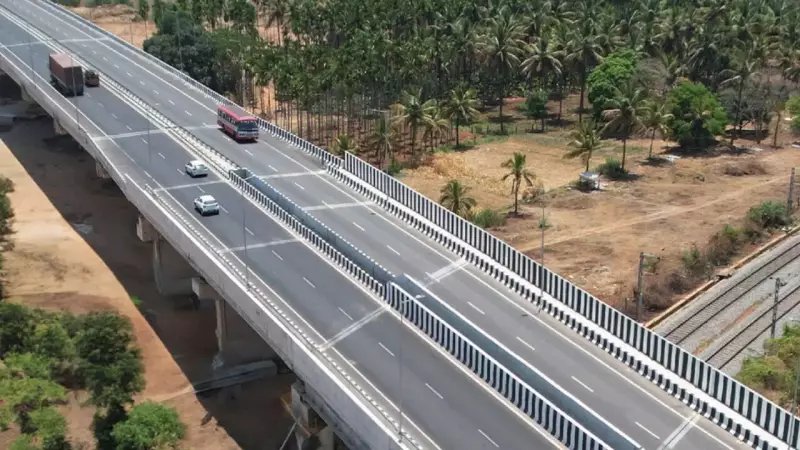
India's infrastructure landscape is undergoing a fundamental strategic shift. Major developers and Infrastructure Funds are now moving beyond implementing isolated projects to creating comprehensive, large-scale infrastructure platforms. This pivotal change is powered by substantial government spending, a stronger regulatory framework, growth-oriented policies, and more reliable financing avenues.
Government Spending and the Expressway Revolution
The journey gained significant momentum after the 2021 union budget, which made a decisive turn towards capital expenditure. The government has consistently raised infrastructure allocations to spur economic demand and execute mega-projects. For the fiscal year 2026 (FY26), the union budget has set aside a massive ₹11.21 lakh crore for infrastructure, marking a 10% increase from the previous year and constituting 3.1% of the estimated GDP.
Within this, the roads and highways sector remains a top priority. The Ministry of Roads Transport & Highways (MoRTH) has been allocated ₹2.7 lakh crore for FY26, with targets including 6,376 km of new bids, major expansions, and brownfield expressway projects. The National Highways Authority of India (NHAI) has been constructing between 4,200 and 6,500 km of national highways annually over the past five years.

While India had only a few expressways like the Mumbai-Pune and Delhi-Agra corridors until 2020, the scene is changing rapidly. MoRTH is now building 27 expressways and access-controlled corridors, spanning 9,860 km at an investment of ₹4.2 lakh crore. States are also leading ambitious projects such as Maharashtra’s Mumbai-Nagpur Expressway and Uttar Pradesh's Ganga, Purvanchal, and Bundelkhand expressways, dramatically improving intra and inter-state connectivity.
Innovative Financing and the Rise of InvITs
Funding this ambitious vision relies heavily on innovative models and private capital. The Public Private Partnership (PPP) framework has evolved considerably under the Viksit Bharat 2047 vision. The government is actively engaging private investors, refining agreements, and ensuring policy stability across roadways, renewables, and ports.
A key instrument in this financial transformation is the Infrastructure Investment Trust (InvIT). Regulated by SEBI, InvITs have matured from niche products into mainstream vehicles offering transparent, long-term yields. They are now managing assets worth over ₹7 lakh crore. The potential reclassification of InvIT units as equity is expected to attract even more long-term capital from pension and sovereign wealth funds.
While early InvITs focused on roads and power transmission, the next wave is diversifying into renewables, digital infrastructure, airports, and warehousing. MoRTH has already raised ₹1.06 lakh crore through Toll-Operate-Transfer (TOT) bundles and InvITs. Although NHAI's current InvIT (NHIT) is privately listed, plans are underway for a new public InvIT to allow retail investor participation alongside institutional players.
Logistics, Sustainability, and the Road Ahead
Beyond roads, integrated logistics are getting a major boost. Through the Multi-Modal Logistics Parks (MMLP) program, MoRTH is establishing 35 large-scale logistics parks, each over 100 acres. These parks will feature multimodal transport access, modern warehouses, and container terminals near ports to cut freight costs and time. Complementing this, the Port Connectivity Project aims to upgrade last-mile links to all ports, with 108 projects identified and 36 completed.
The private sector is aligning with global benchmarks in connectivity, safety, and operational excellence. There is a growing emphasis on sustainable, low-carbon construction methods. Organizations are increasingly investing in Artificial Intelligence (AI) technologies to boost productivity, employ modular construction, manage resources efficiently, and analyze vast datasets to optimize entire project lifecycles for safer and more reliable outcomes.

This holistic platform-based approach, backed by robust funding and a clear policy roadmap, is setting the stage for a transformed infrastructure ecosystem that promises to enhance logistics efficiency, connect economic corridors, and propel India's growth story forward.





