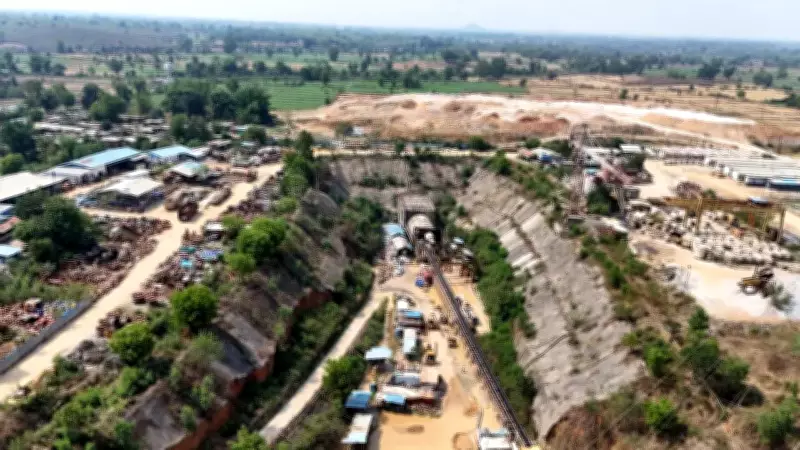
BHOPAL: For 17 years, engineers drilled through mountains, labourers descended into dangerous underground chambers, and giant imported machines repeatedly broke apart against unforgiving rock in Sleemanabad, a small town in Madhya Pradesh's Katni district. Some workers never made it home.
Now, after nearly two decades of delays, deadly accidents, broken machinery, and engineering improvisation, India's longest irrigation tunnel is finally nearing completion. If all goes as planned, by the end of June, engineers may finally accomplish what mythology says nature never intended.
Legend has it that Narmada and Sonbhadra, born in the same Maikal hills, were estranged lovers destined to flow in opposite directions, one westward, the other east, never to meet again. Through the 11.95-km Sleemanabad Tunnel, the waters of the Narmada will finally enter the Son basin.

The tunnel is likely to be inaugurated by Prime Minister Narendra Modi along with Madhya Pradesh chief minister Mohan Yadav, though officials say the event is expected only after construction is fully wrapped up and heavy machinery is removed, making August or September a more realistic timeline.
Commissioned by the Narmada Valley Development Authority (NVDA), the underground passage forms the backbone of the Bargi Diversion Project, designed to carry Narmada waters beneath the Vindhya ridge into the drought-prone farmlands of Vindhya. "Just 92 metres are left and we are trying to finish it by month-end," said Sahaj Srivastava, NVDA's executive engineer for the Sleemanabad project.
More than 300 people, including engineers and labourers, are currently working in shifts to meet the deadline. When operational, the tunnel will channel water from the right bank of the Rani Avanti Bai Sagar (Bargi) dam near Jabalpur to some of Madhya Pradesh's driest districts, including Katni, Satna, Maihar, Rewa and Panna, transforming agriculture across nearly 1,450 villages.
The journey, however, was brutal. The risks turned fatal for some. Two labourers died in separate cave-ins during excavation, while another worker died after a snake bite near the forested project site, officials familiar with the project said.
Many others suffered injuries as teams battled flooding, cave-ins, toxic gases, and unstable geology nearly 30 metres below the surface, officials said. Workers operated in three shifts where sudden water gushes and technical failures could stop work without warning.
The struggle began soon after tunnelling started in 2011. An American-made Robbins Tunnel Boring Machine (TBM), imported with hopes of speed and precision, was expected to cut smoothly through the Vindhyas. Instead, the mountain broke it. What lay beneath Sleemanabad turned out to be one of the toughest geological puzzles engineers had encountered. Layers of marble, limestone, dolomite, slate, and hidden underground cavities repeatedly damaged the imported machine and slowed excavation.
The scale of the challenge became clear early. In the tunnel's initial phase, engineers took nearly 6.5 years to complete barely 1.6 km of tunnelling, as machine breakdowns, shifting geology, and heavy seepage repeatedly crippled progress. At points, the American tunnelling machine virtually stalled underground. In a technical paper presented during the Indian Geotechnical Conference 2020, retired NVDA executive engineer Surendra Singh Pawar suggested the contractor had underestimated the terrain before "betting" on the Robbins machine.
Repeated setbacks forced authorities to bring in specialised experts and eventually deploy a German HK tunnelling machine from the Jabalpur side to rescue progress. By 2016, tunnelling had begun simultaneously from both ends.
Heavy groundwater seepage repeatedly slowed excavation, forcing engineers to deploy massive dewatering systems to keep the tunnel functional. Delays grew so severe that authorities even explored abandoning parts of tunnelling and constructing an open canal instead.
Officials also feared Madhya Pradesh risked losing part of its allocated Narmada water share if the diversion system remained incomplete. Still, the state pushed on.

Originally planned at an estimated cost of Rs 799 crore, the project's expenditure swelled to nearly Rs 1600 crore by completion. Once operational, the Bargi Diversion Project is expected to irrigate nearly 2.45 lakh hectares across around 1,450 villages, while also supplying drinking and industrial water to Jabalpur and Katni, officials said.
Yet perhaps the tunnel's greatest triumph lies beyond engineering. "For 17 years, workers dug through darkness to reconnect waters mythology says were separated forever. Now, through steel, sweat, and sacrifice, engineers have carved a hidden passage beneath the Vindhyas so that the waters of the Narmada may finally enter the Son basin," said an officer who did not wish to be named.
India's longest irrigation tunnel
- Name: Sleemanabad Tunnel
- Location: Sleemanabad, Katni district, MP
- Length: 11.952 km
- Commissioned by: NVDA
- Water carrying capacity: 152 cumecs
- Tunnel depth: Nearly 30 metres underground
- Likely inauguration: PM Narendra Modi and CM Mohan Yadav
Why the project matters
- Irrigation potential: 2.45 lakh hectares
- Benefits around 1,450 villages
- Districts covered: Jabalpur, Katni, Maihar, Satna, Rewa and Panna
- Drinking and industrial water for Jabalpur and Katni
Why it took 17 years
- Worker deaths and hazardous underground conditions
- American Robbins TBM repeatedly broke underground
- Only 1.6 km completed in first 6.5 years
- Difficult geology and hidden cavities
- Heavy groundwater seepage
- German HK machine deployed after setbacks
- Backup open-canal plan explored during delays
- Cost rose from Rs 799 crore to nearly Rs 1600 crore