

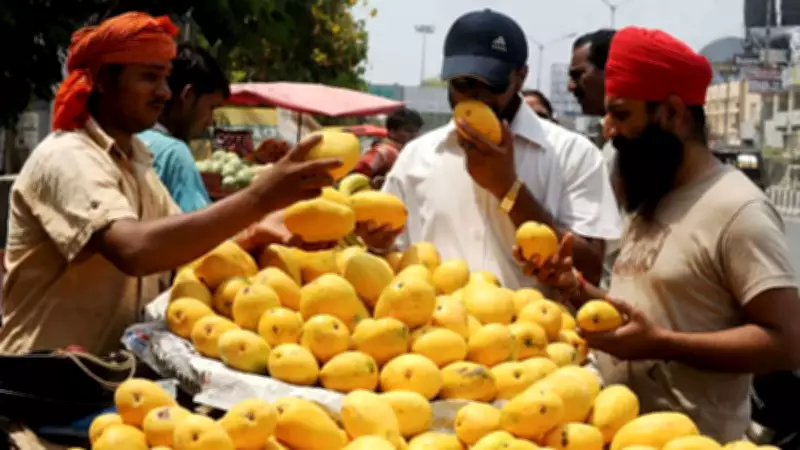
India's Mango Paradox: A Nation Hoarding Its Golden Treasure
Have you ever wondered why a Mexican mango is more readily available in a London supermarket than a prized Ratnagiri Alphonso from India? The answer isn't merely geographical distance; it's rooted in a nation's passionate consumption of its own agricultural gold. India cultivates an astonishing array of over 1,500 mango varieties and harvests more than 24 million metric tons of this summer fruit each year. Remarkably, it supplies nearly 50% of the world's mangoes, yet exports a mere 1% of its fresh produce. Is this a significant missed economic opportunity, or simply the ultimate demonstration of overwhelming domestic appetite? While global consumers yearn for the "King of Fruits," India hosts a private celebration for its 1.4 billion residents.
Viral Sensation: Global Netizens React to India's Mango Consumption
This longstanding fact has recently surged across the internet, captivating and confusing international audiences. Social media platforms are abuzz with reactions to India's massive domestic mango consumption. One user on X exclaimed, "No wonder they all have beautiful skin like milk. Share mango with us please don’t be selfish." Another humorously defended, "Can you blame them? If I lived in the land of Alphonso and Kesar mangos, my export rate would be exactly 0%. I’m not sending those treasures anywhere." Contrasting experiences were shared, such as a user from Florida noting local mango trees often go to waste due to surplus.
Meanwhile, Indians proudly flaunt their devotion to the pulpy fruit online. Claims like "I eat at least 200 in season" and "110-140 per year is too little. We should start importing" highlight the cultural obsession. One user even declared, "We are not opening Strait of Mangoz," emphasizing the protective stance over this national treasure.

The Deep-Rooted Cultural and Historical Significance of Mangoes in India
Mangoes are far more than a seasonal fruit in India; they are a culturally embedded icon with millennia of history. Cultivation dates back thousands of years, with references in ancient texts like the Vedas and Puranas. Today, mangoes are integral to seasonal rituals, family gatherings, and religious ceremonies across the subcontinent.
- Diverse Uses: From refreshing mango shakes for children to tangy pickles for adults and the enjoyment of raw fruit, mangoes are utilized in countless culinary forms.
- Emotional Connection: For Indians, mangoes evoke deep emotions and memories—symbolizing familiarity, love, and the essence of childhood summers.
Analyzing the Indian Mango Market: Production vs. Export Dynamics
The Indian mango industry presents a fascinating paradox in global agriculture. As a production titan, India contributes approximately 45-50% of the world's mango output. Yet, it remains a minor player in the international fresh-fruit trade.
Key Market Insights:
- The domestic mango market is valued at around USD 2.90 billion (2025), with projections to reach USD 3.97 billion by 2030.
- Major producing states include Uttar Pradesh, Andhra Pradesh, Bihar, Karnataka, Tamil Nadu, Gujarat, Maharashtra, Odisha, West Bengal, Jharkhand, Chhattisgarh, and Kerala. Uttar Pradesh and Andhra Pradesh alone account for nearly half of the national production.
- Popular varieties such as Langra, Alphonso, Banganapalli, Dasheri, and Kesar offer diverse flavors, yet minimal exports persist.
In 2024, India's fresh mango export revenue was a modest $60 million. In stark contrast, Mexico, the largest mango exporter, generated $575 million between 2023 and 2025. However, this isn't necessarily a loss for India. The colossal domestic market of 1.4 billion people creates such high demand that marginal export returns pale in comparison.
Logistical and Regulatory Hurdles Hindering Fresh Mango Exports
Exporting fresh mangoes from India faces significant challenges:

- Complex Logistics: Cold-chain shipping for tropical fruits is intricate and costly compared to local distribution.
- Stringent Regulations: Indian exports must comply with rigorous Sanitary and Phytosanitary (SPS) measures.
- High Costs: International freight charges and mandatory treatments like vapour-heat or irradiation for markets like the US and Japan elevate expenses, positioning Indian mangoes as luxury items abroad.
As one X user insightfully noted, "The 'less than 1% exported' stat sounds like a failure. It's actually a demand curve so steep that the rest of the world barely gets a taste."
India's Dominance in the Global Mango Pulp Market
Interestingly, India excels in the mango pulp segment, commanding over 55% of global exports. The Middle East, particularly the UAE and Saudi Arabia, serves as the primary market, absorbing more than 40% of India's pulp and fresh fruit exports, followed by the UK and the US.
For now, the full magic of India's mangoes remains largely confined to its borders, offering a compelling reason for travelers to visit and savor a juicy, fresh bite firsthand.





