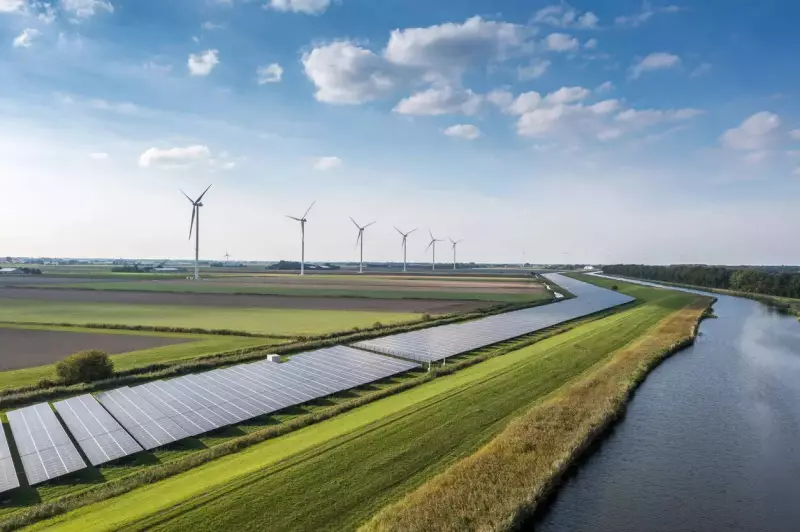
India's renewable energy sector has shattered records in the current calendar year, achieving its highest-ever annual capacity addition to the national grid. Preliminary figures for 2025 indicate a monumental leap, setting a new benchmark for the country's clean energy transition.
A Historic Year for Green Energy
While the final numbers will be confirmed in early January 2026, the sector has already added a staggering 44.5 gigawatts (GW) of new capacity in the first eleven months of 2025. This impressive figure includes power from large hydroelectric projects. This surge marks a significant acceleration from 2024, which saw an addition of approximately 28.7 GW.
The growth in renewable energy capacity, excluding large hydro, has been particularly robust. As of November 30, 2025, it reached 204 GW, reflecting a 26% increase over the previous year. This growth rate outpaces the 21% expansion recorded throughout the entire calendar year 2024. Overall, India's clean energy capacity has skyrocketed from 134 GW at the end of 2023 to the current 204 GW.

The Solar Power Dominance
The driving force behind this green revolution remains solar energy. During the January to November 2025 period, solar power across all segments contributed a massive 35 GW to the grid, a substantial jump from the 25 GW added in 2024.
The breakdown of solar additions is as follows:
- Ground-mounted projects accounted for the lion's share, adding roughly 26 GW.
- The rooftop solar segment made a strong contribution of 7 GW.
- Hybrid projects added nearly 1 GW, with the remainder coming from off-grid installations.
Several states have emerged as leaders in harnessing solar power. The top states for cumulative solar installed capacity are:
- Rajasthan (36 GW)
- Gujarat (25 GW)
- Maharashtra (17 GW)
- Tamil Nadu (12 GW)
Wind Revival and Overall Capacity Mix
In a positive sign for diversification, the wind power sector also experienced a strong revival. It added about 6 GW of new capacity in the first eleven months of 2025, its highest addition in recent years after a period of slower growth.
According to data from the Union Ministry of New and Renewable Energy, India's total installed renewable energy capacity stood at 254 GW as of November 2025. This comprehensive portfolio comprises:
- Solar: 133 GW
- Wind: 54 GW
- Bioenergy: 11 GW
- Small Hydro: 5 GW
- Large Hydro (including pumped storage): 50 GW
Sustained Momentum and Competitive Edge
The pipeline for future growth remains robust. An additional 135 GW of renewable capacity is currently under various stages of implementation or tendering, ensuring the momentum will continue.
Critically, the sector's economic competitiveness remains strong. As noted by the Institute for Energy Economics and Financial Analysis (IEEFA), tariff bids for utility-scale solar projects continue to hover at record-low levels, between Rs 2.44 to Rs 2.55 per kilowatt-hour (approximately $29-$31 per megawatt-hour). This confirms the sustained cost advantage of clean energy technologies over conventional fossil fuels, making the green transition not just an environmental imperative but an economically sound one.