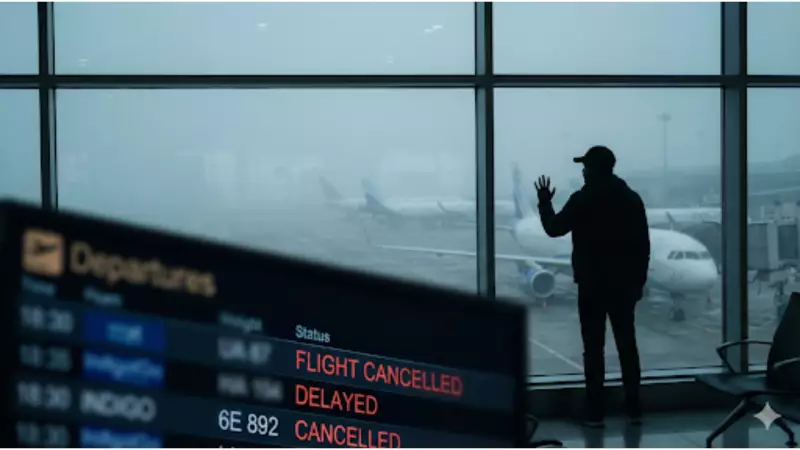
For Indian air travellers, the familiar crackle of an airport announcement has taken on a chilling new meaning. The words "your flight has been delayed," once a nightmare, now land as a sigh of relief. In a week where abrupt cancellations ran into four digits daily, a delay at least confirms the flight exists, the crew showed up, and travel is still a possibility. Silence, not sound, has become the true alarm.
A Desperate Scramble for Alternatives
The crisis at IndiGo, India's largest airline, has turned airports into scenes of utter chaos, with scattered suitcases and endless queues. For passengers like Soubik Majumder, a pre-booked journey from Delhi to Agartala for his brother's wedding disintegrated into a desperate hunt for buses and trains. He had booked his ticket a month in advance, hoping to avoid hassle, only to face a last-minute cancellation due to the ongoing disruptions linked to new aviation norms.
The trouble for many began long before official alerts. Vaishnavi Shree, travelling from Tirupati to Delhi, overheard rumours of cancellation at security. Her flight was delayed incrementally before being axed altogether. Stranded passengers were offered rescheduling or refunds, but those with urgent needs found connecting routes via Hyderabad or Bengaluru either fully booked or cancelled.

Playback singer Abhijit Ghoshal faced a six-hour delay. "After landing in Mumbai at 8.51 pm, it took 40 minutes just for the doors to open, and I received my luggage only at 10.45 pm," he told TOI. Several passengers reported being asked to deboard due to "no pilot available." Sunil D Shaligram said his son was stuck at the airport for over 14 hours with no assistance.
Refunds Offered, But Fares Hit the Stratosphere
In response, IndiGo announced automatic refunds for cancelled flights and a fee waiver for rescheduling bookings between December 5 and 15. However, this did little to douse the flames of frustration. The real blow came from skyrocketing airfares on alternative flights, with prices reaching nearly ten times the original booking amount.
"IndiGo is covering the amount I originally paid, yes, but that doesn't solve the problem," said Majumder. "I can't find anything below Rs 50,000–70,000, and even then only connecting flights." After paying roughly Rs 8,000, he now faced fares ten times higher. Travel industry veteran Ajay Prakash called this "black marketing, profiteering," criticising the profit-driven motives in a sector where IndiGo holds a 64-65% market share.
The fare spikes were staggering. A SpiceJet one-way economy ticket from Kolkata to Mumbai touched Rs 90,000, while Air India’s Mumbai–Bhubaneswar fare hit Rs 84,485. The ripple effect extended to cab fares, which Ghoshal said tripled. The crisis hit livelihoods hard, with artists missing concerts and business travel plans collapsing entirely.
Government Intervention and Mounting Losses
The Ministry of Civil Aviation finally intervened on Saturday, taking serious note of the "unusually high airfares" and invoking regulatory powers to ensure fair pricing. It mandated IndiGo to process all outstanding refunds by 8:00 pm on Sunday, December 7, and directed airlines to waive rescheduling fees for impacted passengers.
The airline's operational metrics collapsed. Its on-time performance (OTP) plunged to a mere 8.5% on Thursday, a stark fall for an airline that built its brand on punctuality. The financial markets reflected the turmoil: InterGlobe Aviation's stock price tumbled over 7% in five sessions, eroding market capitalisation by a staggering Rs 16,190.64 crore since December 1.
The human cost, however, was immeasurable. The chaos disrupted weddings, work commitments, and even final journeys. A passenger in Guwahati, trying to transport her deceased husband's casket to Kolkata, was left in agonising uncertainty about her IndiGo flight. Another from Delhi spent 12 chaotic hours at the airport only to return home, missing a wedding.

Union Civil Aviation Minister Ram Mohan Naidu Kinjarapu stated that restoring normalcy is the immediate priority, with authorities closely monitoring crew scheduling and duty norms. To alleviate the pressure, the South Central Railway announced four special trains to key destinations.
While Delhi airport stated IndiGo operations were "steadily resuming," uncertainty lingers for thousands, including those worried about return journeys. The crisis, largely tied to crew shortages, has exposed the fragile underbelly of Indian aviation's dependence on a single dominant player.
IndiGo will eventually fix its rosters, and the ministry will complete its probe. Airports may return to being temples of impatience rather than despair. But for now, every crackle of the speaker makes passengers inhale sharply—not worried they're late, but relieved they're still on the list. In this brutal week, travellers learned that in modern aviation, the most expensive seat isn't in business class; it's the seat of certainty.