Instant Maid Apps Revolutionize Urban Domestic Work in India
The dreaded text message that signals a manic Monday arriving two hours early was waiting before the morning alarm even sounded. It came from Swapna's long-time domestic helper: "Didi, main aj nahin aungi (Didi, I won't be coming today)." In the past, this would have triggered panic—a frantic rush to the kitchen, a scramble to catch the school bus, a hurried breakfast preparation, a dash for the office shuttle, and finally collapsing into the office chair as if it were Friday afternoon.
"Two months ago, this would have ruined my day," admits Swapna, an education consultant residing in a housing society in Noida's Sector 7x. "But I've discovered the 10-minute help," she adds with relief. For Swapna, instant maid services—where one can book a helper for tasks like dishwashing, laundry, or vegetable chopping as quickly as ordering groceries—have transformed how she handles the crisis of her regular helper taking an unannounced day off.
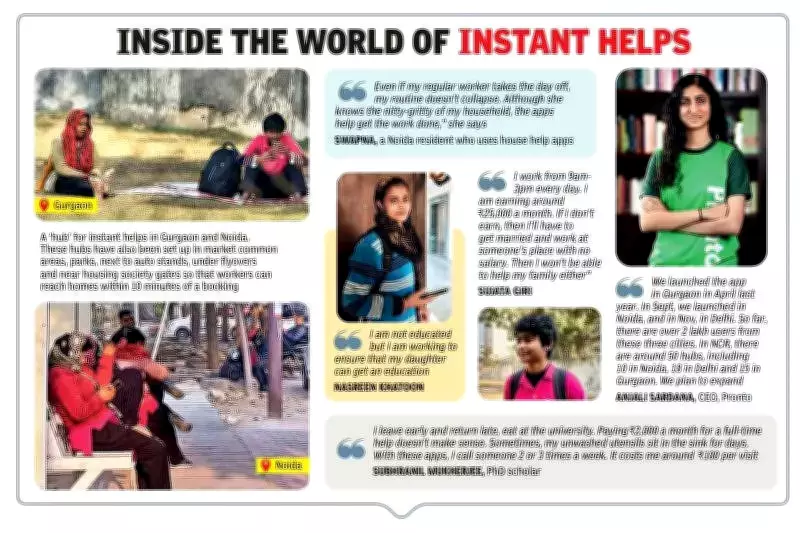
"Even if my regular worker doesn't turn up, my routine doesn't collapse. Although she knows the nitty-gritty of my household, the apps help get the work done," Swapna explains.

The Rise of the 10-Minute Gig Economy Model
Across the National Capital Region (NCR) and India's major metropolitan areas, the gig economy's latest innovation—the 10-minute business model—is rapidly altering one of the oldest urban work structures: domestic house help. This model, comprising nearly an all-women workforce, is offered by aggregators such as Snabbit and Pronto, both based in Bengaluru, and Insta Help by Gurgaon-based startup Urban Company.
These services are gaining swift traction, evident in groups of women clad in pink or green uniforms, standing with phones in hand at market common areas, inside parks, next to auto stands, under flyovers, and near housing society gates. These spots serve as pop-up offices, facilitating on-demand domestic assistance.
How the Gig Works: Stories from the Ground
Kajal, a resident of Noida in her late 20s, describes her experience: "This is my office," she says, referring to a bus stop in Noida Sector 70 where she reports at 7 AM daily after enrolling with Snabbit two months ago. "I log in and reach the bus stop. Bookings come from nearby societies. But sometimes, they can be from a place 2 km away, and then I need to run." Previously a fruit seller, Kajal finds the work physically demanding but appreciates the income, earning around Rs 27,000 per month.
In Gurgaon, Nandini Paswan, aged 20, expresses happiness about upgrading from daily wage work to a consistent job. After five days of training at a Snabbit hub in Nathupur, she now works in Sector 57, waiting at a designated spot between bookings, with a rider service transporting her to assignments.
Vishnu Priya, 31, a veteran domestic helper in Gurgaon, shares her transformation: "I never earned more than Rs 10,000-12,000 a month and couldn't send much back to my family in West Bengal." Since joining an app, her remittance has increased, and she now earns around Rs 25,000 monthly. "I don't want to work that traditional way anymore. And I get respect because I wear a uniform," she adds.
Other workers, like Nasreen Khatoon (23) from Bihar and Sujata Giri (20) from Tigra, highlight how app-based work provides financial stability and opportunities for education and family support, with earnings ranging from Rs 10,000 to Rs 25,000 per month.
Driving Demand: Evolving Lifestyles and Convenience
It's still early days for this gig model, but demand is robust, driven by evolving urban lifestyles—longer work hours, smaller families, increasing numbers of people living alone, and varied domestic needs. For students and young professionals, app-based house help offers on-demand access without long-term commitments, a flexibility traditional domestic work often lacks.

Subhranil Mukherjee, a PhD scholar from Jamshedpur conducting fieldwork in Delhi-NCR, explains: "I leave early and return late. Paying Rs 2,000 a month for a regular help doesn't make sense to me." He uses the apps 2-3 times weekly, spending around Rs 100 per visit, totaling Rs 800 monthly, to manage chores like washing utensils that otherwise get postponed.
Ritu Sharma, 35, who moved from Indore to Gurgaon, found reliability through an app after struggling to secure a house help. "Now, when I book, I ask for the same person each time. Both of us are now familiar, and I don't have to repeat instructions. I am finally trying to make Gurgaon my home," she says.
Through standardized pricing, rating systems, and early incentives, these apps have enrolled thousands of women, focusing on dense urban clusters like Delhi-NCR, Mumbai, and Bengaluru, where demand and labor availability are high due to migration.
Operational Insights and Safety Measures
A Snabbit local coordinator details the pop-up offices, termed 'hubs', which are temporary and set up based on demand, accessibility, and safety. "If bookings increase in an area, we create more hubs. Sometimes, we shift hubs to other places," he notes. On-ground operations involve area team leaders like Atul Agarwal in Noida, who supervise helpers, check uniforms, and ensure safety, including reporting incidents like abusive behavior to police.
Payment systems vary, with workers earning through fixed salaries, daily earnings, and incentives. Ujala, a Snabbit worker, mentions: "If I log in early, I get Rs 20 extra. If I refer someone, I can earn Rs 3,000-Rs 4,000 per referral." Weekends offer higher pay, and shift options range from 6 to 12 hours.
Benefits extend beyond income. According to Urban Company, workers gain access to life accidental cover up to Rs 10 lakh, health insurance of Rs 50,000 to Rs 1 lakh with OPD consultations, and personal loans through NBFC partnerships, reducing reliance on private money lenders.
Challenges and Safety Concerns
Despite advantages, the model presents challenges: grueling physical demands, penalties for refusing bookings, and safety risks in unfamiliar work settings. Pooja shares: "Crossing roads is risky when I'm in a hurry. I'm always running to meet the 10-minute deadline. Even if the distance is longer, I cannot refuse a booking."
Safety measures are in place. Priyanka, a Pronto worker in Noida, says: "During training, I was instructed to keep my phone with me. The app has an SOS button and emergency helpline. If I feel unsafe, I've been told to leave immediately."
Anjali Sardana, founder and CEO of Pronto, emphasizes the agency the model provides: "In the offline world, domestic workers often have no protection. The app has multiple safety layers—SOS systems, emergency helplines, and local response teams." Pronto has over 2 lakh users in Gurgaon, Noida, and Delhi, with plans to expand.
Urban Company offers 24x7 partner helplines and chat support, avoiding late-night jobs for safety. Snabbit reports around 20,000 daily bookings across metros, with Delhi NCR leading, followed by Mumbai and Bengaluru. The company employs a "nano-market" strategy, focusing on dense apartment clusters to minimize travel distances between jobs.
This burgeoning sector highlights a significant shift in urban domestic work, blending technology with traditional labor to create new opportunities and conveniences in India's fast-paced cities.