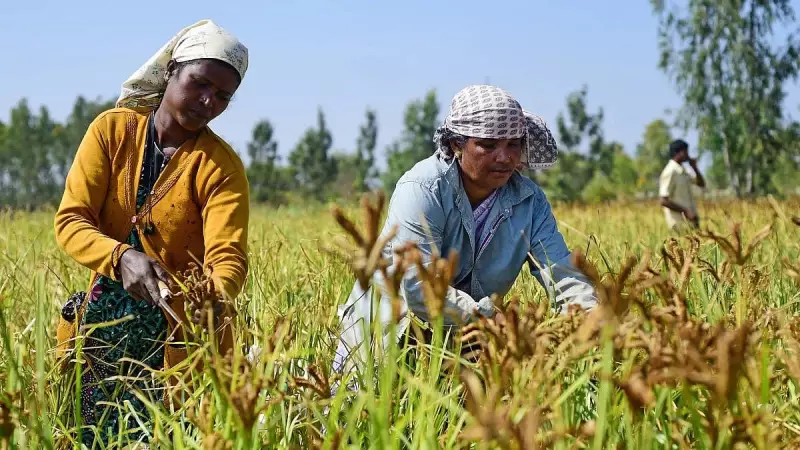
India's agricultural sector has demonstrated remarkable resilience with the latest estimates revealing a substantial kharif food grain production for the 2024-25 season. The Ministry of Agriculture and Farmers Welfare has released comprehensive data showing the nation's farming achievements during the crucial monsoon-dependent cropping period.
Record-Breaking Production Figures
The government's second advance estimate projects total kharif food grain production at 173.3 million tonnes, showcasing the sector's robust performance despite various challenges. This comprehensive assessment, released recently, provides crucial insights into the country's food security situation and agricultural health.
Rice production emerges as the standout performer with estimates reaching 108.5 million tonnes, representing the majority of the total kharif output. This significant achievement in rice cultivation underscores India's continued dominance in global rice production and its capacity to meet domestic consumption demands.

Diverse Crop Performance Analysis
The detailed breakdown reveals varied performance across different crop categories. Nutri-cereals, including millets and other coarse grains, are estimated to contribute 16.8 million tonnes to the total production. This category has gained increased attention due to its nutritional benefits and climate resilience properties.
Pulses production is projected at 6.3 million tonnes, reflecting ongoing efforts to boost protein-rich crop cultivation. Among pulses, tur (pigeon pea) leads with an estimated output of 3.4 million tonnes, while urad (black gram) follows with 2.1 million tonnes.
The oilseeds sector shows promising results with total production estimated at 24.1 million tonnes. Groundnut accounts for 7.8 million tonnes, while soyabean contributes significantly with 13.1 million tonnes to the oilseeds basket.
Sugarcane and Cotton Contributions
Commercial crops have also shown impressive performance metrics. Sugarcane production is estimated at a substantial 434.3 million tonnes, maintaining India's position as a global leader in sugar production. The cotton sector projects output of 32.2 million bales (each of 170 kg), highlighting the textile industry's raw material security.
Jute and mesta production estimates stand at 9.2 million bales (each of 180 kg), supporting the natural fiber industry and traditional manufacturing sectors. These figures collectively paint a picture of diverse agricultural success across multiple crop categories.
The ministry emphasized that these estimates are based on data received from states and validated through appropriate mechanisms. The comprehensive assessment considers multiple factors including weather conditions, sowing patterns, and input availability throughout the kharif season.
This positive agricultural outlook comes at a crucial time when global food security concerns are rising. India's ability to maintain strong production figures reinforces its position as a reliable food producer and contributes to stabilizing domestic food prices while ensuring adequate supply for the population.
The government's agricultural policies, combined with favorable monsoon conditions in most regions, have played a significant role in achieving these production numbers. The data serves as an important indicator for policymakers, agricultural experts, and market participants in planning future strategies and interventions.