

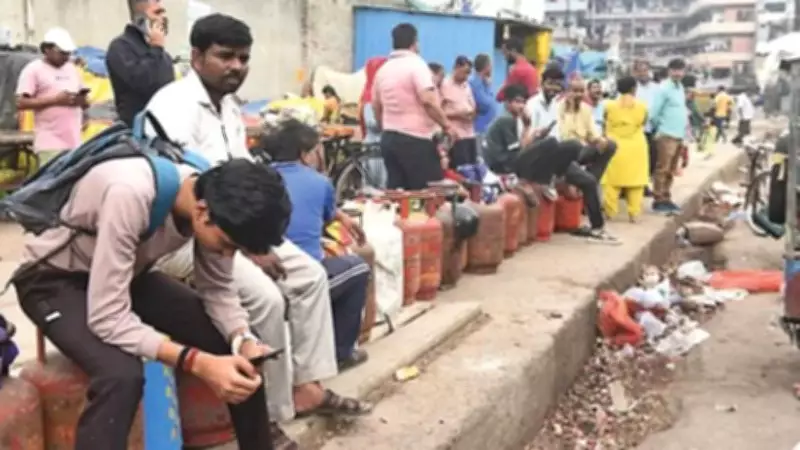
LPG Crisis in NCR Drives Migrant Workers Back to Villages as Black Market Prices Skyrocket
In the National Capital Region (NCR), a severe shortage of LPG cylinders has triggered a mass exodus of informal sector workers from factories in Noida and Greater Noida. Many daily wage earners, unable to afford soaring black market prices, have abandoned their jobs and returned to their native villages across Uttar Pradesh.
Geopolitical Tensions and Supply Disruptions Worsen Shortage
The crisis intensified after attacks by the US and Israel on Iran, which placed additional pressure on global energy supply routes. This led to heightened scrutiny of LPG stocks, effectively shutting down pilferage and illegal refill operations that many migrant workers relied on for affordable cooking fuel.
Dharmendra Nagar, a labour contractor in Greater Noida and Noida, reported that nearly 2,000 out of 8,000 workers employed through him have left their jobs. These workers have returned to villages in districts such as Badaun, Aligarh, Etah, Shahjahanpur, and Mathura.

Black Market Prices Surge, Making Survival Impossible
Previously, workers depended on portable 3kg cylinder-cum-stoves refilled informally for Rs 40-50 per kg. However, black market prices have now skyrocketed to Rs 400-500 per kg, depleting their meagre savings rapidly.
"A large chunk departed on April 1, right after collecting their salaries," Nagar explained. "Once a worker goes on leave without informing their supervisor, they effectively lose that job. But right now, their only priority is making sure they don't go to sleep hungry."
Bharat Kumar, a daily wager in Greater Noida, highlighted the dire situation: "I used to get an LPG refill for Rs 50 per kg every two days. Now the rate has hit Rs 400 per kg. How do I save for rent, send money home and still eat?" His landlord in Devla village has even prohibited him from building mud chulhas, eliminating a traditional fallback option.
Food Costs Rise, Further Squeezing Workers
Eating out is no longer a viable alternative, as roadside food stalls have passed on higher LPG costs to customers. Madan Prajapati, a mason working in Surajpur, noted: "A Rs 50 thali now costs Rs 80, and a paratha that was Rs 20 is now Rs 40. I can only afford to eat out once every four days. The other days, I may have to sleep hungry."
Contracted Workers Struggle with Daily Life Restructuring
While daily wage earners leave, blue-collar factory workers on contracts with better salaries have largely stayed. However, their daily routines have been drastically altered, with many starting early to queue for cylinders before their shifts.
Kuldeep, a printing line worker in Sector 10, was outside a gas agency in Harola at 8 am on a Saturday, two hours before his shift, trying to collect a cylinder booked two days earlier. "My shift starts at 10 am. I have to get the cylinder and deliver it home before," he said. "Unlike daily wage workers, who can sometimes negotiate a late start, factory workers operate on rigid shifts where a missed day can mean a pay cut or dismissal."
Ramashankar, a security guard in Sector 6, has been attempting to collect a cylinder booked on March 28, with only early-morning visits possible before his shift. Maryam, a garment factory worker, faced similar issues as home delivery was suspended in parts of Harola after alleged looting by residents without valid connections.
Families with Dual Incomes Hit Hardest
Gangeshwar Dutt of the Centre of Indian Trade Unions pointed out that families where both spouses work factory shifts without valid gas connections are suffering the most. "They cannot just leave for their village. They have children to feed. So, they are being forced to buy cylinders at exorbitant prices, and then have to either convince their landlord to delay rent or borrow from the ration store. Either way, their debts keep mounting," he stated.
The price of a 14.2 kg cylinder, once around Rs 1,100, now costs Rs 4,000-4,500 in the black market. For workers earning Rs 12,000 monthly, this single expense can devastate their entire budget.

Pradeep, a factory worker from Sector 57, expressed his frustration: "With a salary of Rs 12,000, it is impossible to manage rent, fees and food. How am I to buy a gas cylinder for Rs 4,000?"
Return to Traditional Cooking Methods and Rising Anxiety
Some have resorted to wood-fired chulahs out of desperation. Seema, who works at a chemical factory in Sahibabad and lives in Ghaziabad's Arthala village, has been cooking on a chulah for over a week. "Earlier, we somehow managed by buying small cylinders from local sources. Now nothing is available," she said.
Rumours have compounded the anxiety, with fears of a repeat lockdown prompting some to leave. Bhola, a water delivery truck driver from a JJ Cluster in Sector 9, observed: "People thought everything might shut again." Another worker waiting in a queue outside a gas agency mentioned he was holding out until salaries were credited on the 10th of the month.





