

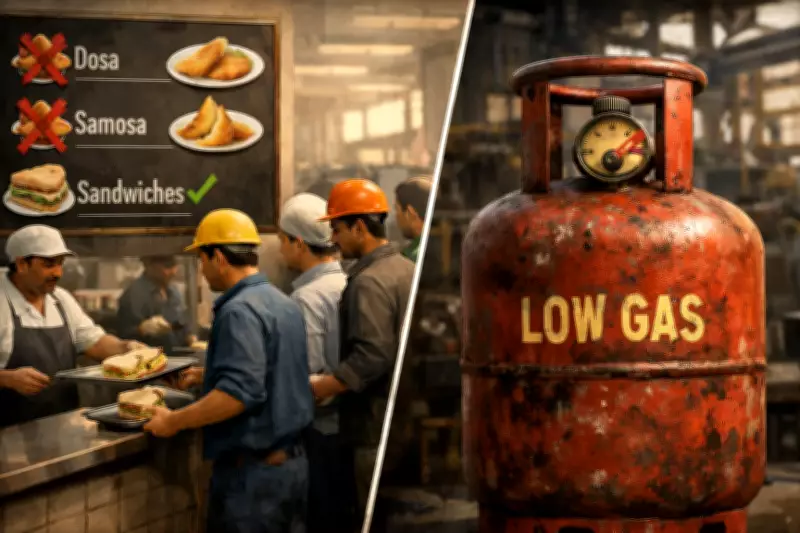
Middle East Tensions Trigger LPG Shortage, Disrupting Indian Factory Operations
The escalating conflict in the Middle East is now directly impacting daily industrial life in India, as a severe shortage of commercial LPG disrupts factory production and even basic worker amenities like canteen services. Manufacturers across the country are grappling with supply constraints that threaten both manufacturing processes and employee welfare.
Factory Canteens Forced to Redesign Menus
Factory kitchens are undergoing dramatic transformations as companies struggle to conserve limited LPG supplies. Traditional Indian staples that require significant gas consumption are disappearing from canteen menus. Items like perfectly crisped dosas, freshly fried samosas, and non-vegetarian dishes are being replaced with simpler alternatives that demand minimal cooking.
"Every day has become a new challenge now," revealed Satish NS, President of Haier India, which manufactures refrigerators and televisions. "Component suppliers are facing challenges with low LPG supplies, which will impact final production. Brazing operations in factories are getting affected. And even running factory canteens has become difficult."

Many facilities have adopted a "hand-to-mouth" approach, with some executives reporting LPG stocks that may only last until the weekend. Packaged foods, sandwiches, and other items requiring little or no cooking are increasingly becoming the norm, while even tea supplies have been reduced in some plants.
Major Manufacturers Feel the Pinch
The impact spans across India's industrial landscape. Parle Products, the country's largest packaged food company, has significantly scaled back food variety at its 10 company-run factories and 125 third-party plants. Their extensive canteen menus have been restricted to just a few dishes, with chapatis, dosas, and fried snacks making way for simpler preparations like sandwiches.
"Workers understand the problem at hand," explained Mayank Shah, Vice President at Parle Products. "Even production is being impacted in plants that run on fuels such as LPG, propane, and butane, with some shifts or lines not operating. We are trying to balance overall production with the plants that are least impacted."
Other industrial giants are implementing similar measures:
- Mahindra & Mahindra has removed live counters and fried foods from canteens
- Tata Motors warned suppliers about restricted food menus at plant events
- Godrej Enterprises reports severe impact on brazing work for sheet metal operations
Manufacturing Processes Disrupted During Peak Demand
The timing couldn't be worse for appliance manufacturers. "This is when demand for cooling appliances such as air-conditioners and refrigerators is peaking," noted Kamal Nandi, head of appliances business at Godrej Enterprises. The shortage has created critical challenges for brazing operations essential to production lines.
GK Sharma, India region chairperson at French auto parts maker OP Mobility, described the situation as "navigating a tough phase," particularly affecting paint shop processes that rely on consistent fuel supplies.
Innovative Alternatives Emerge Amid Crisis
To maintain worker meals and production continuity, companies are exploring creative solutions:
- Electrification of kitchen equipment including induction cooktops, electric rice cookers, and roti makers
- Revival of traditional firewood stoves (chulhas) in some factory canteens
- Exploration of solar power alternatives for cooking and manufacturing
Some forward-thinking facilities have avoided disruptions entirely. Daimler India Commercial Vehicles, manufacturer of Bharat Benz trucks and buses, continues normal canteen operations thanks to their complete transition to electricity powered by 100% solar energy.
Government Intervention and Supply Management
The Indian government has implemented measures to cushion the impact of the deepening energy crisis. Authorities have prioritized LPG supply for households while imposing a 20% cap on average monthly commercial LPG supply by oil marketing companies. These companies will coordinate distribution with state governments to manage the shortage.

Refineries have been instructed to maximize LPG production, with some already increasing output by redirecting propane and butane streams toward LPG manufacturing. Manufacturing companies will receive up to 80% of their average supply from the previous six months, though this still represents a significant reduction during peak production periods.
The situation highlights how geopolitical tensions thousands of miles away can directly affect everyday industrial operations and worker welfare in India, forcing rapid adaptation across the manufacturing sector.





