

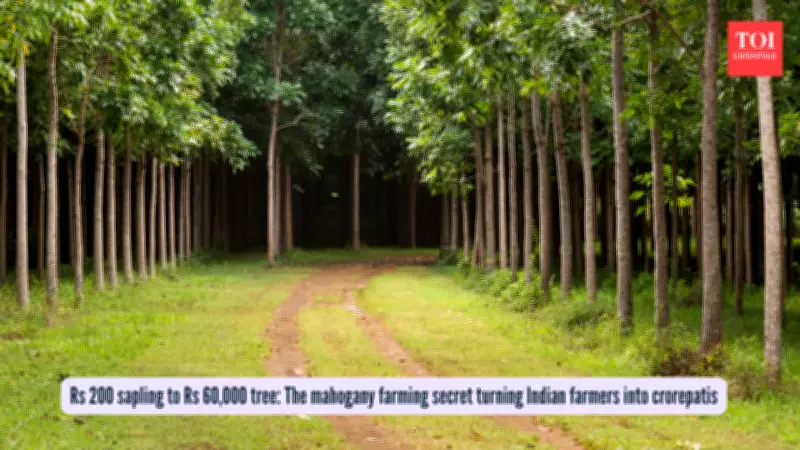
Mahogany Tree Farming: India's Green Gold Rush for Patient Farmers
In India, where land is often viewed as a legacy and farming fuels aspirations, a quiet revolution is transforming farmlands. Grain fields are gradually giving way to green goldmines, as forward-thinking planters abandon quick cash crops for massive timber trees that promise substantial payoffs decades later. This shift represents a strategic move towards sustainable wealth-building in agriculture.
Why Mahogany Trees Are the Ultimate Long-Game Investment
Mahogany, revered as the "king of timber," offers premium wood celebrated globally for its exceptional durability and rich, deep-red hue. The timber commands impressive prices, ranging from Rs 1,500 to Rs 2,500 per cubic foot, and finds applications in diverse industries such as shipbuilding, luxury car interiors, rifle stocks, and high-end bungalow woodwork. Additionally, it is used in crafting musical instruments like guitars, tablas, and harmoniums.
Beyond its construction uses, Mahogany trees have medicinal and commercial value. Various parts of the tree are employed in traditional treatments for conditions like malaria, diabetes, and diarrhea. The leaves contribute to the production of mosquito repellents, soaps, and herbal tonics, adding another revenue stream for farmers.

Low-Cost Startup with Minimal Maintenance
Entering Mahogany farming requires a relatively modest initial investment. Saplings are affordable, costing between Rs 200 and Rs 300 each. For instance, planting 500 trees totals approximately Rs 1 lakh. These trees are notably drought-tolerant and pest-resistant, demanding minimal care—primarily occasional watering and no expensive fertilizers. They thrive without intensive labor, growing to heights of 50-60 feet within 12-15 years, eventually maturing into harvest-ready giants.
Massive Returns from Mature Trees
The financial rewards of Mahogany farming are substantial. A single mature tree yields around 40 cubic feet of timber. At an average selling price of Rs 1,500 per cubic foot, this translates to roughly Rs 60,000 per tree. Scaling up, a plot with 500 trees can generate up to Rs 3 crore in pure profit after accounting for costs. This setup functions as a form of passive income that accumulates silently over the years, offering financial security for future generations.
Factors Driving the Popularity of Mahogany Farming
Several trends are fueling the rise of Mahogany cultivation in India. Global timber demand is increasing, driven by furniture booms and a growing emphasis on sustainable sourcing. In contrast, traditional crops face heightened risks from climate variability and market fluctuations. Mahogany provides a stable alternative, allowing farmers to diversify their income. During the early years, farmers can intercrop with vegetables or shade-tolerant plants between the trees to earn supplementary revenue. For optimal growth, it is recommended to plant trees with 10x10 feet spacing on a one-acre plot, accommodating about 400-500 trees.
Key Risks and Essential Tips for Success
While Mahogany farming offers lucrative prospects, it requires careful planning and patience. Farmers must wait for trees to reach 12-15 years of age to maximize value, as premature cutting reduces trunk thickness and overall yield. It is crucial to check local regulations, as some regions impose restrictions on non-native species. Conducting soil tests to ensure well-drained, loamy conditions is advisable for healthy growth. Annual pruning of lower branches enhances tree development, and selling timber to reputable mills ensures the best prices.
This venture is not a short-term money scheme but a long-term wealth-building strategy. Many farmers view Mahogany groves as valuable assets to pass down as inheritance or wedding gifts to their children, embedding them into family legacies.

Transforming Traditional Agriculture
Mahogany farming is reshaping conventional agricultural practices in India. By adopting a "plant once and reap profits for years" approach, it offers a sustainable model that reduces reliance on seasonal crops and mitigates environmental risks. This shift empowers farmers to build enduring wealth while contributing to ecological balance, marking a significant evolution in India's agricultural landscape.





