

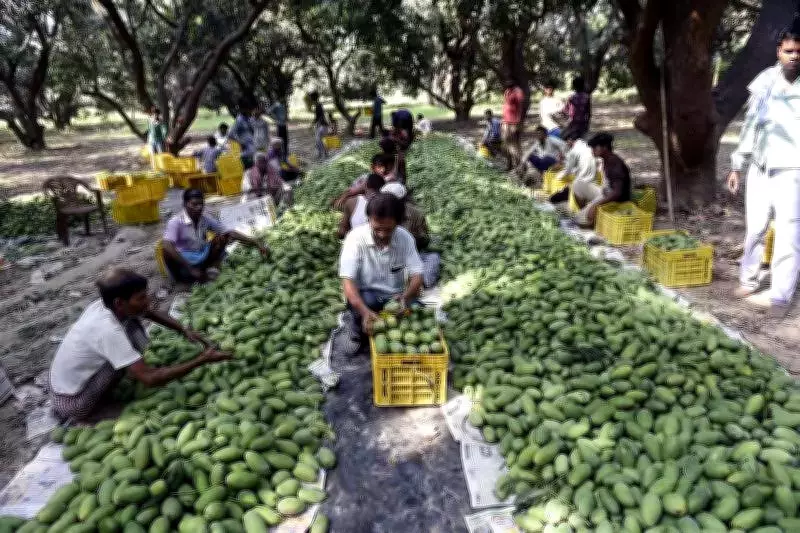
Malihabad Farmers Turn to Chemical Cultar for Enhanced Mango Production
In the mango-rich region of Malihabad, near Lucknow, farmers are increasingly adopting a chemical intervention to secure higher yields. They are using paclobutrazol, commonly known as cultar, to break the natural alternate-bearing cycle of mango trees. This practice promises bumper harvests every year, but it raises significant concerns among agricultural scientists.
How Cultar Works and Its Introduction in Malihabad
Cultar operates by inducing hormonal changes in mango trees, prompting them to flower even during off-years. Typically, mango trees follow an alternate-bearing pattern, producing a heavy crop one year and a light one the next. By applying cultar, farmers can maintain consistent production, which is economically appealing.
The use of cultar in Malihabad dates back to 2002, when government horticulturists first demonstrated its application. Orchard owner Upendra Singh, recognized for mango conservation efforts, recalls that his farm was one of the two initial demonstration sites. "Mine was one of the two orchards where the demonstration was conducted. I couldn't maintain the trees then due to limited resources. This year, I used it again in some orchards," he explained.

Scientific Guidelines and Potential Dangers
Experts emphasize strict adherence to usage guidelines to mitigate risks. Dr. H.S. Singh, a principal scientist at ICAR–CISH in Lucknow, outlines critical parameters: cultar must be applied 90 days before flowering, typically between late September and mid-October, with doses tailored to the tree's age. "Any deviation will not give the desired results and may harm the tree," he warned.
The chemical forces trees to consume stored nutrients to produce more flowers, which can lead to growth retardation with annual use. While fruit quality remains unaffected, the strain on trees necessitates adequate manure, especially cow dung, to help them withstand stress.
Farmer Perspectives and Long-Term Implications
Local growers acknowledge the benefits but also recognize the risks of overreliance on cultar. Naseeb Khan, an orchard owner who used the chemical for the first time under expert supervision, noted that forcing trees to fruit annually weakens them over time. "Constant use reduces the tree's lifespan. It goes against its natural cycle," he said.
Mango trees typically begin yielding fruit at around five years of age and can remain productive for decades, even centuries, with proper care. Scientists and experienced farmers recommend periodic breaks from cultar, coupled with practices like pruning and nutrient management, to strengthen trees and ensure their longevity.
Balancing Short-Term Gains with Sustainable Farming
The trend in Malihabad highlights a broader dilemma in agriculture: balancing immediate economic gains with long-term sustainability. While cultar offers a solution to inconsistent yields, its indiscriminate use poses a threat to tree health and orchard viability. Farmers are urged to follow expert advice and integrate chemical use with traditional care methods to protect these valuable assets for future generations.






