

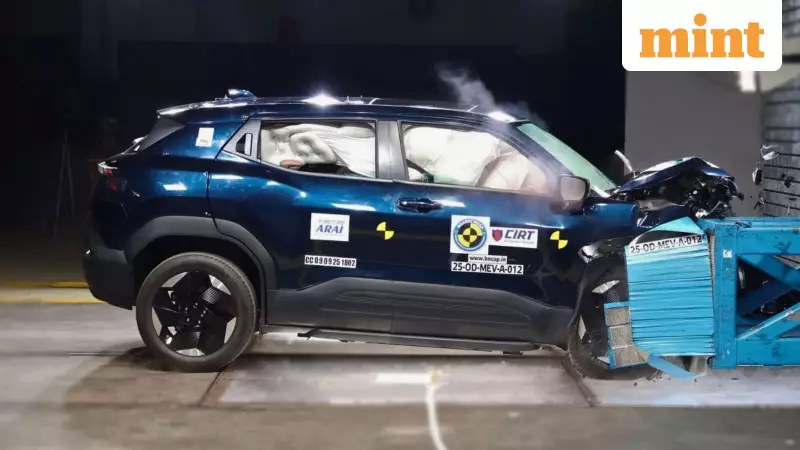
India's indigenous vehicle safety assessment program, Bharat NCAP, has released its crash test results for 2025, putting several popular cars through rigorous evaluations. The spotlight shines on Maruti Suzuki, the country's automotive sales leader, with five of its models assessed across different segments. The results showcase a range of safety performances, with ratings spanning from four to a maximum of five stars.
Maruti Suzuki's Bharat NCAP Report Card: A Mixed Bag of Excellence
The tested models included the Dzire, Victoris, e Vitara, Baleno (in two variants), and the Invicto. The safety scores were determined based on two critical parameters: Adult Occupant Protection (AOP) and Child Occupant Protection (COP). While some models achieved a perfect five-star rating in both categories, others showed room for improvement, particularly in child safety.
The detailed ratings are as follows:

- Maruti Suzuki Dzire: AOP: 29.46/32 (5 stars), COP: 41.57/49 (5 stars)
- Maruti Suzuki Victoris: AOP: 31.66/32 (5 stars), COP: 43/49 (5 stars)
- Maruti Suzuki e Vitara: AOP: 31.49/32 (5 stars), COP: 43/49 (5 stars)
- Maruti Suzuki Baleno (2 airbags): AOP: 24.04/32 (4 stars), COP: 34.81/49 (3 stars)
- Maruti Suzuki Baleno (6 airbags): AOP: 26.52/32 (4 stars), COP: 34.81/49 (3 stars)
- Maruti Suzuki Invicto: AOP: 30.43/32 (5 stars), COP: 45/49 (5 stars)
Deep Dive into Top Performers and Their Crash Test Details
The five-star champions, the Dzire, Victoris, e Vitara, and Invicto, demonstrated robust safety structures. The Dzire, a best-selling sedan, offered good protection for the head, neck, pelvis, and thighs of front occupants in frontal tests, though driver chest protection was marginal. Its side impact performance was rated good. The newly launched Victoris SUV, equipped with six standard airbags and ADAS, provided good to adequate protection for all critical body regions in both frontal and side collisions, justifying its top score.
A notable entry is the yet-to-be-launched Maruti Suzuki e Vitara, the brand's first electric vehicle tested by Bharat NCAP. It impressed with good protection for the head and neck of front occupants, alongside adequate driver chest and good passenger chest protection. It aced the side impact tests, offering good safety across all body regions.
The Invicto, a rebadged Toyota model, also secured a five-star rating. Its frontal offset test showed good head protection, adequate chest safety, and good protection for the pelvis and driver's foot.
The Baleno Story: How Airbags Influence Safety Ratings
The case of the Maruti Suzuki Baleno is particularly instructive for car buyers. Bharat NCAP tested two variants: one with two front airbags and another with six airbags. Both versions received a four-star AOP rating and a three-star COP rating, indicating similar child safety performance regardless of airbag count.
However, the six-airbag variant scored higher in AOP points (26.52 vs 24.04). In frontal crashes, protection was primarily good for the head and neck, with marginal scores for the chest, pelvis, and thighs. The six-airbag model offered better side impact protection, achieving good ratings for the head, abdomen, and pelvis. This highlights that while more airbags can enhance specific area protection, the overall structural integrity plays a decisive role in the final star rating.
These Bharat NCAP 2025 results provide crucial, transparent data for Indian consumers, empowering them to make informed decisions. They underscore that within a single brand's portfolio, safety levels can vary significantly based on the model and its variant. The tests also validate the high safety standards of Maruti Suzuki's newer models like the Victoris and the upcoming e Vitara, while pointing out areas where popular models like the Baleno have scope for enhancement in future iterations.






