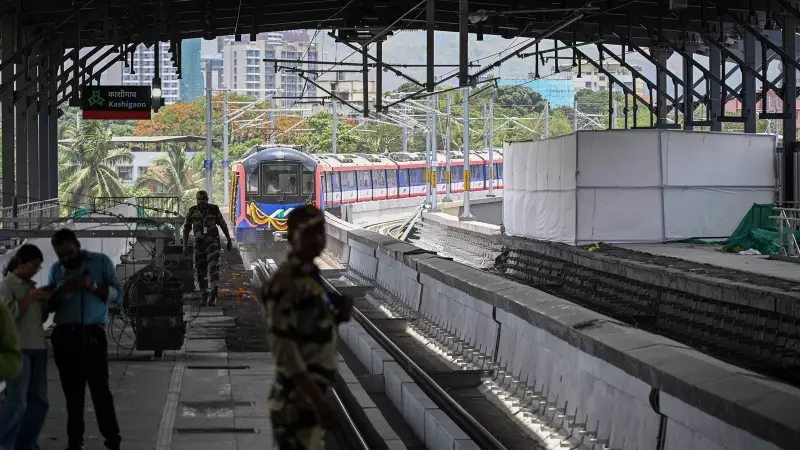
Mumbai's Rs 22,862 Crore Metro Plan to Revolutionize Airport Commute
Mumbai's notoriously congested airport commute is poised for a dramatic transformation. The Maharashtra Cabinet Infrastructure Committee has given its approval for a groundbreaking 35-kilometer Metro corridor, officially designated as Metro Line 8 or the Gold Line. This ambitious project will establish a direct rail link between Chhatrapati Shivaji Maharaj International Airport (CSMIA) in Mumbai and the upcoming Navi Mumbai International Airport (NMIA).
A Strategic Pillar for the Twin-Airport System
With an estimated investment of Rs 22,862 crore, the Gold Line represents the first-ever Metro connection between Mumbai and Navi Mumbai. It is strategically designed to serve as a critical backbone for the region's emerging twin-airport system. As air passenger traffic continues its upward trajectory, the existing CSMIA is operating at near saturation. The new NMIA is expected to share this growing load, making seamless and efficient connectivity between the two aviation hubs absolutely essential.
This connectivity is vital not only for transferring passengers but also for airport staff, cargo logistics, and transit travelers who need to move between the two facilities. The project addresses a long-standing gap in the metropolitan region's transportation network, promising to enhance economic integration and urban mobility on an unprecedented scale.

From Hours to Minutes: Drastic Reduction in Travel Time
The most significant impact of the Gold Line will be the drastic compression of travel time. Currently, the road journey between CSMIA and NMIA, covering a distance of approximately 38 to 40 kilometers, can take anywhere from 75 to 120 minutes. During peak traffic hours, this commute often stretches beyond two hours, causing significant delays and stress for travelers.
Once operational, the Gold Line is projected to slash this travel time to a mere 30 to 35 minutes. This reduction of more than half the current duration will provide a fast, reliable, and congestion-free alternative to road travel. It will effectively decouple airport connectivity from Mumbai's infamous road traffic, offering a predictable and efficient transit option.
Route Design and Station Infrastructure
The detailed alignment of Metro Line 8 has been meticulously planned to maximize connectivity. The corridor will originate at CSMIA Terminal 2 in Mumbai and terminate at NMIA Terminal 2 in Navi Mumbai, traversing through key eastern suburbs and major nodal points in Navi Mumbai.
Of the total 35-kilometer length, approximately 9.25 kilometers will be constructed underground, while 24.36 kilometers will be elevated. The underground section will extend from CSMIA to Ghatkopar, with the elevated stretch continuing from Ghatkopar East all the way to the Navi Mumbai airport. The average spacing between stations is planned to be about 1.9 kilometers.
The Gold Line will feature a total of 20 stations: six underground and fourteen elevated. The underground stations will be strategically located between CSMIA Terminal 2 and Ghatkopar East. The proposed station lineup, from west to east, includes:
- CSMIA T2
- SG Barve Marg
- Kurla Central
- Lokmanya Tilak Terminus (LTT)
- Ghatkopar East
- Govandi West
- Mankhurd
- ISBT–Mankhurd
- Vashi
- Sanpada
- Juinagar
- Nerul Sector 1
- Nerul
- Seawoods
- Belapur
- Sagar Sangam
- Targhar
- Moha
- NMIA West
- NMIA Terminal
Seamless Integration with Existing Transport Networks
A key feature of the Gold Line is its design for seamless integration with Mumbai's broader transportation ecosystem. The corridor will interface with three existing Metro lines, significantly enhancing multi-modal connectivity. Crucially, it will also provide a direct connection with the Lokmanya Tilak Terminus (LTT) railway station.
This integration means that commuters, including long-distance train passengers arriving at LTT, will be able to access either airport using a single Metro line without the need for complicated transfers. This design philosophy prioritizes passenger convenience and aims to create a unified urban transit network.

Implementation Framework and Timelines
The project will be executed by the City and Industrial Development Corporation (CIDCO) under a public-private partnership (PPP) model. The funding structure is robust, involving approximately 20% viability gap funding from both the central and state governments. The remaining capital expenditure will be mobilized from a private sector partner.
Land acquisition for the corridor is estimated to cost around Rs 388 crore for seven hectares. While the project's foundational framework has received approval, the tendering process is yet to commence. Chief Minister Devendra Fadnavis has issued directives to officials to expedite all necessary clearances to maintain the project schedule.
The intended completion timeline is set at five years; however, the state government has expressed a more ambitious target of finishing the project within 3.5 years. This accelerated timeline underscores the project's high priority for enhancing Mumbai's infrastructure and global connectivity.
The Gold Line Metro project is more than just a transportation link; it is a transformative infrastructure initiative that will redefine connectivity between Mumbai and Navi Mumbai. By converting a multi-hour road ordeal into a swift 30-minute metro ride, it promises to boost economic activity, support the twin-airport strategy, and significantly improve the quality of urban commute for millions of residents and travelers.