Nagpur Family Engineers Remarkable Solution to Escape Flooding by Lifting Entire House
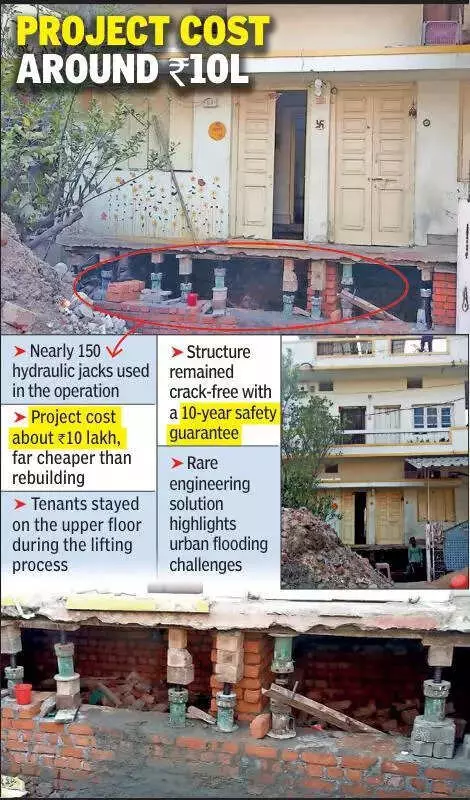
A family in Nagpur has performed an extraordinary engineering feat to protect their home from monsoon flooding. The Rakhunde family in New Dyaneshwar Nagar near Manewada raised their entire two-storey house by five feet using hydraulic jack technology.
The Flooding Crisis Caused by Elevated Roads
Repeated cement concreting of roads in the area created a serious problem over recent years. Road levels rose higher than surrounding houses, leaving homes vulnerable during monsoon seasons. Rainwater now gushes into properties that sit below road level, turning routine rainfall into a recurring crisis.
The Rakhunde family's 45-year-old ancestral home sank nearly three feet below the newly built cement road. This led to frequent flooding and constant worry, especially for elderly family members who faced health risks from the water intrusion.

A Cost-Effective Alternative to Demolition
Faced with the prospect of demolishing and rebuilding their entire structure, the family explored alternatives. Demolition and reconstruction would have cost between fifty and sixty lakh rupees, a substantial financial burden.
"My parents are old and it was very risky," said Rohit Rakhunde. "I initially decided to reconstruct the house with increased height, but the cost was too high. Then I came across a company that lifts houses without damaging the structure."
The Engineering Process Behind the House Lifting
The family hired a specialized contractor from Uttar Pradesh who used hydraulic jack technology to lift standing structures without damaging the original design. The process involved placing nearly 150 hydraulic jacks under key load-bearing points like walls and columns.
Contractor Murtuza Hussain from Bahraich district explained the technique. "The process begins with dismantling the ground-floor flooring, followed by careful excavation beneath the structure. Slowly, jacks are placed under key load-bearing points. Once the jacks are installed, the structure remains stable and is lifted uniformly."
Remarkably, tenants continued living on the upper floor even as permanent construction work proceeded beneath them. The two-storey house spans a 1,500 square foot plot with approximately 1,000 square feet of construction on each floor.
Financial and Structural Advantages
The lifting project proved significantly more affordable than rebuilding. The contractor quoted 220 rupees per square foot for lifting the structure, totaling about 4.4 lakh rupees. Materials added another 4 lakh rupees, bringing the total cost close to 10 lakh rupees.
Before finalizing the plan, Rohit visited similar projects executed by the contractor in Delhi. Convinced by the workmanship, he proceeded with confidence. The family also secured a legal agreement guaranteeing the contractor's responsibility for any structural issues within ten years.
"We have a legal agreement with the company which guarantees that if anything happens to the house within 10 years, the contractor will be responsible," Rohit added.
A Model for Urban Flooding Solutions
As Nagpur continues grappling with rising cement road levels and inadequate drainage systems, the Rakhunde family's lifted home stands as a striking example of practical innovation. Their solution demonstrates how engineering creativity can address urban flooding woes without requiring complete demolition.
The entire lifting process typically takes two to three months to complete. So far, the operation has proceeded smoothly without causing any cracks in the structure. This successful project offers hope to other families facing similar flooding challenges in cities where infrastructure development sometimes creates unintended consequences for residential properties.