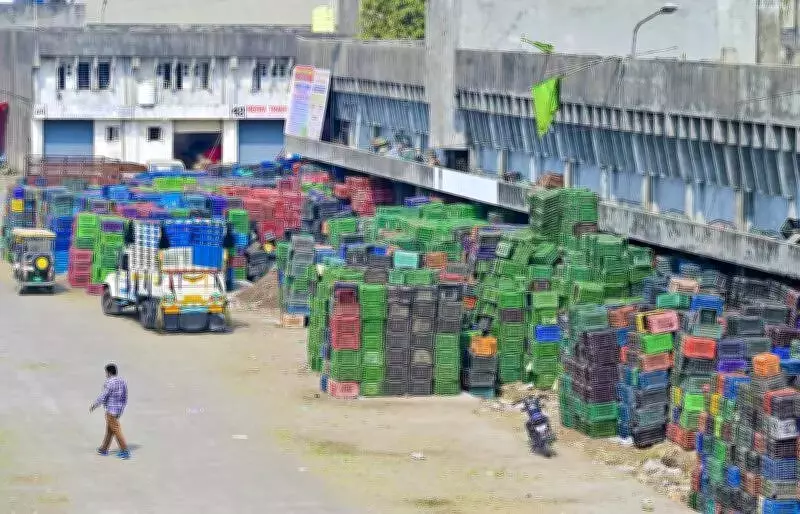
Nagpur Vegetable Strike Sends Prices Soaring, E-Commerce Remains Steady
The indefinite strike by commission agents at the Kalamna Agriculture Produce Market Committee (APMC) yard in Nagpur has begun to significantly impact household budgets across the city. As the strike disrupts the traditional supply chain, vegetable prices have witnessed sharp increases in local markets. However, a contrasting trend has emerged with instant e-commerce platforms maintaining smooth operations and stable pricing for daily provisions.
Market Yard Operations Severely Disrupted
On Thursday, at Kalamna—often referred to as Asia's largest market yard—vegetable arrivals plummeted to less than 5% of the daily average. Normally receiving between 9,000 to 10,000 quintals of fresh vegetables, the market managed only about 430 quintals. Despite this drastic reduction, APMC managing committee officials confirmed that all produce that reached the market was successfully auctioned, ensuring no farmer returned with unsold stock.
The market closure on Fridays further complicated the situation, potentially delaying fresh supplies. However, officials expressed optimism that once operations resume on Saturday, supplies could easily reach at least 5,000 quintals. They also noted that farmers have the alternative option of unloading their produce at the Cotton Market within the city.

Vegetable Prices Double Across the Board
The strike's immediate effect has been dramatic price increases across multiple vegetable categories. At Kalamna wholesale market, tomato rates jumped from Rs 8/kg to Rs 14/kg, while carrot prices nearly doubled from over Rs 8/kg. Cauliflower saw similar increases, rising from Rs 12/kg to Rs 25/kg.
The situation was even more pronounced at the retail level. Neighborhood vendors in areas like Dharampeth were selling tomatoes at approximately Rs 40/kg—double the pre-strike rates. Cauliflower retailed at Rs 30/kg, again representing a 100% increase. More extreme examples included spinach, which skyrocketed from Rs 20/kg to Rs 80/kg, and coriander, which surged from Rs 20-30/kg to Rs 100/kg within a day.
Drumstick became virtually unavailable, with limited stock selling at Rs 150/kg at the semi-wholesaler level in Cotton Market. Green chillies, already elevated due to poor crop conditions this year, flared to Rs 80-100/kg in wholesale markets from their previous Rs 55-60/kg range.
E-Commerce Platforms Provide Alternative Channel
While traditional markets experienced turbulence, e-commerce giants continued operations without disruption. These platforms maintained their deep discount rates and regular delivery schedules, providing consumers with a reliable alternative. The resilience stems from their procurement strategy—e-commerce players primarily source supplies directly from farms, using markets like Kalamna only to fill occasional gaps.
Traders emphasized that vegetable trade operates freely and isn't confined to APMC boundaries, allowing for flexible supply chain arrangements. This structural advantage enabled e-commerce platforms to bypass the strike's impact entirely.
Root Cause of the Dispute
The strike originated from a dispute over shed allocations at Kalamna APMC following the relocation of traders from Cotton Market. The Jai Kisan Vyapari Sangh has alleged that allocations favored members of the rival Yuva Adatiya Sangh guild. While members of the latter group are not participating in the strike, some acknowledged the strike's significant impact on market operations.
The matter is currently under consideration at the directorate of cooperative marketing, which functions as a quasi-judicial body. An officer involved stated that no decision can be made regarding the striking traders' demands while the matter remains sub judice.
Despite the severe supply reduction at Kalamna, factions of agents who chose not to strike continued operating without significant hurdles. The limited arrivals included a single truck of carrots, eight pick-up vehicles with peas, and one pick-up truck containing tomatoes, fenugreek, round gourd, bitter gourd, and brinjals—all of which were successfully auctioned.