

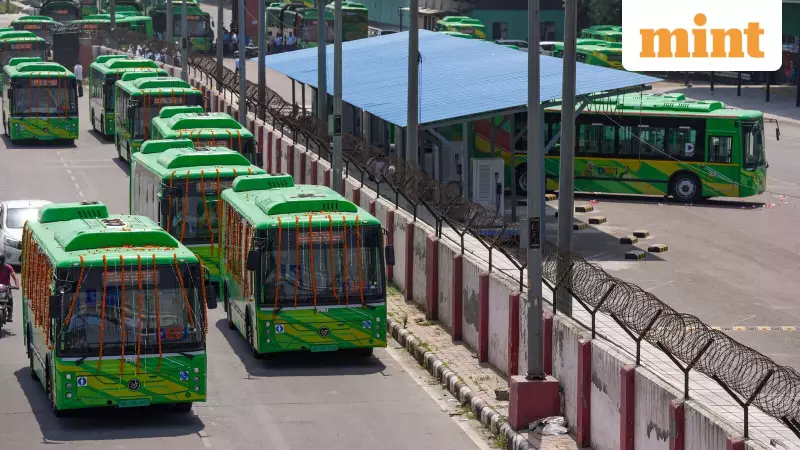
In a significant shake-up of India's commercial vehicle landscape, new-age electric vehicle manufacturers have captured the lion's share of the country's largest electric bus tender, leaving established industry leaders empty-handed. The results for the massive ₹10,900-crore tender under the PM E-Drive scheme, revealed on Wednesday, show a dramatic shift in market dynamics.
New Champions Emerge in Electric Mobility Race
PMI Electro Mobility Solutions and Eka Mobility emerged as the dominant winners, securing contracts for a combined 8,695 electric buses. PMI Electro won 5,210 buses, while Eka Mobility bagged 3,485 units. These two companies alone account for nearly 80% of the 10,900 e-buses tendered.
The only other winner was Olectra Greentech, a subsidiary of Megha Engineering, which secured a partial victory with 1,785 buses. The tender required supplying e-buses across five major cities: Bengaluru, Hyderabad, Delhi, Surat, and Ahmedabad. The winning bidders will be paid on a per-kilometer basis over a contract period of 10 to 12 years.

Legacy Players Stumble and Face Setbacks
The tender outcome delivered a major shock to legacy commercial vehicle manufacturers. Industry giants Tata Motors and VE Commercial Vehicles (VECV) did not win a single contract, according to executives familiar with the development.
Chennai-based Ashok Leyland faced a different hurdle, missing the tender submission entirely due to a reported technical glitch. The company has subsequently approached the Delhi High Court regarding the matter. A spokesperson for Ashok Leyland declined to comment, stating the issue is sub judice.
Government officials and industry executives spoke anonymously as the formal results have not been made public. Final letters of award are expected to be issued in the coming weeks.
Aggressive Bidding and Strategic Advantages
The success of the new-age manufacturers is attributed to highly competitive and aggressive pricing. A government official indicated that discovered prices were 5-15% lower than initial estimates, varying by city. The bidding was so fierce that margins were sometimes as low as 20 paise, with price gaps between the top bidders reaching up to 10% in some cases.
An executive noted that the new players found innovative ways to offer e-buses at cheaper rates. Eka Mobility credited its win to deep vertical integration across the EV value chain through group companies like Pinnacle Industries and a focus on balanced pricing for long-term sustainability.
The business model for this tender separates manufacturing from operations. Winning manufacturers supply the buses to fleet operators, who then run them for city transport authorities. This allows bus makers to avoid operational complexities. Notably, PMI Electro participated independently, while others like Eka Mobility bid through fleet partners such as Greencell Mobility.
Execution Hurdles and Future Implications
Experts warn that executing contracts of this magnitude presents severe challenges. The rollout involves deploying thousands of new buses into existing transit systems, requiring massive driver upskilling, establishment of strict safety protocols, and the creation of extensive depot and charging infrastructure.
T.S. Kiran, former executive director of the Association of State Road Transport Utilities (ASRTU), noted that while the initial years of the 12-year contract may be difficult, operations could stabilize later.
The tender miss is particularly notable for Tata Motors, which led the e-bus market in 2024 with 1,462 deliveries but is projected to deliver only 213 units in 2025. The company has expressed caution about tender models that place excessive responsibility on manufacturers, advocating for asset-light models and payment security mechanisms.
This landmark tender, concluded on 26 December 2025, signals a potential turning point where agile, specialized EV startups can outmaneuver traditional automotive powerhouses through focused strategy and aggressive financial planning in India's rapidly electrifying public transport sector.






