

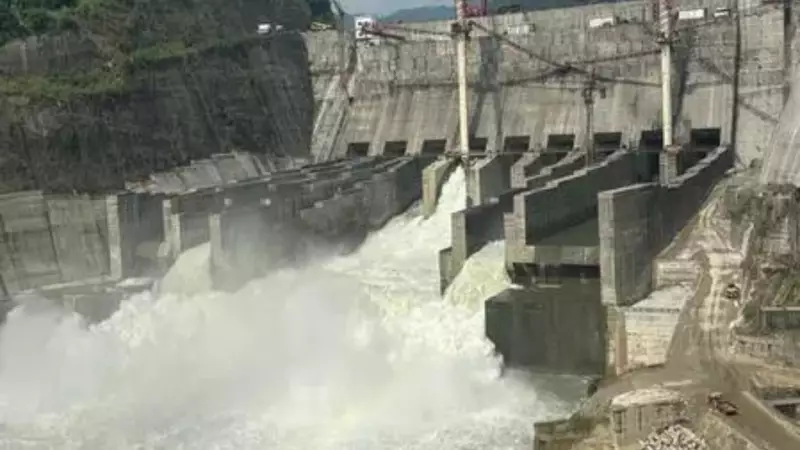
In a landmark development for India's renewable energy sector, the nation's largest hydropower plant has officially begun operations. The first unit of the massive 2,000 MW Subansiri Lower Hydroelectric Project was commissioned on Tuesday, marking a significant step towards strengthening power supply in the northeastern region.
A Virtual Inauguration for a National Milestone
Union Power Minister Manohar Lal Khattar inaugurated the commercial operation of the first 250 MW unit via virtual mode. The event was attended by key officials including Union Power Secretary Pankaj Agarwal and NHPC Chairman and Managing Director Bhupender Gupta. Khattar emphasized that the commissioning was more than a technical feat; it was a "testament to years of hard work, dedication and teamwork." He highlighted the project's role in supporting the growth of Northeast India, strengthening the national grid, and advancing India's ambitious net-zero emission goals.
Project Scale and Engineering Marvel
Located on the border of Arunachal Pradesh and Assam, the Subansiri Lower Project is a run-of-the-river scheme with small pondage. It features eight units of 250 MW each. Officials stated that three more units are slated for commissioning soon, with the remaining four expected to be operational in a phased manner by 2026-27.

Upon full commissioning, this mega project will generate approximately 7,422 million units of renewable electricity annually. The infrastructure includes the largest dam in Northeast India—a 116-metre-high concrete gravity dam—which will also aid in flood moderation and water management in the Subansiri River basin.
The project is an exemplar of engineering excellence, incorporating several record-breaking components:
- India's heaviest hydropower generator rotors and largest stators.
- The country's largest aggregate processing plants and highest-capacity batching plant.
- The first-ever use of Rotec's Tower Belt for dam concreting in India.
As the first cascaded dam on the Subansiri, it provides a substantial flood cushion of 442 million cubic metres, with about one-third of its total reservoir storage kept empty during floods to protect downstream communities.
Far-Reaching Benefits for the Region and Nation
The project's benefits extend far beyond electricity generation. Sixteen states across India are designated as beneficiaries, with the northeastern region set to receive a significant 1,000 MW from the project. In a move to support the host states, Arunachal Pradesh and Assam will receive free power allocations.
NHPC has also undertaken extensive environmental protection measures, investing about ₹522 crore in riverbank protection and erosion control along a 60 km stretch of the Subansiri River. These works have effectively stabilized the riverbanks for over five years.
The government anticipates that the project will act as a catalyst for regional development. The availability of continuous, reliable power is expected to spur the growth of small-scale industries, create employment and business opportunities, and potentially reduce migration from the Northeast. Additionally, improvements in river navigation and a boost to tourism are projected long-term benefits.
Power Secretary Pankaj Agarwal underscored the project's importance in improving energy supply in the Northeast and showcasing India's commitment to sustainable power systems. NHPC CMD Bhupender Gupta reiterated that the project would strengthen the national grid and provide reliable renewable energy to meet the country's rising demand.






