

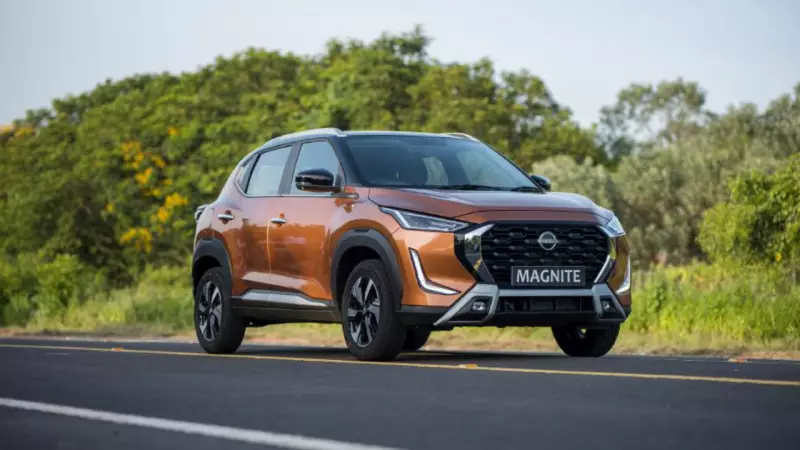
Japanese automaker Nissan Motor India has officially declared a price increase for its vehicles, effective from the first day of 2026. The company will implement a hike of up to 3 per cent across its model range, impacting its current sole offering in the market.
Impact on the Nissan Magnite SUV
Presently, Nissan retails only the Magnite subcompact SUV in India, with its ex-showroom price tag spanning from Rs 5.62 lakh to Rs 10.90 lakh. Following the announced increment, the popular SUV's price band is projected to shift to approximately Rs 5.79 lakh to Rs 11.23 lakh (ex-showroom). While Nissan has not provided an official statement detailing the reasons behind this move, industry analysts point towards the annual price revision cycle, escalating input costs, and volatile foreign exchange rates as likely contributing factors.
A Three-Pronged Product Offensive for India
This price revision coincides with Nissan's strategic blueprint for a significant resurgence in the competitive Indian automotive landscape. The brand is gearing up for a product-led reset, aiming to reintroduce itself strongly to consumers. The cornerstone of this strategy is the launch of three all-new models within a condensed timeline of about 16 months.

The rollout will commence with the global debut of a new compact MPV in January 2026. Codenamed and expected to be launched as the Gravite, this B-segment seven-seater will be constructed on the CMF-A+ architecture. It is strategically aimed at value-conscious family buyers, with an anticipated ex-showroom price point under the Rs 8.5 to 9 lakh bracket. Power will likely be sourced from a 1.0-litre, three-cylinder turbo-petrol engine, a unit already employed in several Renault-Nissan alliance cars. Nissan plans to distinguish the Gravite through unique exterior design and an overhauled interior cabin layout.
SUV Lineup Expansion: Tekton and a Premium Rival
Following closely will be the Tekton, Nissan's next-generation SUV for India, scheduled for an unveiling in February 2026. This model will share its CMF-B platform with the upcoming Renault Duster. However, Nissan intends to position the Tekton with a more robust, rugged character and a distinctly premium interior to carve its own identity. Its powertrain options are expected to be aligned with those of the new Duster.
The third and final model in this ambitious trilogy will be a premium seven-seat SUV. This vehicle will be based on the long-wheelbase variant of the CMF-B platform that also supports the Dacia Bigster. Rather than being a mere extended version of the Tekton, this SUV is planned as a standalone offering designed to compete directly with established players in the segment, such as the Hyundai Alcazar and the MG Hector Plus.
This concerted push of new products underscores Nissan's commitment to rebuilding its brand presence and expanding its footprint in key volume-driving segments of the Indian market, setting the stage for a transformative phase beginning in early 2026.






