Noida's Sector 104 Nightlife Zone: A Ticking Time Bomb of Fire Hazards
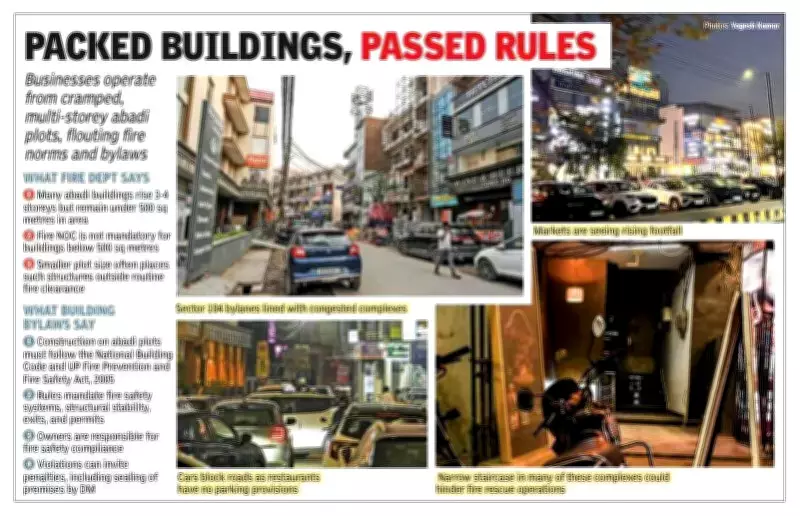
On a typical Saturday evening, Noida's Sector 104 transforms into a chaotic fairground, with cars parked haphazardly, pedestrians navigating through dense traffic, and crowds overflowing from cafes, restaurants, wine shops, and small entertainment joints. Music blares from upper floors as servers rush up and down cramped staircases, balancing trays of food and liquor. Amid the revelry, few patrons notice the tangled web of electrical wires between buildings or the alarming fact that most structures in this popular nightlife hub lack fire safety clearance.
Roots of the Problem: 5% Abadi Lands and Unchecked Development
These commercial establishments are constructed on what are known as 5% abadi lands. In exchange for surrendering land to the administration for road and residential sector development, farmers receive compensation and are allotted these 'developed' plots carved from village population areas. The plots come with a special provision: owners can start businesses or build houses on them. Many sell or rent these lands to entrepreneurs, leading to rapid, unplanned growth.
Buildings in this zone often rise up to four floors in densely packed lanes, housing wine shops and eateries side by side. They attract hundreds of patrons every weekend, creating a high-risk environment for fire-related disasters due to sheer footfall and congested access points.

Residents Voice Dire Warnings: "No Escape" in Case of Fire
Local residents from Hajipur village express grave concerns. One anonymous resident stated, "If there is a fire, there is no escape. The staircases are so narrow that even two people can't pass at once. Fire engines will never reach here. We keep warning authorities, but no one listens." The danger is exacerbated by the nature of businesses operating in the area. Every restaurant features kitchens with LPG cylinders, makeshift exhaust systems, and overloaded power connections. In several buildings, loose wires hang perilously close to gas pipes and wooden interiors.
Another Hajipur resident emphasized, "Just one spark is enough. We live with our families above or next to these places. The crowd is outsiders, but the risk is ours." A similar concern is emerging in Shahdara village, though on a smaller scale. As buildings spring up quickly without proper safety planning, residents fear it could become another Hajipur within a year or two if development continues unchecked.
Unaware Patrons and Regulatory Grey Zones
Patrons visiting these eateries remain largely oblivious to the risks. A group dining at a fourth-floor restaurant in Hajipur admitted fire safety never crossed their minds, citing the area's liveliness and affordability compared to Sector 18 or malls. Another customer outside a wine shop-cafe combination noted the crowd itself should serve as a warning, but conceded that such thoughts are often dismissed during leisure outings.
Restaurant and café operators acknowledge operating in a regulatory grey zone. A cafe manager in Hajipur explained that compliance is complicated by small plot sizes and high costs. "Most of us are operating on small areas. According to the rules, if the built-up area is below 500 square metres, a fire NOC is not mandatory. Installing full fire safety systems is expensive, and there is no clear direction," he said. An owner in Shahdara echoed this, citing pressure under ease of doing business initiatives that discourage stringent enforcement without offering practical solutions.
Administrative Response and Enforcement Challenges
District magistrate Medha Roopam acknowledged the risks, stating that the administration has taken note. "During a recent disaster management meeting, the fire department has been instructed to audit such areas and take action against establishments that do not have the required fire safety arrangements, including sealing where necessary," she told TOI.

However, fire department officials highlight enforcement limitations. A senior official noted that establishments operating in areas below 500 sq m are not mandated to obtain a fire NOC under existing norms. "As per government guidelines and ease of doing business directions, we have also been advised not to carry out coercive sealing drives against such small businesses," he said. Since most establishments on the 5% plots in Sector 104 and 143 are built on areas below 500 sq m, they fall outside compliance norms, creating a significant regulatory gap.
Grim Reminders from Past Incidents
This regulatory void raises uncomfortable questions, especially in light of past tragedies. In 2024, a fire at a similar hotel in Sector 104 resulted in a woman's death, with investigations revealing the absence of a fire NOC and basic safety measures. More recently, in December 2025, a fire at the Birch by Romeo Lane nightclub in Goa—also operating without a fire NOC—claimed 20 lives. These incidents serve as stark reminders of the potential consequences of running overcrowded, non-compliant business spaces, underscoring the urgent need for action to prevent future disasters in Noida's burgeoning nightlife districts.