PAU Krishi Vigyan Kendra Empowers Farmers with Spice Crop Training in Hoshiarpur
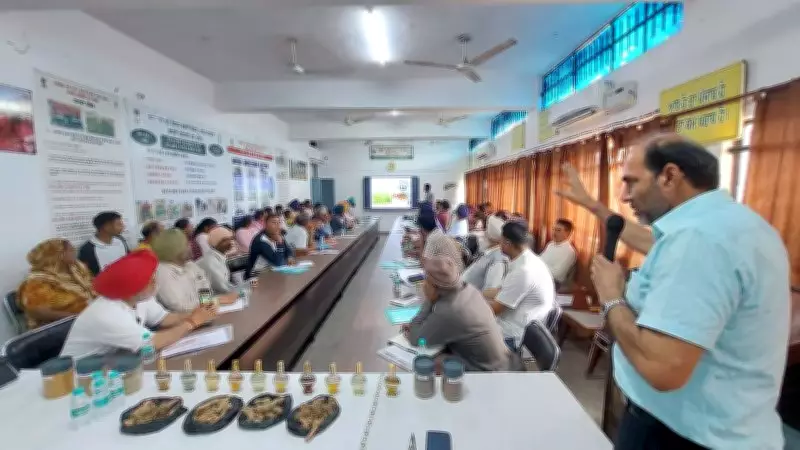
In a significant move to promote agricultural diversification and enhance farmer livelihoods, the PAU-Krishi Vigyan Kendra (KVK) in Hoshiarpur, in collaboration with the School of Organic and Natural Farming at PAU Ludhiana, conducted a specialized training program on improved cultivation and processing techniques for aromatic and spice crops. This initiative, held under the auspices of the Directorate of Arecanut and Spices Development based in Calicut, Kerala, attracted enthusiastic participation from 50 farmers and farmwomen, highlighting a growing interest in high-value and sustainable farming practices.
Focus on High-Value Crops for Economic Growth
The program was inaugurated by Maninder Singh Bons, the associate director (Training) at KVK Hoshiarpur, who underscored the farmer-centric efforts of the KVK and emphasized the immense potential of aromatic and spice crops in the district. He encouraged participants to adopt these crops as a viable strategy to increase profitability and ensure long-term sustainability in agriculture.
Expert-Led Sessions Covering Scientific and Commercial Aspects
The training featured a series of comprehensive lectures delivered by experts. Rajender Kumar, the course director and principal agronomist at the School of Organic and Natural Farming, PAU Ludhiana, discussed the scope of aromatic and spice crops in Punjab, with a particular focus on production technologies for turmeric and mentha. Vajinder Pal Kalra, an agronomist, provided insights into improved agronomic practices for seed spices.

Khushdeep Dharni, a professor in Business Management at the School of Business Studies, PAU Ludhiana, guided farmers on agri-business models and export procedures for aromatic and medicinal crops, opening new avenues for market linkages and entrepreneurship.
Practical Demonstrations and Hands-On Learning
From KVK Hoshiarpur, Gurpratap Singh, an associate professor in Agronomy, and Ajaib Singh, an assistant professor in Agricultural Engineering, conducted practical sessions on production techniques for key aromatic crops and processing methods for turmeric and other spices. Additionally, Charanjit Kaur, a principal extension scientist in Agronomy, and Rakesh Kumar Sharma, a senior extension scientist in Entomology from the Farm Advisory Service Centre in Gangian, offered detailed guidance on organic standards, pest management, and disease control in aromatic, medicinal, and spice crops.
Harpreet Singh, an Agricultural Development Officer from Mahilpur, explained the step-by-step process for obtaining organic certification, further supporting farmers in adopting sustainable practices.
Exhibition and Distribution of Resources
An exhibition showcasing a diverse range of aromatic and spice crops, along with their value-added products, was organized to provide participants with hands-on exposure. Curated by Parminder Singh, an associate professor in Vegetable Science, this display aimed to familiarize farmers with emerging crop options and their commercial potential.
To encourage immediate adoption, turmeric seed and herbal plants were distributed among the participants, reinforcing the practical orientation of the program. The training was coordinated by Karmvir Singh Garcha, an assistant professor in Vegetable Science, who also proposed the vote of thanks, concluding the event on a positive note.