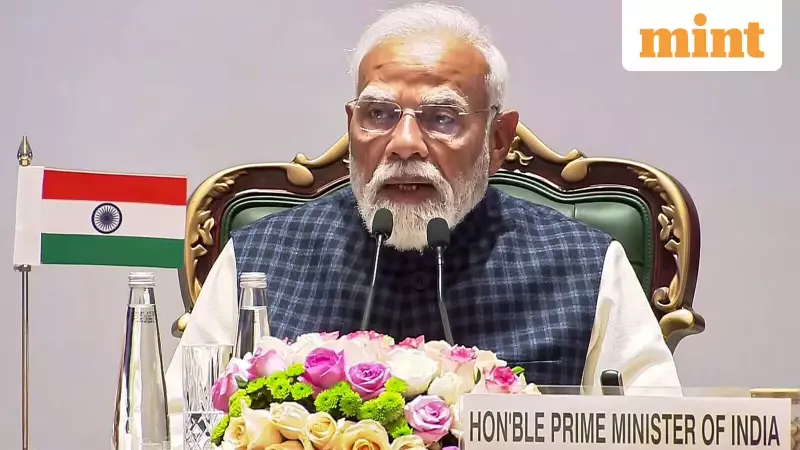
PM Modi Calls for $500 Billion Global Investment in India's Energy Sector
Prime Minister Narendra Modi on Tuesday made a compelling appeal to international energy corporations to channel investments into India's rapidly expanding energy landscape. Addressing the inaugural session of India Energy Week 2026, Modi revealed that the country presents investment opportunities valued at an impressive $500 billion across exploration and downstream sectors.
India's March Toward Energy Independence
Modi emphasized that India is steadily progressing toward energy independence, having fortified its energy security in recent years. "The energy sector is at the centre of our aspirations. It has opportunities worth $500 billion. So, I call upon all players to make in India, innovate in India, scale with India, and invest in India," the Prime Minister declared passionately.
He outlined the government's ambitious target to attract $100 billion in investments specifically in the oil and gas exploration domain by the year 2030. This strategic push comes as India, currently the world's third-largest oil importer, sources approximately 90% of its crude oil from foreign nations.

Diversifying Sources Amid Global Tensions
The Prime Minister acknowledged the pressing need to diversify India's energy import portfolio, driven by ongoing geopolitical disruptions. These include:
- Conflicts in West Asia
- US interventions in Venezuela
- Sanctions affecting key Russian oil suppliers
These factors have compelled Indian refiners to broaden their sourcing strategies significantly.
Andaman-Nicobar Basin: The New Hydrocarbon Frontier
Modi spotlighted the emerging potential of the Andaman and Nicobar basin as the nation's next major hydrocarbon hope. Under the Hydrocarbon Exploration and Licensing Policy (HELP), the government has allocated:
- Four blocks covering 23,261 square kilometers in the Andaman-Nicobar Basin
- Another four blocks spanning 47,058 square kilometers in the Andaman Basin
According to India's Hydrocarbon Resource Assessment Study (HRAS), this region holds estimated resources of 371 million metric tonnes of oil equivalent (MMTOE). In a promising development, state-run Oil India Ltd announced the discovery of natural gas in an offshore block in September 2025, secured under the Open Acreage Licensing Policy (OALP).
Building a Competitive Energy Ecosystem
The Prime Minister articulated India's vision to develop a robust energy sector ecosystem that not only meets domestic demand but also positions the country as a competitive global exporter through affordable refining and transportation solutions. "India is developing an energy sector ecosystem capable of meeting local demand and, through affordable refining and transportation solutions, making exports highly competitive for the world," he affirmed.
LNG Expansion and Infrastructure Development
With liquefied natural gas (LNG) demand rising steadily, India has set a target to meet 15% of its total energy demand through LNG. Modi emphasized the necessity to develop the entire LNG value chain, highlighting several investment avenues:
- Domestic construction of LNG transportation vessels under a new ₹70,000 crore ship-building programme
- Development of LNG terminals at Indian ports
- Regasification projects
- LNG pipeline networks
- City gas distribution systems
- Petrochemical sector expansion
Refining Capacity and Global Export Leadership
Noting India's position among the top five global exporters of petroleum products, with exports reaching 150 countries, Modi revealed plans to transform India into the world's largest refining hub. The government is actively working to increase India's refining capacity from the current 260 million tonnes to 300 million tonnes.

Reforms Driving Investor Confidence
"Today's India is riding on the reforms express and undertaking rapid reforms across every sector," Modi stated, underscoring the government's commitment to creating a transparent and investor-friendly environment. Key legislative measures include:
- The Oilfields (Regulation and Development) Amendment Act, 2025
- The Petroleum and Natural Gas Rules, 2025
These reforms have substantially strengthened India's upstream ecosystem and reduced no-go areas for exploration, promising increased profitability for investing companies.
Government Perspectives on Energy Growth
Union Minister for Petroleum and Natural Gas Hardeep Singh Puri, also addressing the event, projected that India's share of global energy demand would surge by 30-35% by 2050, reaching approximately 10% of worldwide consumption. Despite this growth trajectory, India's per capita energy consumption remains at about 40% of the global average, making its expansion both necessary and responsible.
Puri highlighted the government's success in shielding citizens from global price volatility. While fuel prices escalated in many major economies post-2021, Delhi's prices in 2025 remained lower than 2021 levels. Furthermore, for over 100 million Pradhan Mantri Ujjwala Yojana (PMUY) beneficiaries, LPG cylinder prices have been maintained at approximately $5.5-$6, ranking among the lowest globally.
The India Energy Week 2026 serves as a pivotal platform showcasing India's commitment to transforming its energy landscape through strategic investments, technological innovation, and progressive policy reforms, positioning the nation as a global energy powerhouse of the future.