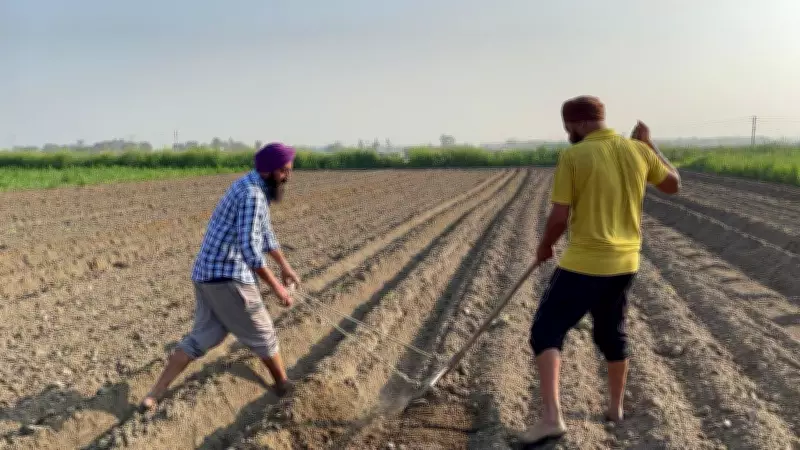
From Failed Migration to Farming Success: How a Punjab Farmer Rewrote His Destiny
In 2022, Chirmal Singh Sekhon paced anxiously at Delhi's Bangla Sahib Gurdwara, waiting for a phone call that would change his life. An agent had promised to send him and his family to the United States via the notorious 'dunki' route—from Delhi to Nicaragua, then Mexico, and finally into the US—all within seven days. The cost was a staggering Rs 90 lakh, payable only after arrival, for which Chirmal was prepared to sell his ancestral land in Punjab's Sangrur district.
The call never came. Three years later, standing on that same land in Daska village of Lehragagga, now transformed into thriving vegetable patches, Chirmal calls his failed migration bid "the biggest blessing of my life." What began as a desperate attempt to escape farming has become a remarkable success story of agricultural innovation and self-reliance.
The Turning Point: From Disillusionment to Discovery
Like thousands of youth in Punjab's hinterlands, Chirmal once believed migration was the only path to prosperity. After leaving farming at age 20, he worked various jobs in Chandigarh and Delhi as a driver, mall employee, and taxi driver. Influenced by an agent and a friend in the US, he applied for visas to Canada and Europe, only to face rejections. The dunki route seemed like his last hope.

"We waited at Bangla Sahib for a week, repeatedly told we would fly 'today or tomorrow,'" Chirmal recalls. "The flight never happened. Later, we learned the chartered plane had been detained in France." Disillusioned, he returned home to Punjab, where his family urged him to do something productive.
Almost reluctantly, he sowed pumpkin on just two kanals of land. Three months later, after expenses, he earned Rs 1.17 lakh. "That changed my thinking forever," he says. Encouraged by this success, he expanded vegetable cultivation to 2.5 acres—nearly nine times the initial area—and has been scaling up steadily over the last two years.
Transforming Agriculture: The Direct Marketing Revolution
Chirmal's approach to farming represents a significant departure from traditional practices. Instead of selling through mandis and middlemen, he personally markets his vegetables directly to consumers in nearby villages. This direct marketing strategy has proven revolutionary for his income.
- In wholesale mandis, vegetables typically fetch Rs 5–20 per kg
- Consumers pay Rs 30–50 per kg for the same produce from retailers
- By selling directly, Chirmal earns Rs 25–40 per kg while consumers get fresh produce at lower prices
His vegetables are currently sold in three villages, including his own, with announcements made through gurdwaras to inform residents of fresh arrivals. Sales timings are adjusted seasonally—afternoons in winter and early mornings in summer—to ensure optimal freshness and convenience.
"Had I not failed in going abroad, I would never have learned how profitable agriculture can be," Chirmal reflects. "Those who say farming is finished don't understand it. My income is no less than the dollars that I would've made had I migrated."
Breaking Social Barriers and Maximizing Productivity
Chirmal believes the biggest barrier for farmers isn't diversification itself, but social conditioning. "Most farmers feel hesitant or even ashamed to sell their own produce," he observes. "They prefer mandis, where traders decide the rates. But why should someone else decide the value of our hard work?"
His family of 15 owns around 10 acres, with wheat and paddy still grown on seven acres. The remaining land is dedicated to a diverse range of seasonal and off-season vegetables:
- Pumpkin
- Garlic
- Carrots
- Turnips
- Potatoes
- Peas
- Various gourds
The family employs sophisticated cultivation techniques, dividing fields strategically and growing up to eight crops on one acre through careful timing. Nurseries are prepared in advance, plots are reused immediately after harvest, and the same land is cultivated three times a year. About a dozen laborers are employed for several months annually, and all family members—including children—work in the fields, learning agriculture hands-on.

Financial Success and Future Plans
Chirmal now sells about a quintal of vegetables daily, earning Rs 2,500–3,000 or more per day depending on demand. He claims an annual income of nearly Rs 3 lakh per acre from vegetables—more than three times the combined earnings from wheat and paddy per acre.
Looking ahead, Chirmal has ambitious plans:
- Expanding vegetable cultivation to cover more villages
- Adding turmeric to their crop portfolio
- Establishing processing units for products like pickles
- Aiming to raise per-acre income to Rs 5–6 lakh
"In mandis, even farmers become laborers, while traders earn from their produce," Chirmal notes. "Unless farmers break this mindset, diversification alone won't bring profits."
A New Perspective on Migration and Agriculture
Chirmal's journey has fundamentally changed his perspective on migration. "Now, I will go abroad only as a tourist—never to settle," he declares. Looking back, he regrets the years spent chasing foreign dreams, but without bitterness.
"I learned that dignity, income and family can grow together," he concludes, "if you trust your own soil."
His story serves as an inspiring example for Punjab's farming community, demonstrating that prosperity can be found not in distant lands, but in innovative approaches to traditional agriculture. As he continues to expand his operations and influence, Chirmal Singh Sekhon stands as a testament to the potential of Indian agriculture when approached with creativity, determination, and a willingness to challenge conventional wisdom.