

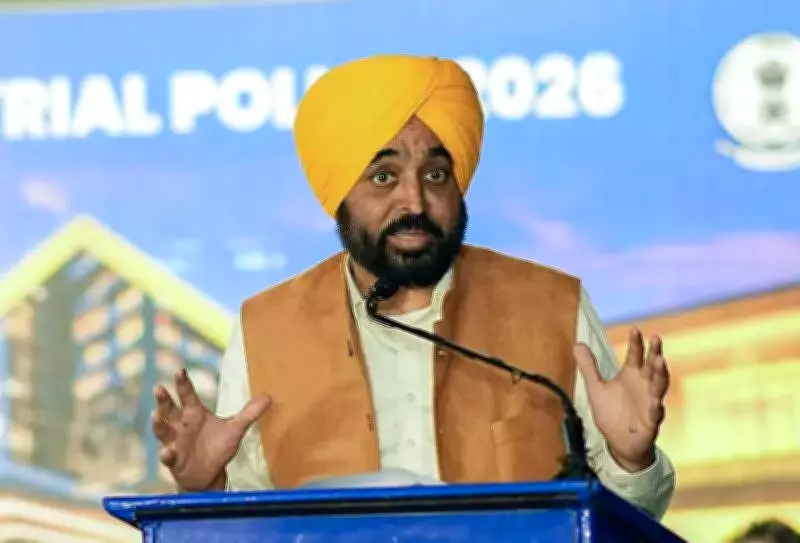
Punjab Chief Minister Unveils Ambitious Industrial and Business Development Policy 2026
In a significant move to revitalize the state's economy, Punjab Chief Minister Bhagwant Singh Mann officially introduced the new Industrial and Business Development Policy 2026 during a high-profile event held in Ludhiana on Saturday. The policy is strategically designed to position Punjab as India's foremost investment hub by implementing comprehensive reforms and a highly adaptable incentive framework that caters specifically to the diverse needs of various industries.
Customized Incentive Packages for Diverse Sectors
Addressing a gathering of prominent industrialists, Chief Minister Mann elaborated on the policy's innovative approach, which allows investors to select up to 20 different incentives and create customized packages aligned with their unique business models. He emphasized that industries operate with distinct cost structures, necessitating tailored support mechanisms.
"Pharmaceutical companies require different forms of assistance compared to electric vehicle manufacturers. Similarly, a data center incurs different expenses than a textile manufacturing plant. Our new policy acknowledges these critical differences and enables incentives to be optimized according to both sector-specific requirements and project scale," Mann explained.

Introduction of Capital Subsidy and Enhanced Support
A groundbreaking feature of the policy is the introduction of capital subsidy, a first for Punjab. Mann highlighted that this measure significantly reduces financial risk for investors. "If an entrepreneur plans to establish a Rs 100-crore plant, without capital subsidy, the entire investment burden falls on them. With this subsidy, the government co-invests a portion upfront, thereby lowering the capital at risk and encouraging larger ventures," he stated.
The policy also addresses a common gap in traditional industrial frameworks, which often focus predominantly on attracting new investors. "Most existing policies are tailored for greenfield projects and companies being lured from other states, often overlooking businesses already operational within Punjab. Our new policy extends incentives to include modernization and expansion projects, ensuring support for established enterprises as well," Mann added.
Long-Term Stability and Expanded Definitions
To provide greater certainty for investors, the policy offers incentive support for up to 15 years, surpassing the typical five-to-ten-year durations found in many other states. Additionally, the definition of fixed capital investment has been broadened to encompass land, labor housing, research and development facilities, effluent treatment plants, sewage treatment plants, and zero liquid discharge systems, reflecting a holistic approach to industrial development.
Empowering Small Businesses and Promoting Inclusive Employment
Chief Minister Mann underscored the policy's focus on small and medium-sized enterprises by lowering the eligibility threshold for the Employment Generation Scheme. "Punjab's industrial backbone is not solely comprised of large factories. It includes thousands of small manufacturers in cities like Ludhiana, Jalandhar, Batala, and Gobindgarh, who employ 30 to 50 people and operate on narrow profit margins. Integrating these businesses into the EGS framework will support enterprises that generate the highest number of jobs per rupee invested," he asserted.
The policy also encourages inclusive employment practices by offering enhanced EGS support for businesses that hire women, individuals from Scheduled Castes and Scheduled Tribes, and persons with disabilities. Furthermore, additional incentives are provided for IT/ITeS sectors and global capability centers.
Regional Development and Sector-Specific Frameworks
To promote balanced industrial growth, the policy introduces a 25% additional incentive for nine thrust sectors and for industries located in border and Kandi areas, which have historically received less investment. "Punjab is now compensating investors for regional risks with tangible financial benefits, not just verbal assurances," Mann remarked.

He also announced that several key sectors, including IT/ITeS, global capability centers, electric vehicles, electronics system design and manufacturing, semiconductors, filmmaking, and tourism, will have dedicated policy frameworks developed through consultations with industry experts, ensuring targeted and effective support.
This comprehensive policy marks a pivotal step in Punjab's economic strategy, aiming to attract substantial investment, foster job creation, and drive sustainable industrial growth across the state.





