

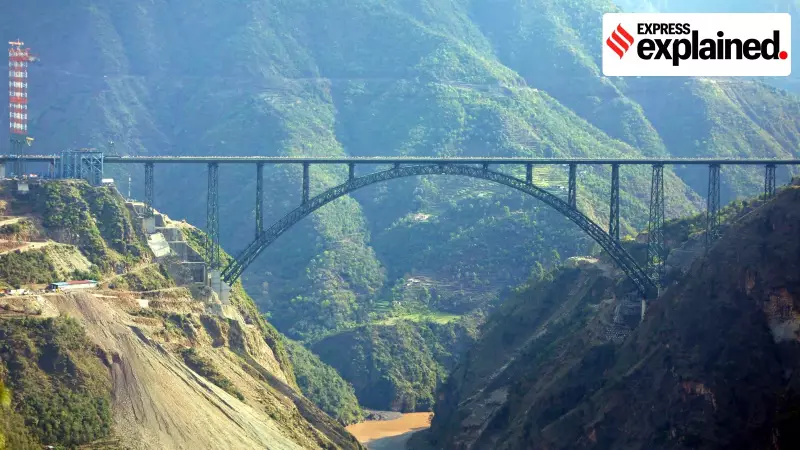
The year 2025 marked a historic chapter for Indian Railways, as the nation's rail network finally reached its long-awaited final frontiers in the north and the east. The iconic sound of train horns echoed through the Kashmir Valley and the hills of Mizoram for the first time, symbolizing the completion of century-old dreams and setting the stage for new strategic challenges.
Historic Connections: From the Himalayas to the Northeast
On June 6, 2025, Prime Minister Narendra Modi inaugurated the final 63-km Katra-Sangaldan section, completing the monumental 272-km Udhampur-Srinagar-Baramulla Rail Link. Built at a staggering cost of Rs 43,780 crore, this project overcame immense geographical hurdles, featuring the world's highest railway arch bridge over the Chenab River and India's longest operational transportation tunnel, T-50. The first Vande Bharat train journey from Katra to Srinagar culminated a vision first conceived by Maharaja Pratap Singh in 1898.
Similarly, in the northeast, the Bairabi-Sairang line was inaugurated in September 2025, connecting the railhead at Bairabi to Sairang near Aizawl. This achievement brought the Indian Railways to the capital of Mizoram for the first time, making Aizawl the fourth northeastern capital after Guwahati, Agartala, and Itanagar to join the national rail grid. The state's challenging, landlocked geography had delayed this connection for decades.

Infrastructure Push and Safety Overhaul
The year was not without tragedy, as a stampede at New Delhi Railway station on February 15, 2025, claimed 18 lives. This incident prompted the launch of a nationwide project to create holding areas on high-passenger platforms. The Railways' thrust remained on safety, removing traffic bottlenecks, expanding tracks, and improving customer amenities under the Amrit Bharat station scheme.
Significant technological strides were made with the commissioning of Kavach 4.0, an advanced automatic train protection system, over 738 route kilometers. The year also saw the rollout of 13 Amrit Bharat trains for migrant workers, two Namo Bharat Rapid Rail Services, and trials for the Vande Bharat sleeper trains.
Freight: The Backbone and Its Challenges
Freight remains the financial backbone of Indian Railways, contributing nearly 65% of its total earnings. In the financial year 2024-25 (FY25), total freight loading stood at 1,617 million tonnes (MT). However, the system faces significant challenges. Coal alone accounted for 823 MT, or almost 50% of the total loading, highlighting a lack of diversification.
A recent parliamentary committee report urged the Railways to broaden its freight basket to include automobiles, consumer goods, and e-commerce to cushion against commodity demand fluctuations. The operationalization of the last stretch of the Western Dedicated Freight Corridor (WDFC) to Jawaharlal Nehru Port (JNPT) presents a key opportunity to increase rail's modal share in freight, which currently stands at about 27% compared to road.
New Strategic Frontiers and the Bullet Train
With Kashmir and Mizoram connected, the Railways is now expediting other strategically vital border projects. These include:
- The Sivok-Rangpo line in Sikkim: A 45-km project, about 75% complete, costing Rs 7,876.92 crore, which will connect Sikkim to the national network.
- The Jiribam-Imphal line in Manipur: A 111-km line (over 90% complete, cost: Rs 14,323 crore) to put Imphal on the rail map.
- The Rishikesh-Karnaprayag line: A 125-km strategic project featuring a 14.57-km tunnel, serving as a gateway to the China border and facilitating the Char Dham Yatra.
Meanwhile, India's first bullet train project, the Mumbai-Ahmedabad High Speed Rail, reported 55.63% physical progress and 69.62% financial progress by November 2025. Officials aim to complete the first section in Gujarat by December 2027, with the entire project slated for December 2029.

As Indian Railways marches towards its ambitious goals of 3 billion tonnes of freight loading and 10 billion passengers by 2030, it also positions itself as a green mobility champion. With broad gauge electrification nearing 100%, hydrogen trains in the pipeline, and over 2,600 solar-powered stations, the network accounts for only about 1% of the country's transport emissions, offering a sustainable path forward for India's connectivity dreams.





