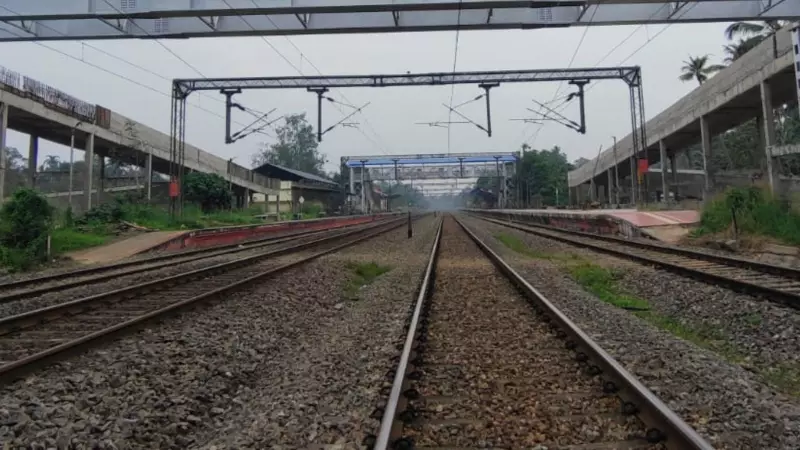
In a major infrastructure push aimed at decongesting one of its busiest corridors, Indian Railways has announced a massive project to construct approximately 400 kilometers of new railway lines between Pandit Deen Dayal Upadhyay Junction and Jhajha. The project, with an estimated cost of Rs 17,000 crore, involves building third and fourth lines on this critical section of the Delhi-Howrah route to significantly enhance passenger and freight movement.
Phased Construction and Project Breakdown
The East Central Railway (ECR) zone, which administers this route, has strategically divided the colossal undertaking into multiple, manageable segments to ensure faster and more efficient execution. Construction is slated to begin in a phased manner within the coming months.
The entire stretch has been segmented into smaller sections: Pandit Deen Dayal Upadhyay Junction–Danapur, Danapur–Fatuha, Fatuha–Bakhtiyarpur, Bakhtiyarpur–Punarkh, Punarkh–Kiul, and Kiul–Jhajha. This modular approach is designed to streamline work and minimize overall disruption to existing train services.

Initial approvals have already been granted for key sections. The Railway Board has cleared the Bakhtiyarpur to Fatuha (24 km) segment, involving land acquisition of 6.6 hectares at a cost of around Rs 931 crore. Similarly, the Bakhtiyarpur to Punarkh (30 km) section, requiring 1 hectare of land at about Rs 392 crore, has been approved. The tender process for the Bakhtiyarpur-Punarkh section is nearing completion, after which land acquisition and construction will commence.
Other critical segments are also advancing. The Punarkh to Kiul section, with an estimated cost of Rs 2,514 crore, and the Kiul-Jhajha section, pegged at Rs 903 crore, are in the final stages of approval. Approvals for the remaining sections are being processed at various administrative levels within the railway system.
Addressing Historical Capacity Constraints
The need for this expansion is deeply rooted in the history and growing demands on this corridor. The Pandit Deen Dayal Upadhyay Junction-Jhajha railway line was originally constructed in the 1860s and 1870s and was later doubled. However, over the decades, relentless population growth and industrialization have led to a steep increase in both passenger and freight trains.
This surge has resulted in operations far exceeding the original design capacity of the tracks, creating significant challenges for maintenance and punctuality. The addition of third and fourth lines is deemed essential to overcome these bottlenecks, increase track capacity, and provide a dedicated path for smoother operations.
Officials noted that specific engineering solutions are required in congested areas. "Due to land constraints around Patna, the construction will involve the removal of two stabling lines between Danapur and Patna to make space for the new lines," an ECR statement explained. "Similarly, between Patna and Patna City, an additional line will be constructed for use in a reversible manner for up and down directions."
Expected Impact and Economic Boost
The project's benefits are projected to be substantial and multi-faceted. Primarily, it will dramatically improve the reliability and punctuality of train services on the premier Delhi-Howrah route by separating the flow of passenger and freight trains. This decongestion is critical for one of the most densely trafficked rail corridors in the country.
Furthermore, the enhanced infrastructure is expected to act as a catalyst for regional economic development. By ensuring smoother and faster freight operations, the new lines will boost industrial activity and logistics efficiency in the states along the route. This infrastructure upgrade is poised to contribute significantly to the region's overall economic growth, attracting new investments and supporting existing industries.

When combined with the ongoing Eastern Dedicated Freight Corridor project, these new lines will create a robust, high-capacity network. This integrated system will not only facilitate the smooth operation of current trains but also pave the way for introducing a significant number of additional passenger and freight services in the future, meeting the growing transport demands of the nation.