

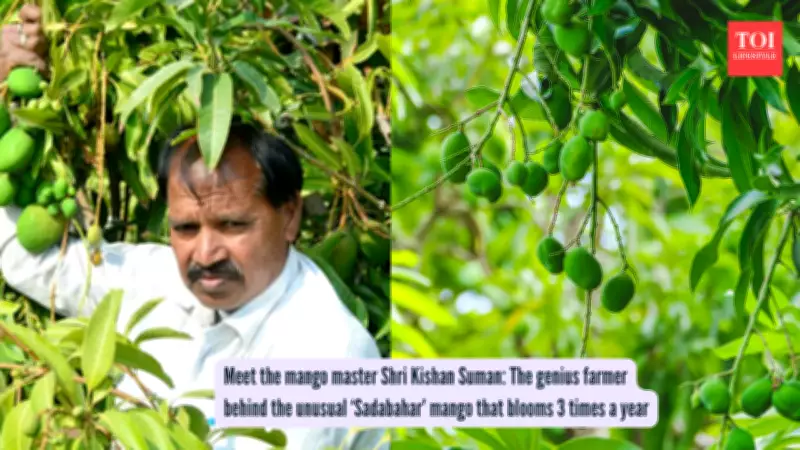
Rajasthan Farmer Creates All-Season Mango Variety That Fruits Three Times a Year
India's profound affection for mangoes is legendary. The sweet, juicy, pulpy, and utterly delicious king of fruits arrives with over 1,500 varieties, briefly illuminating our summers. Devotees eagerly await their annual taste of the vibrant orangish-yellow delight. But what if you could enjoy that Alphonso-like pleasure not just once, but three times a year? This seemingly impossible dream has become reality, thanks to the ingenuity of a farmer from Rajasthan who started his revolutionary work right in his own backyard.
Meet Shri Kishan Suman: The Visionary Behind the Magical Mango
Shri Kishan Suman, a 52-year-old farmer from Girdharpura village near Kota, Rajasthan, initially cultivated traditional crops like rice and wheat. However, unstable market prices prompted him to seek alternatives. In 1995, he transitioned to floriculture, successfully growing roses, mogra, and thuja for three years. His innovative spirit shone when he produced a remarkable rose plant featuring seven distinct colors on a single stem.
"I thought if I could achieve such wonders with roses, why not experiment with mangoes?" Suman explained to The Better India. He began by collecting mango stones from various varieties and nurturing them with care. Through grafting saplings onto robust rootstock, he observed a particular tree flowering remarkably three times annually: during January-February, June-July, and September-October.

The Birth of the 'Sadabahar Mango'
Around the year 2000, Suman meticulously developed that exceptional tree into what he named 'Sadabahar'. This dwarf, disease-resistant variety mirrors the Alphonso in taste, boasting a fibre-free texture, substantial size, and a captivating saffron-orange hue. Unlike other multi-season varieties like Baramasi or Dofasla, Sadabahar excels in table quality, making it a superior choice for consumers.
News of this breakthrough spread through Sundaram Verma, a volunteer with the Honey Bee Network, reaching the National Innovation Foundation (NIF). "The NIF instructed me not to sell or gift Sadabahar saplings, and I faithfully followed their advice for eleven long years," Suman recalls. During this period, the NIF conducted extensive nationwide testing of the variety. Notably, fruits were harvested in 2012 from plants Suman had gifted to Kamal Hissaria, who cultivated them on a farm near Kota.
Recognition and Legacy of the Sadabahar Mango
Shri Kishan Suman's dedication has earned him significant accolades. In March 2017, he was honored with the Farm Innovation Award at Rashtrapati Bhavan during the NIF's 9th Biennial Grassroots Innovation Awards. Today, the Sadabahar mango tree proudly grows in Amrit Udyan at Rashtrapati Bhavan and is officially registered under the Protection of Plant Varieties and Farmers’ Rights Act, securing its unique status.
While traditional mango trees typically require about five years to begin fruiting, growers find the wait for Sadabahar worthwhile. Its ability to produce high-quality fruit three times a year, combined with its exceptional taste and resilience, makes every bite a celebration of agricultural innovation. This story exemplifies how grassroots creativity can transform a seasonal luxury into a year-round delight, enriching both farmers and mango enthusiasts across the nation.






