Rajasthan Intensifies Bid for Mega Textile Park Following Union Budget Announcement
In a significant development following the Union Budget's announcement to establish seven mega textile parks across India, a high-level delegation from the Apparel Export Promotion Council (AEPC), led by Chairman A Shaktivel, conducted a visit to Kota on Saturday. The purpose was to evaluate the region's potential for hosting one of these ambitious projects.
State Government's Strong Pitch for the Project
While AEPC representatives maintained a reserved stance during the assessment, government sources have confirmed Rajasthan's strong and active interest in securing a mega textile park. Officials are leveraging the state's robust industrial ecosystem and considerable export capabilities as key selling points. This initiative aligns with broader national efforts to boost the textile sector's global footprint.
Chief Secretary's Strategic Meeting with Industry Leaders
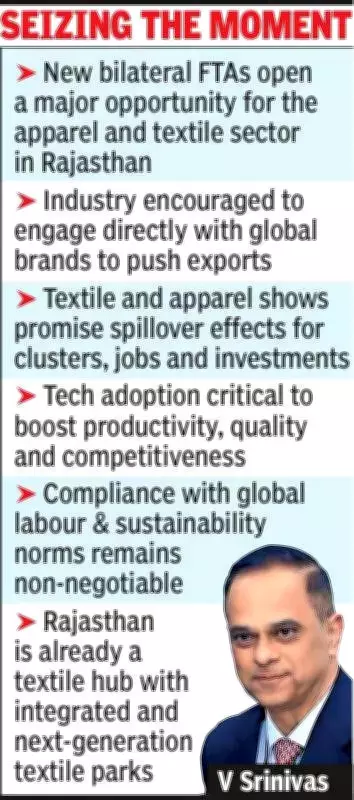
Prior to the site visit, Chief Secretary V Srinivas convened a crucial meeting on Friday evening with senior AEPC representatives and members of the Garment Exporters of Rajasthan (GEAR). In his address, Srinivas urged the industry to capitalize on the current momentum generated by India's ongoing trade negotiations with major economies like the UK, the European Union, and the United States.

"We must convert this diplomatic and trade momentum into tangible export growth," Srinivas emphasized, outlining a proactive strategy for international market penetration.
Emphasis on Global Outreach and Brand Building
The Chief Secretary stressed the critical need for structured, brand-focused international engagements. He advocated for a stronger presence in Western markets alongside traditional Asian hubs.
"Along with Asia, we must be present in the US and Europe. A flagship apparel show in Los Angeles is essential, and we should also target other major industrial capitals," he stated, proposing that Rajasthan itself could host a large-scale, apparel-focused exhibition.
"A large textile show has powerful spillover effects. Jaipur would be more than happy to host such an event," Srinivas added, highlighting the potential for such initiatives to boost local industry visibility and attract investment.
Textiles as a Major Employment Driver
Underscoring the sector's socio-economic importance, Srinivas pointed out that textiles remain India's largest employment generator after agriculture.
"Every additional $1 billion in textile exports creates nearly 10 lakh jobs," he noted, reinforcing the project's potential for massive job creation. To showcase Rajasthan's existing capabilities, he highlighted successful textile parks in Jaipur, Pali, the Kishangarh high-tech weaving park, and the Rupaheli Textile Park in Bhilwara.
Addressing Operational and Compliance Challenges
The Chief Secretary assured exporters that the state government would promptly address any operational hurdles. He also reflected on the sector's resilience, noting that despite global trade disruptions, job losses in textiles were contained as international brands continued sourcing from India.
Srinivas outlined three fundamental pillars for sustainable growth:
- Technology Adoption: Modernizing manufacturing processes.
- Compliance: Adhering to global labor and environmental standards.
- Global Outreach: Expanding international market access.
Drawing from the success of the Tirupur Apparel Park in Tamil Nadu, he praised its "remarkable" adherence to norms. He acknowledged past challenges, such as child labor allegations, but highlighted that initiatives like DISHA have been transformative.
"Thousands of apparel factories across the country were brought under strict compliance frameworks, ensuring global standards were fully met," Srinivas explained.

Regulatory Reforms Enhancing Competitiveness
The Chief Secretary also detailed recent regulatory reforms that bolster the industry's operational flexibility. Amendments to the Shops and Establishments Act, updated labour codes, and the deregulation of working hours now permit factories to operate 24/7. This includes provisions for employing women during night shifts with appropriate security measures.
"These reforms allow us to build large, globally competitive factories," Srinivas concluded, positioning Rajasthan as a prime candidate for the new mega textile park, backed by a supportive policy environment and a proven industrial base.