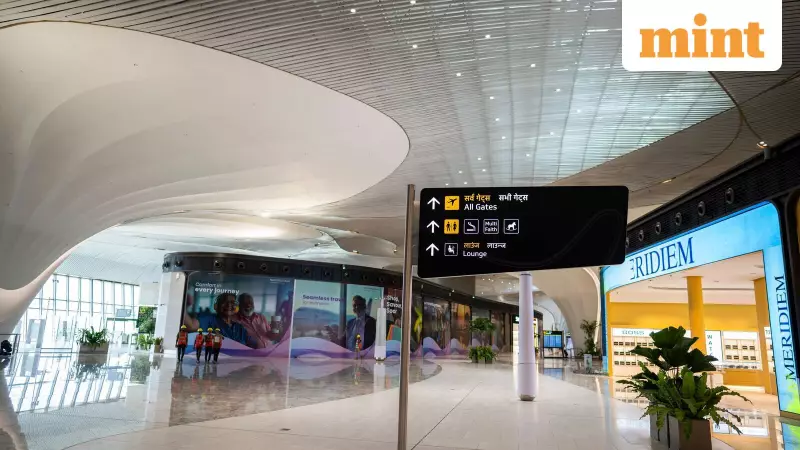
Passengers at Mumbai's newest infrastructure marvels are walking into a frustrating reality. The state-of-the-art Navi Mumbai International Airport (NMIA) and sections of the Mumbai Metro Aqua line are plagued by a complete absence of cellular signals from private telecom operators. This isn't a technical glitch but the result of a high-stakes commercial war, leaving travellers stranded in digital dead zones.
The Core of the Connectivity Crisis
The problem began when the Adani group-operated Navi Mumbai International Airport launched commercial operations on 25 December 2025. Travellers quickly discovered that their phones from Reliance Jio, Bharti Airtel, or Vodafone Idea were rendered useless. The root cause was the lack of a signed agreement for telecom connectivity between the airport authority and the service providers.
A similar scenario has unfolded for the past three months on the Mumbai Metro Aqua line, where commuters face patchy or non-existent connectivity. In both cases, the infrastructure developers and telecom companies have failed to agree on commercial terms for enabling mobile networks.

The Sticking Point: Exorbitant Fees and Third-Party Gatekeepers
Telecom operators are crying foul over what they label "exorbitantly" high charges demanded by the infrastructure owners. They argue that as licensed spectrum holders, they are legally entitled to provide connectivity under the Right of Way (RoW) rules of the Telecom Act, without being forced to go through a designated middleman.
The conflict intensified when infrastructure developers appointed third-party service providers to build and control the telecom infrastructure. For the Mumbai Metro Aqua line, the Mumbai Metro Rail Corp (MMRC) brought in ACES, a Saudi Arabia-based digital infrastructure firm, as a neutral host. At Navi Mumbai airport, the operator deployed its own in-building solution (IBS). Telecom companies see this as the creation of an unnecessary gatekeeper, putting them at the mercy of these third parties who seek to recover investments quickly by charging high fees.
The Staggering Numbers Behind the Dispute
The financial demands are at the heart of the stalemate. Telecom operators reveal that the Navi Mumbai airport sought about ₹92 lakh per month per operator. For four operators, this totals a staggering ₹44.16 crore annually. Telcos claim these charges are grossly disproportionate and that they could deploy their own IBS networks at one-fourth of the quoted cost.
In a revised offer, the airport proposed aligning charges with those at Mumbai International Airport Ltd (MIAL), which would slash the fee by over 50% to roughly ₹40 lakh per month. However, operators rejected this too, citing that even the reduced amount is unreasonable compared to the ₹10-12 lakh they pay at other major airports like Delhi.
Meanwhile, commuters can only access the state-owned Bharat Sanchar Nigam Ltd (BSNL) network at Navi Mumbai airport, as BSNL has partnered with NMIA at no cost. The airport also offers free Wi-Fi, but this is a poor substitute for seamless cellular service.
Legal Ambiguity and Government's Role
The situation is mired in regulatory grey areas. The Telecommunications Act, 2023, and the Telecom RoW Rules mandate that licensed telecom providers should get right of way from public entities on reasonable, transparent terms, with charges limited to administrative costs, not commercial revenue.
However, the law's application to public-private partnerships (PPPs) and privately-operated airports like NMIA is not automatic. It requires a specific government notification to classify such entities as "public entities" under the Act. Until that happens, commercial terms must be mutually agreed upon, leading to the current impasse.
The Department of Telecommunications (DoT) is actively mediating, holding regular meetings with all stakeholders to break the deadlock. The precedent set in August 2024, where DoT asked the National Highways Authority of India (NHAI) to provide connectivity in Dwarka Expressway tunnels without any fee, offers a potential path forward.

As the war of attrition continues, the ordinary passenger remains the ultimate casualty, forced to choose between world-class infrastructure and basic digital connectivity.