

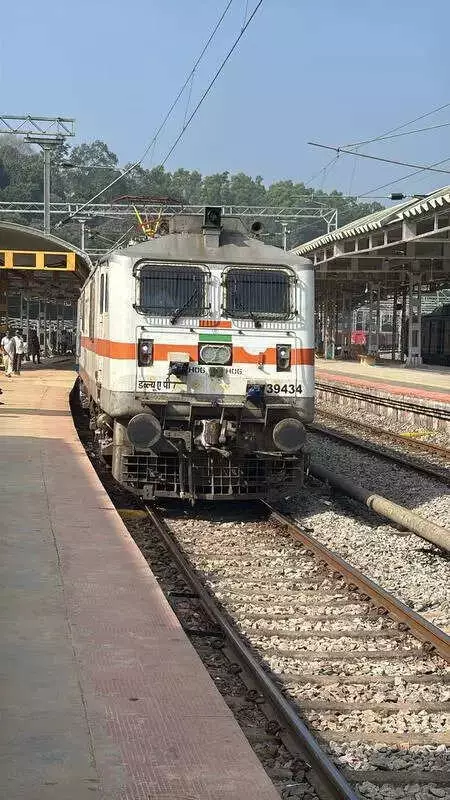
In a significant engineering feat, the Mysuru division of South Western Railway (SWR) has successfully electrified the entire Ghat section, following a conclusive electric locomotive trial conducted on Sunday. This accomplishment marks a pivotal moment in upgrading the rail network within this topographically demanding region.
A Daunting Terrain Conquered
The newly electrified stretch covers 55 kilometers between Sakleshpur and Subramanya Road, widely regarded as one of the most technically difficult sections on the Indian Railways map. The route's formidable challenges include a steep 1-in-50 gradient, passage through 57 tunnels, crossing 258 bridges, and navigating 108 sharp curves. Its high susceptibility to landslides added a layer of extreme complexity to the electrification works.
Officials stated that the project, which kicked off on December 1, 2023, was executed at a cost of Rs 93.5 crore. The core work involved setting up five switching stations along the route and installing overhead electrification (OHE) equipment across the entire section. The OHE system was engineered for a maximum speed of 120 kilometers per hour, with the distance between two traction poles kept within 67.5 meters to guarantee safety and reliability.

Engineering Precision for Safety and Stability
Given the unique challenges, the project demanded specialized solutions. Inside the 57 tunnels, the team installed 419 main brackets and an equal number of spare brackets to support the overhead equipment. To ensure foundational integrity, comprehensive geological surveys for both lined and unlined tunnel sections were carried out by experts from the National Institute of Rock Mechanics and Bangalore University.
"Pull-out tests were meticulously conducted at every single bracket location," a railway release explained, highlighting the focus on long-term safety. These tests verified the proper grouting and anchoring of bolts, a critical step given the terrain's instability.
Managing the overhead system's tension and stability on gradients and inclines reaching up to 830 meters required robust engineering designs and specialized equipment. Furthermore, the Commissioner of Railway Safety (CRS) enforced strict operational restrictions due to the steep slopes and limited space for safety features. Adhering to these protocols while maintaining normal train operations significantly heightened the project's difficulty.
Overcoming Nature's Wrath
The execution phase battled severe natural obstacles. Heavy monsoon rains, frequent landslides, soil erosion, and rockfalls regularly disrupted progress. Transporting materials to remote and often inaccessible work sites became a major logistical hurdle, often necessitating reliance on rail transport itself for supply movement.
Despite these adversities, the project reached its culmination with the successful trial run. The entire Ghat section is now primed for electric traction, paving the way for cleaner, more energy-efficient, and cost-effective train operations.
This milestone represents a crucial advance toward Indian Railways' mission of achieving 100% electrification. It underscores the organization's dedication to constructing sustainable and resilient rail infrastructure, even in the nation's most challenging landscapes.






