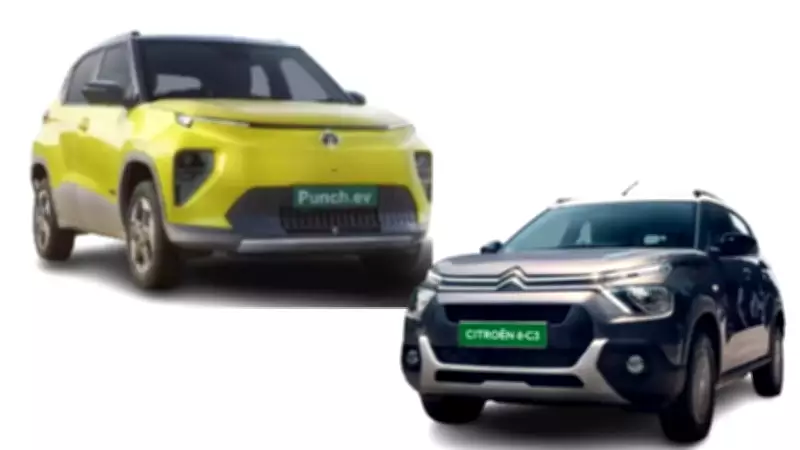
Tata Punch EV vs Citroen eC3: A Comprehensive Comparison of India's Affordable Electric Cars
The landscape of affordable electric vehicles in India is witnessing significant growth, with manufacturers introducing competitive models to capture this emerging market. Among the most notable contenders are the recently updated Tata Punch EV and the Citroen eC3, both positioned as accessible entry points into electric mobility. This detailed comparison examines their key specifications, performance metrics, and value propositions to help potential buyers make an informed decision.
Battery, Range, and Performance Specifications
The Tata Punch EV offers consumers flexibility with two distinct battery pack options. The standard configuration features a 30 kWh battery that provides an MIDC-certified range of approximately 365 to 375 kilometers on a full charge. For those seeking extended driving capabilities, the long-range variant comes equipped with a larger 40 kWh battery pack that delivers an impressive claimed range of up to 468 kilometers under ideal conditions.
In real-world driving scenarios, Tata Motors reports that the 30 kWh version achieves a C75 range between 260 and 275 kilometers, while the 40 kWh model offers approximately 335 to 350 kilometers of practical driving range. Performance-wise, the long-range Punch EV generates up to 130 horsepower and 154 Newton-meters of torque, providing responsive acceleration and adequate power for urban and highway driving. The standard battery variant produces 88 horsepower while maintaining the same torque output of 154 Nm.

In contrast, the Citroen eC3 adopts a simpler approach with a single battery configuration. The vehicle is powered by a 29.2 kWh battery pack that delivers a claimed range of 246 kilometers on a complete charge. Performance specifications are more modest, with the eC3 producing 57 horsepower and 143 Newton-meters of torque, making it suitable primarily for city commuting and shorter trips.
Charging Capabilities and Infrastructure
Both electric vehicles support DC fast charging technology, though with notable differences in charging speeds. The Tata Punch EV demonstrates superior charging efficiency, capable of replenishing its battery from 10 to 80 percent in approximately 30 minutes when connected to a compatible DC fast charger. Additionally, the vehicle supports multiple AC charging options, including 3.3 kW and 7.2 kW chargers, providing flexibility for home and workplace charging scenarios.
The Citroen eC3 requires significantly more time for DC fast charging, taking around 57 minutes to achieve the same 10 to 80 percent charge level. For standard charging using a conventional 15-ampere household socket, the eC3 needs approximately 10.5 hours to reach full battery capacity, making overnight charging a practical necessity for daily use.
Pricing and Ownership Models
Price positioning reveals distinct market strategies between the two manufacturers. The Tata Punch EV starts at an ex-showroom price of about ₹9.66 lakh for the base variant, with top-end models reaching approximately ₹12.59 lakh depending on battery configuration and feature packages. Tata Motors also offers an innovative Battery-as-a-Service (BaaS) scheme, which reduces the initial purchase price to ₹6.49 lakh with a battery rental cost of ₹2.6 per kilometer driven, providing an alternative ownership model for budget-conscious consumers.
The Citroen eC3 enters the market at a higher price point, starting from ₹12.90 lakh ex-showroom. While it lacks the battery subscription option available with the Punch EV, it represents Citroen's commitment to the Indian electric vehicle segment with a complete ownership package.
As India's electric vehicle ecosystem continues to evolve, both the Tata Punch EV and Citroen eC3 contribute to making electric mobility more accessible to a broader range of consumers. The Punch EV stands out with its dual-battery strategy, superior range options, and flexible ownership models, while the eC3 offers a straightforward electric vehicle solution for urban commuters. Prospective buyers should consider their daily driving needs, charging accessibility, and budget constraints when evaluating these two compelling options in India's growing affordable electric car segment.