Telangana's Vegetable Production Crisis: A Deep Dive into the Numbers
Despite possessing favorable agro-climatic conditions and access to modern cultivation technologies, the state of Telangana is confronting a severe crisis in vegetable production. This shortfall has forced the region to become heavily dependent on imports from other states to meet its daily consumption requirements, raising significant concerns about food security and agricultural sustainability.
The Stark Reality of Production vs. Demand
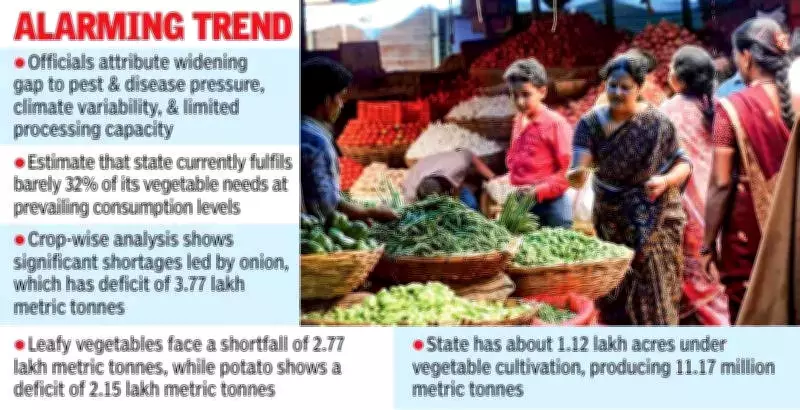
According to data presented at a recent national vegetable conference organized by Sri Konda Laxman Telangana Horticultural University and the All India Coordinated Research Projects (an initiative of the Indian Council of Agricultural Research), Telangana's vegetable production meets only 32.22% of current demand. At the standard consumption benchmark of 250 grams per person per day, the state requires approximately 34.67 million metric tonnes annually. However, production stands at just 11.17 million metric tonnes, leaving a staggering deficit of 23.50 million metric tonnes.
When measured against the recommended dietary intake of 300 grams per person per day, the situation becomes even more dire. The annual requirement escalates to 41.61 million metric tonnes, with production covering a mere 26.84% of this need. This creates an enormous gap of 30.44 million metric tonnes that must be filled through external sources.

Crop-Wise Deficits and Land Requirements
A detailed crop-wise analysis reveals significant shortages across multiple vegetable categories:
- Onion: Faces a deficit of 3.77 lakh metric tonnes, requiring an additional 44,549 acres to bridge the gap
- Leafy Vegetables: Experience a shortfall of 2.77 lakh metric tonnes, needing 59,045 additional acres
- Potato: Shows a deficit of 2.15 lakh metric tonnes, requiring 26,806 more acres
- Other Major Gaps: Include significant shortages in bhendi (okra) and tomato production
Experts estimate that when accounting for post-harvest losses, approximately 2.69 lakh additional acres would be required to achieve complete self-sufficiency in vegetable production.
Seasonal Challenges and Supply Instability
The vegetable supply chain in Telangana faces further disruption due to pronounced seasonal shortages:
- Tomato scarcity from May to August
- Onion shortages from July through October or November
- Leafy vegetable deficits from January to August
- Potato supply gaps from May through December
Agricultural experts have recommended implementing staggered planting schedules to ensure more consistent year-round availability and reduce these seasonal fluctuations.
Key Constraints Affecting Productivity
Officials and agricultural specialists attribute the widening production gap to multiple interconnected factors:
Biological Challenges: The region faces significant pressure from sucking pests, borers, and fruit fly infestations. Viral diseases such as yellow vein mosaic and leaf curl, along with fungal diseases like phytophthora and anthracnose, further compromise crop health and yield.
Climate Variability: Extreme temperature fluctuations, excessive rainfall patterns, and winter stress conditions create additional hurdles for consistent vegetable production.
Infrastructure Limitations: Despite Telangana's advantages in market access and connectivity, the state suffers from limited processing capacity and post-harvest losses that exacerbate the production deficit.
Pathways to Improvement
While Telangana benefits from increasing adoption of advanced agricultural practices like drip fertigation and protected cultivation, experts emphasize that several critical interventions are needed:

- Strengthening supply chains to reduce distribution inefficiencies
- Developing robust processing infrastructure to minimize post-harvest losses
- Promoting farmer producer organizations to enhance collective bargaining and resource sharing
- Investing in value-addition facilities to improve economic returns for growers
These measures could help reduce dependence on vegetable imports from other regions while stabilizing market prices for consumers. The current cultivation area of approximately 1.12 lakh acres produces vegetables at an average productivity rate of 9.89 tonnes per acre, indicating that both expansion of cultivated land and improvement of yield per acre will be necessary to address the substantial production shortfall.
The vegetable production crisis in Telangana represents not just an agricultural challenge but a broader food security issue that requires coordinated efforts between government agencies, research institutions, and farming communities to develop sustainable solutions for the state's growing population.