

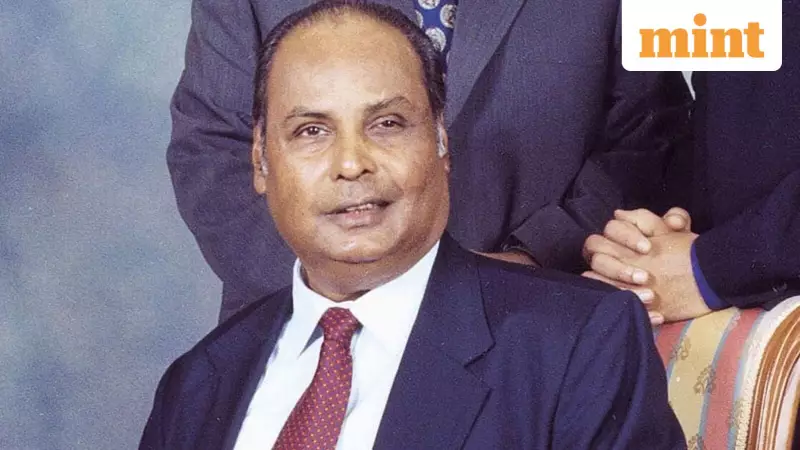
The legendary journey of Dhirubhai Ambani, the architect of India's largest private sector conglomerate, Reliance Industries, began not in a boardroom but in the sun-baked village of Chorwad, Gujarat. While his professional triumphs are well-documented, the seeds of his extraordinary success were sown in a childhood marked by scarcity, audacity, and an unshakeable will to conquer limits. His early years offer a masterclass in entrepreneurial orientation, revealing how a young boy with limited means developed the mindset to build a business empire now valued at over $250 billion.
The Making of a Maverick: Fearlessness Forged in Youth
Dhirubhai Ambani was born on 28 December 1932 to a schoolteacher father and homemaker mother, Jamnaben. His circumstances were modest, to say the least. With only two sets of clothes, which he would iron by placing them under his mattress overnight, young Dhirajlal Hirachand Ambani walked three kilometres each day in the blistering heat to fetch buttermilk for his family from Kukkaswada village. Yet, even in these constraints, his innate business acumen and defiance of fear began to surface.
In a telling childhood incident, as a seven-year-old boy, he spent a moonless night alone in a cremation ground to prove that fear was merely a phantom of the mind. This act was a precursor to a lifelong pattern of confronting and dismantling hurdles. His boldness was further amplified by India's freedom movement; he defied the Nawab's ban by scrawling patriotic slogans on walls in Junagadh and proudly unfurled the Indian tricolour on 15 August 1947.

Early Business Ventures: The First Signs of an Entrepreneur
Long before Reliance was a glimmer in his eye, Dhirubhai exhibited classic markers of an entrepreneurial mindset. His first lessons in profit and market timing came from buying mangoes during his errands and selling them later at a margin. Dissatisfied with meagre school canteen portions, he didn't just complain. He organized his classmates, pitched a logical solution to the headmaster, and won the catering contract himself.
With minimal capital as a pre-teen, he purchased wholesale oil and retailed it, dutifully sharing his profits with his mother. These were not mere childhood escapades but fundamental exercises in risk-taking, innovation, and proactive behaviour. He observed the world with a visionary's eyes. When he saw foreign cars on the streets of Mumbai during a visit, he didn't gaze longingly but declared with certainty that he would own them one day.
From Aden to Empire: Laying the Foundation
In 1948, with a matriculation certificate in hand, Dhirubhai made a pivotal decision to forgo college. He moved to Aden to work as a clerk at the petrol station of A. Besse & Co. This period was his informal business school. He immersed himself in learning trading, accounting, and documentation. He read copiously and keenly observed the mechanics of commodity and currency trading, absorbing crucial lessons in money management.
Following his marriage to Kokilaben in 1955, he returned to India in 1958 with modest savings but an expansive mental map of global commerce. He started with a small venture, importing yarn and exporting spices. However, this was merely the first step in a grand, scalable vision. With an intuitive grasp of value chain integration, he vertically expanded from textiles into petrochemicals, relentlessly building the Reliance empire.
The Legacy: Guts, Luck, and Antifragility
Dhirubhai Ambani's unique genius lay in recognizing the power of equity. He democratized stock ownership, creating a grassroots army of over 1.2 million shareholders by 1986, who became his staunchest supporters against bureaucratic hurdles. When asked by his daughter Dipti for the secret to his success, he succinctly replied, "Guts and luck." His guts were undeniable—even a debilitating stroke in 1986 that paralyzed his right hand could not stop him from planning the world's largest grassroots refinery at Jamnagar.

The 'luck' he spoke of was perhaps what author Nassim Taleb terms 'antifragility'—the ability to thrive and gain from volatility and disorder. Dhirubhai Ambani passed away in July 2002, but his legacy is indelible. He redefined scale, championed vertical integration, fostered unparalleled shareholder loyalty, and instilled the belief that business begins at home. His most profound contribution to Indian entrepreneurship is the powerful notion that extraordinary vision can indeed emerge from the most ordinary circumstances, and that the only true barriers are those we accept in our minds.





