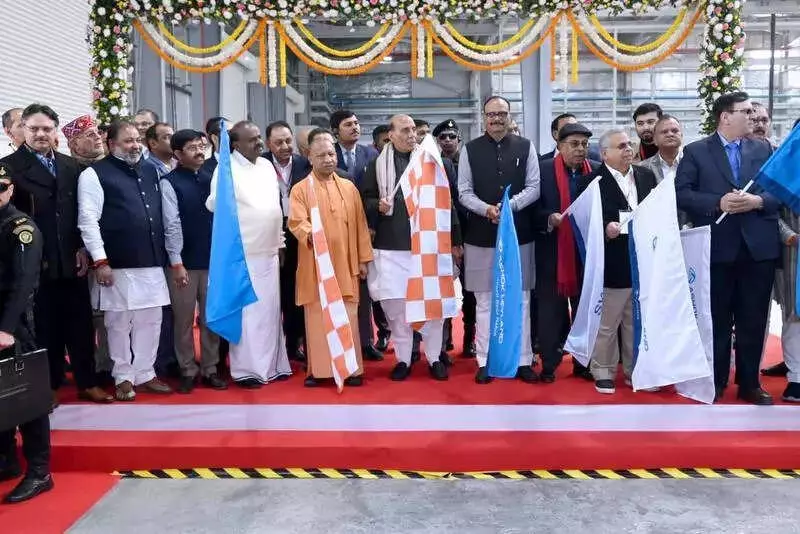
Union Minister for Heavy Industries and Steel, HD Kumaraswamy, on Friday highlighted a new electric bus manufacturing facility in Uttar Pradesh as a significant step reflecting India's comprehensive strategy to achieve net-zero carbon emissions and foster self-reliance in mobility.
Uttar Pradesh: A Foundation for Advanced Manufacturing
Praising the state's infrastructural development, Kumaraswamy stated that Uttar Pradesh has become a central hub for the country's most extensive expressway and railway networks. He emphasized that this robust infrastructure creates a solid foundation for advanced manufacturing sectors to thrive.
The minister specifically described the Ashok Leyland facility as a crucial milestone, not just for the company's growth but for India's entire clean mobility journey.

Government's Dual Focus: Green Transition and 'Make in India'
Kumaraswamy credited Prime Minister Narendra Modi's leadership for setting an ambitious path toward net-zero emissions while simultaneously strengthening the Make in India and Atmanirbhar Bharat initiatives. He outlined substantial government support for electric mobility through two key schemes:
FAME-II Scheme's Impact
The minister noted that the FAME-II scheme, with a substantial outlay of Rs 11,500 crore, has been instrumental in accelerating electric vehicle adoption across the nation. The scheme has facilitated the purchase of over 16.7 lakh electric vehicles and sanctioned the establishment of more than 9,000 public charging stations.
Acceleration via PM e-DRIVE
Further boosting this momentum, the PM e-DRIVE scheme, with an outlay of Rs 10,900 crore, has accelerated EV adoption, resulting in the sale of over 20 lakh vehicles so far. A significant part of this scheme, Rs 2,000 crore, has been earmarked specifically to set up a vast network of over 70,000 charging stations nationwide, addressing a key infrastructure hurdle.
Charting a Self-Reliant, Sustainable Future
The establishment of the electric bus manufacturing plant in Uttar Pradesh is positioned as a tangible outcome of these interconnected policies. It symbolizes India's dual commitment to reducing its carbon footprint and building domestic manufacturing capacity in a critical future industry. The minister's statements underscore a strategic vision where infrastructure development, industrial policy, and green goals converge to propel the country toward a self-reliant and sustainable mobility ecosystem.